Construction rarely goes exactly within budget. Most cost overruns arise not in finishing work or material procurement, but before work even begins—due to the lack of a well-thought-out design. Making decisions on the fly leads to rework, unnecessary expenses, and extended deadlines. To understand how design can reduce the final budget, it's important to understand what mistakes can be avoided in advance. You can learn more at
- Why the project is the basis of an accurate budget
- Site features and their impact on the budget
- Planning: How to Avoid Costly Changes
- Engineering systems: some of the most expensive renovations
- Materials: Why the project reduces the likelihood of overpayment
- Alterations are the budget's main enemy
- Bottom line: Design saves more than you think
Why the project is the basis of an accurate budget
The project determines design solutions, layout, materials, utility systems, and even future operating costs. When this data is missing or incomplete, the construction team faces uncertainty: where to run utility lines, how thick the walls should be, how to construct joints, and which materials are compatible with each other.
This uncertainty leads to:
- additional purchases of materials;
- delays due to the need to clarify decisions;
- alterations to already completed sections.
This doesn't depend on the size of the house: even a small cottage without a plan can end up significantly more expensive due to minor but systemic errors.
Site features and their impact on the budget
The site isn't just a backdrop for the future home, but a factor influencing construction costs. The design takes into account the site's characteristics, which helps avoid cost overruns.
Soil. The site's geology determines the type of foundation. Without careful consideration, you risk choosing a foundation that's too complex or, conversely, insufficiently strong. Both lead to unnecessary costs.
Terrain. Elevation differences require site preparation. A well-thought-out design solution helps minimize excavation work and ensure proper drainage.
Lighting and wind loads. The orientation of a house helps reduce heat loss in winter and improve natural light. This impacts subsequent heating and lighting costs.
Interesting fact: in temperate climates, proper home orientation can significantly improve energy efficiency, especially if the design incorporates large windows or panoramic glazing.
Planning: How to Avoid Costly Changes
Layout affects cost just as much as materials. Mistakes often arise from changes made "on the fly," once the walls are already up.
A well-thought-out layout allows:
- reduce the length of utility lines (if the bathrooms and kitchen are located compactly);
- reduce the number of unnecessary corners and complex shapes that increase material consumption;
- avoid dismantling if wishes change during the course of the work.
Even one moved partition may require redoing the electrical system, ventilation, or finishing—and this is a direct cost overrun.
Engineering systems: some of the most expensive renovations
Utilities are the area where mistakes are most costly. The reason is simple: many elements are hidden within walls, screeds, and ceilings.
Most often, problems arise if:
- heating capacity is not calculated;
- there are no passages for ventilation ducts;
- pipes are placed without taking into account the location of furniture or plumbing;
- communications cross structural elements where this is prohibited.
Hidden alterations are always more expensive than overt ones—they are more difficult to carry out and require careful intervention.
Materials: Why the project reduces the likelihood of overpayment
When precise estimates are not available, materials are either purchased "in reserve" or in insufficient quantities. In both cases, problems arise: cost overruns or forced delays.
The project helps:
- determine the exact amount of wall materials;
- select compatible insulation materials, solutions and finishing materials in advance;
- avoid situations where one wall requires one composition, and another - another.
The project also allows for budget allocation between construction stages and avoids a sharp increase in costs mid-way through the process.
Alterations are the budget's main enemy
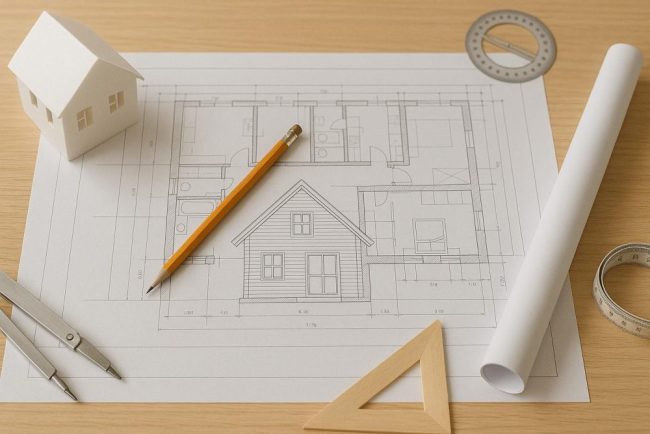
Alterations occur when something is done without taking into account future design elements. For example:
- the thickness of the final finish is not taken into account;
- the floor level was chosen incorrectly;
- there is no junction between the roof and the wall;
- utility lines intersect in inappropriate places.
Any rework isn't just a redo, it's also a waste of time and a new risk of error. The more precise the design, the less likely such situations are.
Bottom line: Design saves more than you think
Saving money on construction starts not with choosing cheap materials, but with a high-quality design. This helps:
- reduce the number of reworks;
- reduce construction time;
- accurately calculate the volumes of materials;
- avoid errors in engineering systems;
- take into account the features of the site.
A well-thought-out project makes construction predictable: the budget becomes clear, and the home is more reliable and comfortable.