The topic of waste stacks is rarely discussed until they're unnoticed. But when odors, unstable sewer operation, or strange sounds from the stacks appear, attention to these elements of the utility system increases sharply. Questions are especially common among residents of upper floors, management companies, and those facing roof renovations or major utility system repairs. At first glance, a waste stack is simply a pipe exiting the roof, but it connects the building's internal sewer system to the outside environment and plays a much more important role than might appear.
In multi-story buildings, the ventilation system becomes part of the overall balance between air, water, pressure, and the familiar comfort inside the apartments. Misunderstanding its purpose or attempts to "simplify" the design almost always have consequences that become apparent not immediately, but after months or even years of use.
- What is hidden behind the concept of a fun riser?
- Why is the roof the exit point?
- How a fan riser works in real conditions
- Scenarios where a fun boner becomes a problematic topic
- Possible consequences of different approaches
- Limitations and nuances that are often forgotten
- Common misconceptions about fan risers
- A broader view: the waste riser as part of the overall engineering logic of the house
What is hidden behind the concept of a fun riser?
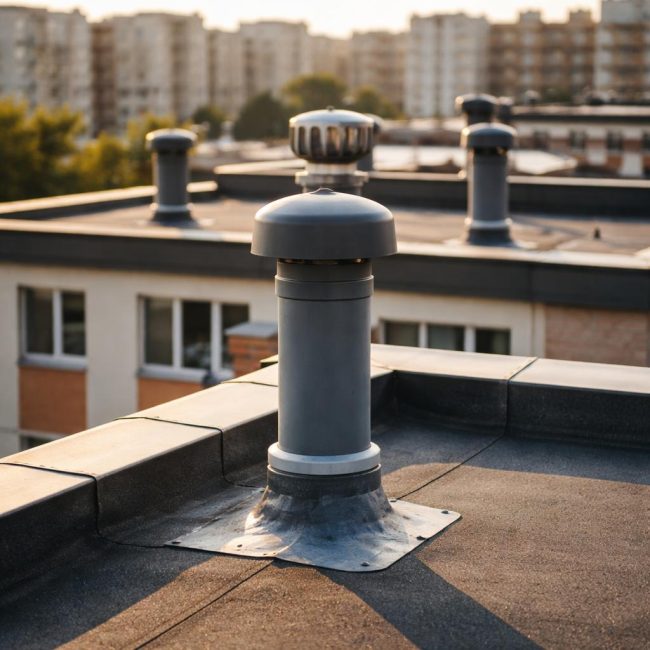
A waste stack is a vertical extension of the sewer stack, extending above roof level. Its purpose is not to drain wastewater, but to handle air. Within the sewer system, processes involving the movement of water and gases are constantly occurring. When a large volume of water flows down the stack, it entrains air, creating zones of vacuum and excess pressure.
If the system has no room to "breathe," the pressure begins to equalize through the nearest accessible points—the drain traps of plumbing fixtures. At this point, water from the water traps can partially or completely escape, allowing sewer odors to enter the living spaces. The roof waste stack serves as a safe outlet through which the system equalizes the pressure without affecting the apartments.
It's important to understand that a waste stack is not an optional extra or a "just in case" item. In multi-story buildings, it is the logical completion of the entire vertical sewer system, ensuring its stability under a wide range of operating conditions.
Why is the roof the exit point?
The placement of the waste stack on the roof is not only about the convenience of pipe routing. At this height, conditions are created where air can dissipate freely, without being recirculated through windows, ventilation shafts, or utility rooms. Airflows at roof level are usually more stable, and odor concentrations are quickly reduced by natural mixing.
Furthermore, placing the exit above the living quarters reduces the risk that decomposition products and sewer gases will be perceived by residents as a localized problem within their individual apartment. In this sense, the roof acts as a neutral zone where utility systems can "unload" without direct contact with the living environment.
In multi-story buildings, the roof is also convenient for combining several risers and their logical completion, especially in buildings with a repeating floor plan.
How a fan riser works in real conditions
During everyday use, the operation of the waste stack remains unnoticed. It doesn't create draft in the traditional sense and doesn't function as a hood with a constant air flow. Its role becomes apparent during periods of intense water discharge: simultaneous flushing in several apartments, the operation of household appliances, and peak loads in the morning and evening.
During such periods, short-term pressure fluctuations occur within the riser. The vent riser allows these fluctuations to be compensated for by air inflow or outflow through the roof. Once the load is reduced, the system returns to equilibrium.
The seasonal factor is especially noteworthy. In winter, at low temperatures, the behavior of air and gases within the system changes. It is during this period that errors in the design or operation of waste stacks become especially apparent, ranging from unstable trap operation to localized freezing of roof outlets.
Scenarios where a fun boner becomes a problematic topic
In practice, questions about waste stacks most often arise not during new construction, but during modifications to an existing building. Major roof repairs, attic insulation, and utility system refurbishments—all of these projects can affect waste stacks, even if they weren't the primary purpose of the project.
One typical scenario is the partial or complete blockage of a riser outlet due to a change in the roof structure. The pipe may remain in place externally, but its operating conditions change, affecting the entire system. Another common scenario is an attempt to reduce the number of roof outlets for aesthetic reasons or to simplify maintenance.
Questions also arise during remodeling of upper-floor apartments, when the load on the waste riser changes or new water discharge sources are added. Although the waste riser formally remains a common element of the building, changes within a single apartment can impact the operation of the entire vertical plumbing system.
Possible consequences of different approaches
Treating waste stacks as a secondary element often leads to a chain of indirect problems. Odors in apartments are only the most obvious and easily recognizable symptom. Much less noticeable, but no less significant, are accelerated wear of seals, unstable operation of traps, and increased stress on pipe connections.
Over the long term, improperly functioning sewer ventilation can lead to increased humidity in the shafts, localized corrosion of metal components, and deposits in the pipes. These processes develop slowly and are often attributed to the "age of the building," but are actually caused by an imbalance in pressure.
On the other hand, overcomplicating a system without understanding its principles also doesn't always produce the expected results. Adding auxiliary elements or changing the configuration without considering the overall logic of the risers' operation can create new points of instability.
Limitations and nuances that are often forgotten
A ventilation stack works in conjunction with other building systems: ventilation, roof structures, and utility shafts. Its effectiveness depends not only on the stack itself but also on the surrounding environment. For example, dense construction, roof extensions, or changes in roof aerodynamics can affect air dispersion.
Maintenance deserves special attention. Despite its apparent simplicity, the roof outlet of a waste stack is exposed to precipitation, temperature fluctuations, and debris. Access to it is often limited, making any structural changes particularly sensitive.
It's also important to consider the human factor. A waste riser is an element that can easily be "lost" in documentation or during approvals, as it's not directly associated with the apartment's comfort. This leads to situations where its fate is decided without the involvement of specialists responsible for the overall engineering systems.
Common misconceptions about fan risers
One of the most common misconceptions is the idea that a waste stack is simply a ventilation pipe that can be replaced or removed without consequences. In reality, it performs a strictly defined function related to the flow dynamics within the sewer system.
Another persistent belief is that odor problems are always related to problems within the apartment. While localized causes are certainly possible, in multi-story buildings the source is often higher up—at roof level or in the building's common system.
The role of additional devices is also often overestimated, while the importance of the basic design is underestimated. When the fundamental principles of a system's operation are compromised, ad hoc solutions rarely produce sustainable results.
A broader view: the waste riser as part of the overall engineering logic of the house
When considering a waste stack in isolation from the rest of the building, it's easy to miss its true significance. It's part of a complex yet logical system, in which every element maintains balance. A multi-story building isn't the sum of its individual apartments, but a unified organism, where even the most subtle details impact the overall quality of life.
Understanding the role of roof stacks helps us view engineering solutions differently as a whole: as processes, not just a collection of pipes and devices. This perspective allows us to anticipate the consequences of changes and avoid problems that only manifest themselves later. In this sense, a roof stack is more than just a technical detail, but an indicator of how carefully and thoughtfully the home's interior is designed.