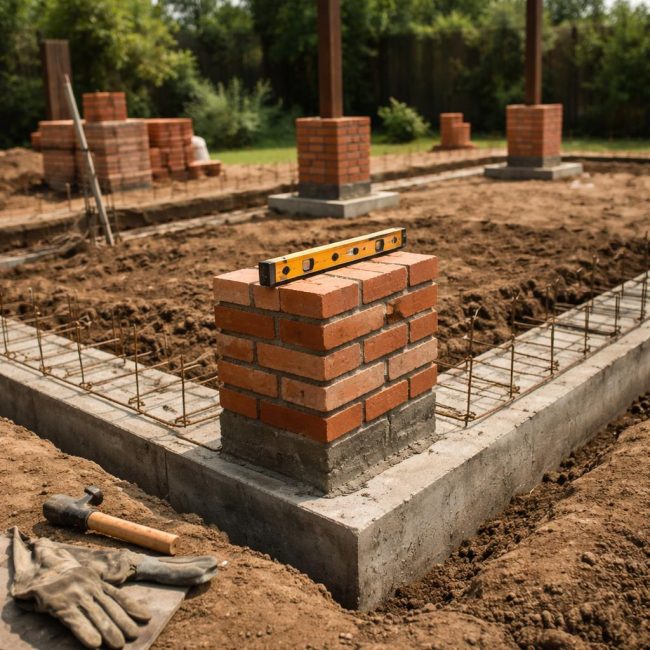
Brick sheds seem simple, almost like an "auxiliary" element of the site—not a house, not a garage, not a permanent structure. This is why the foundation issue is often revisited later in the project, when it becomes clear that the structure isn't as stable as expected. Brick visually creates a sense of reliability and solidity, but it also increases the demands on what lies beneath. The foundation for a brick shed is a topic that isn't approached from a textbook, but through practice, doubts, and the mistakes of others observed on neighboring properties.
Interest in this question arises in various situations. Some are planning a carport and choose brick pillars as a more permanent option. Others are building an extension to their house and want the carport to look architecturally cohesive. And still others encounter distortions, cracks, and subsidence after the work is completed and are trying to understand where exactly the foundation was underestimated. In all these cases, the foundation ceases to be an abstract construction term and becomes a key element of the entire structure.
Why a brick shed is not a “light” structure
Brick is perceived as a familiar and understandable material, but in the context of a canopy, it dramatically changes the status of the entire structure. Even if the roof is made of lightweight materials, the brick supports themselves create significant loads, concentrated at specific points. Unlike metal or wooden posts, brick pillars are virtually inflexible and unforgiving of foundation movements.
In practice, this means that a brick canopy can no longer be considered a temporary or relatively lightweight structure. It interacts with the ground almost like a small permanent structure. Any seasonal movements, uneven soil moisture, or weak areas of the foundation are immediately visible—cracks in the masonry, joint separation, and roof distortion.
Furthermore, brick does not tolerate deformation well. While a wooden post can slightly accommodate movement due to its own elasticity, brickwork reacts by collapsing its structure. Therefore, a brick canopy foundation serves not only a load-bearing function but also a protective one, isolating the structure from ground instability.
The essence of the foundation in the context of the canopy
A canopy foundation isn't just "something concrete under pillars." Its role is to distribute the load and align the structure with its surroundings. A canopy is located in an open area, exposed to temperature fluctuations and precipitation, and is often located at the edge of a built-up area, where the soil may be less stable.
In the case of brick piers, the foundation acts as a transitional link between the rigid masonry and the living, shifting soil. It absorbs changes in soil moisture, frost movement, and shrinkage, redistributing them so that the brick does not become subject to stress. This is where misunderstandings often arise: visually, a small overhang seems unimportant, but the physics of the process dictate otherwise.
It's also important to note that a canopy rarely exists in isolation. It can be connected to paths, a pavement, retaining walls, a fence, or the main house. In this case, the foundation becomes an element of the overall system, not an isolated detail. Inconsistency between these components causes the canopy to "live its own life," gradually losing its geometric structure.
How the foundation works in practice
At a fundamental level, the foundation for a brick canopy must ensure the stability of each support and the synchronicity of their behavior. This is especially important for canopies with multiple columns, where the misalignment of one element immediately affects the entire roof structure. Even the slightest difference in settlement becomes noticeable due to the rigid connection between the elements.
In real-world conditions, foundations face a host of factors. The underlying soil can be heterogeneous, especially if the site was artificially formed or has complex topography. Water can accumulate in certain areas, increasing movement. Frost processes have an uneven effect, causing the foundation to rise and fall.
A foundation designed solely for static loads is often vulnerable to these dynamic effects. A brick canopy, unlike a massive building, lacks the overall mass to support and stabilize the foundation. Therefore, the role of the foundation is particularly critical here.
Typical scenarios and their consequences
One common scenario involves constructing brick pillars on a simplified foundation, designed more for visual appeal than for soil management. During the first few years, such a structure may appear quite satisfactory, especially on dense soils. Problems arise later, when accumulated seasonal movements begin to affect the masonry.
Another scenario involves attaching the canopy to existing structures. When one part of the canopy rests on the house's foundation, while the other rests on separate supports, a difference in the behavior of the foundations arises. The house has already undergone the main stages of settlement, while the canopy is just beginning to interact with the ground. Without accounting for this difference, the canopy foundation may "lag" or, conversely, move more rapidly.
There are also situations when a canopy is built on a site with variable ground levels—near drainage areas, slopes, or backfill. Here, the foundation also serves a stabilizing function, preventing the supports from shifting laterally or gradually tilting.
Limitations and nuances that are often forgotten
Sheds are typically located outside the heated area, meaning the foundation beneath them is completely exposed to external temperature conditions. This creates conditions different from those experienced by the foundation of a residential building. Moisture, frost, and solar heat act without a buffer, and the brickwork finds itself at the forefront of these processes.
Another consideration relates to operational loads. A carport, recreation area, or utility area is constantly subject to additional stresses—from vibrations to uneven weight distribution. In this case, the foundation must support not only the weight of the structure itself but also changes associated with the use of the space beneath the carport.
It's also important to consider the visual aspect. Any foundation deformations under brick supports become immediately noticeable because the brick accentuates the defects rather than concealing them. This turns even minor structural issues into aesthetic losses, which is especially critical for canopies located on the façade of the property.
Common misconceptions
One of the most persistent misconceptions is the idea of a shed as a "temporary" or secondary structure that doesn't require a solid foundation. In this context, brick pillars are often perceived as a decorative element rather than a load-bearing part of the structure with its own requirements.
Another myth concerns the one-size-fits-all approach. It's often assumed that the same type of foundation will work for any shed, regardless of size, configuration, or site conditions. In reality, it's the context—the soil, climate, and location—that determines how the foundation will perform over time.
Finally, there's a common misconception that foundation problems become apparent immediately. This creates a false sense of security when the first few years of use pass without any visible defects. However, a brick shed foundation is a delayed-effect system, and many consequences become noticeable only after several seasons.
Wider than just the base
A brick shed foundation isn't a separate technical detail, but rather part of the overall design of the site. It connects architecture, geology, and the everyday use of the space. The degree to which this interaction is carefully considered determines not only the durability of the structure but also its appearance, its sense of reliability, and its integrity.
In this sense, the foundation is always a matter of time. Not only how long it will last, but also how it will perform over the years, seasons, and changing conditions. A brick shed can become a tranquil and stable feature of the site, or it can become a source of constant minor problems. The difference between these scenarios begins underground, where the foundation bears all that's not immediately visible.