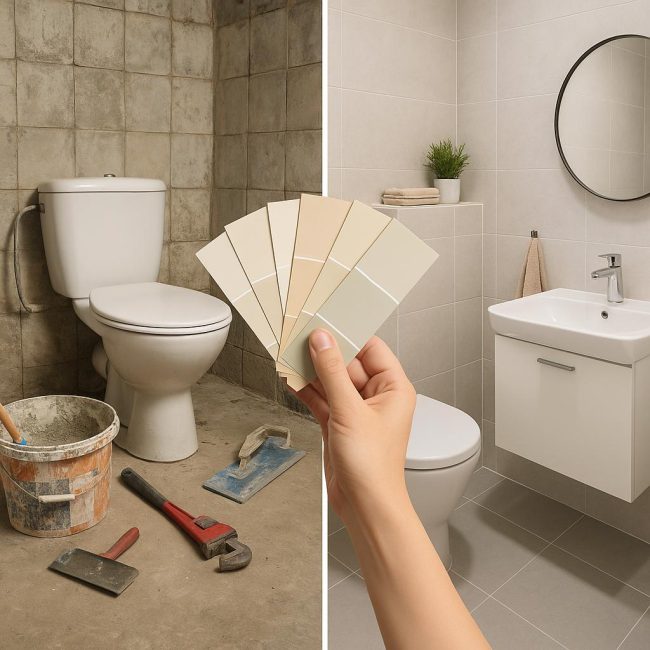
A major bathroom or toilet renovation without breaking the bank is possible. Our guide will show you how to plan a budget bathroom renovation, avoiding unnecessary expenses and achieving a beautiful result.
Budget life hacks
- Buy materials in bulk. Sellers often offer discounts for bulk purchases, so consider teaming up with friends or acquaintances.
- Keep an eye on deals from building materials stores, and sign up for newsletters and promotions from major DIY chains. Discounts can sometimes reach up to 30%, which can save you a significant amount of money.
- Do your own repairs: today, the internet is full of instructions and videos that can help beginners master simple repairs.
- Choose affordable but high-quality materials. Always compare prices and read product reviews.
- The secondary building materials market (websites and message boards, forums of renovation communities) sometimes offers high-quality tiles, doors, or lamps for a third of the market price.
- Old cabinets and vanities that served their previous owners for several years can be given a new lease of life by restoration and refinishing, making your bathroom truly exclusive.
Another important life hack is careful project planning. This allows you to accurately calculate the amount of building materials and create a step-by-step renovation plan.
Step 1. Communications
Check the condition of the plumbing and utility systems (water pipes, sewerage, and electrical wiring). It's best to replace old cast-iron pipes with polypropylene or metal-plastic ones. Completely upgrade the electrical wiring, installing sockets and switches with IP65 or higher moisture protection.
We recommend hiring professionals to handle communications. Find professionals on classifieds sites or ask your friends for their contact information.
Step 2. Floors
Choose porcelain tiles or budget-friendly tiles, such as Turkish or Chinese. Choose large sizes (30x60 cm) to reduce the number of joints and make installation easier. Remember to waterproof the floor and install the tiles using adhesive suitable for wet areas.
Step 3. Walls
Ceramic tiles are traditionally used for bathroom walls. A solid, light-colored tile, such as white or beige, will save money. Large tiles, such as 30x60 cm, will reduce the number of grout joints.
Another option is water-based paint, which is resistant to water and mildew. It's practical and inexpensive.
Design projects suggest combining tiles in wet areas with paint on walls that are not exposed to moisture. Budget savings can reach 40-60%.
Step 4. Plumbing
Bathroom renovations inevitably involve replacing plumbing fixtures. To avoid unnecessary expenses, remember a few simple rules:
- Choose mid-range products. Budget models often rival expensive brands in quality and performance.
- Buy simple models. The simpler the design and mechanics, the cheaper the product and the longer its lifespan.
- Pay attention to the fittings. The quality of the toilet cistern mechanism, faucet cartridge, and sink trap is more important than a beautiful body. High-quality internal fittings will double the lifespan of the appliance, and replacing the fittings is much cheaper than replacing the entire plumbing system.
- Skip the expensive bathtub. If your bathroom space allows, consider installing a shower stall. It takes up less space and is less expensive to install than a high-quality acrylic or cast iron bathtub.
- Reuse plumbing fixtures. An old bathtub can be restored with enamel, and an old toilet can be polished and coated with a water-repellent finish. Saving on small items can yield significant benefits.
Step 5. Ceiling
The cheapest and easiest option is to paint the ceiling with white water-based paint. However, this option is only viable if you have a level ceiling slab.
There are several types of suspended structures that can be used to cover a rough ceiling:
- Plastic PVC panels are not durable and there is always a risk of damaging them during use;
- Stretch ceiling – fast, but you will have to pay professionals for installation;
- Cesal aluminum slats are easy to install yourself, and such a ceiling will last 20-25 years or more.
Renovating a bathroom is challenging, but it's entirely doable, even on a budget. Even on a minimal budget, you can create a functional and stylish bathroom.