Finding spare parts for a truck is a challenge every truck owner faces, especially if the vehicle is not new. Original components are expensive, delivery times can stretch for weeks, and if a breakdown occurs mid-trip, time is of the essence. Under these circumstances, more and more drivers and trucking company owners are turning to alternative sources: online platforms, local suppliers, and truck dismantlers. This is especially true for popular brands like Scania—a large number of carriers operate these trucks, meaning demand for components is stable. As a result, Scania dismantlers are becoming one of the first stops for those looking for the right part.
- Why new parts aren't always an option
- Main sources of used spare parts
- Truck dismantling
- Private sellers and small services
- Online platforms and bulletin boards
- Groups and chats in messengers
- How to Search Properly: A Step-by-Step Approach
- When disassembly is the best option
- Risks and how to minimize them
- Conclusion
Why new parts aren't always an option
Genuine parts are certainly reliable. But they're also expensive and often time-consuming. This is especially true for parts that aren't stocked in domestic warehouses: they have to be ordered specifically for the customer, and delivery can take 2-4 weeks. For those who work hard and can't afford downtime, this is critical. Furthermore, manufacturers don't continue to produce spare parts for all models—especially discontinued ones.
Given high operating costs for fuel, taxes, repairs, and salaries, companies and private carriers are looking for ways to save money. That's why the used truck parts market is so thriving—it offers a viable alternative, allowing you to restore your vehicle without breaking the bank.
Main sources of used spare parts
Truck dismantling
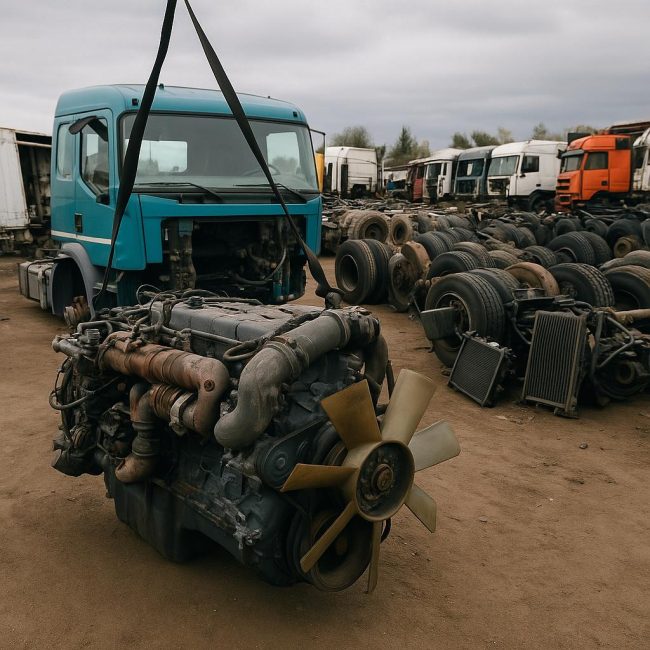
This is perhaps the most reliable and structured way to find a used part. Large auto dismantlers employ specialized technicians for disassembly, inventory, labeling, storage, and shipping. If you need a specific brand, you can find a dismantler that specializes in it, ensuring a wider selection: from cabins and frames to suspension components, transmissions, axles, and small electrical parts. The advantage is the ability to inspect the part's condition on-site, as well as receive components already removed, cleaned, and ready for installation.
Private sellers and small services
Some mechanics and service stations buy faulty trucks for dismantling or work in tandem with owners of vehicles that are beyond repair. Parts are stored in garages, hangars, and warehouses, and are often sold through classifieds without official documentation. The risks are higher, but sometimes a rare part can be found there.
Online platforms and bulletin boards
Websites like Avito, Drom, Trucker, and specialized forums have become the primary search tools. They offer access to dismantlers, private sellers, and even former vehicle owners. However, it's important to remember that the level of transparency in transactions varies greatly. When buying remotely, there's always a risk of receiving a part in the wrong condition or being left without the item altogether.
Groups and chats in messengers
Telegram, WhatsApp, and Viber are platforms where entire communities exist dedicated to repair, maintenance, and searching for truck parts. They post ads, discuss suppliers, and help with selection. For queries like "I need a steering rack for a Scania R-series, preferably from 2010." You can get dozens of contacts within an hour.
However, there is no guarantee of quality and responsibility - it is based solely on trust.
How to Search Properly: A Step-by-Step Approach
Identify the exact model and part number.
Working with a dismantler or supplier begins with accurate identification. Scania has a large number of modifications, and even small differences in production year can affect compatibility.
Check multiple sources.
The first part you find at a salvage yard isn't always the best option. Compare the condition, price, and purchase terms. Sometimes it's better to wait two days than to buy anything.
Check the origin of the part.
Some sellers can tell you what car the part came from, its mileage, and why it was scrapped. If it was in an accident not caused by the vehicle, the part is likely in good condition.
Don't buy by eye.
Ask for photos, videos, license plates, and measurements. Ideally, an in-person inspection. Some large salvage yards take professional photos and even provide documentation.
Always consider shipping.
Large parts, such as cabins, axles, or gearboxes, require special packaging and transportation. Find out in advance who handles this and what warranties are available.
When disassembly is the best option
Situations in which a used part is preferable to a new one:
- Rare model, discontinued. Finding new parts is difficult and the wait is too long.
- Budget repair. When it’s important to simply “get there” or drive the car to the nearest base.
- Urgent replacement. Waiting for the original takes weeks, but the car is needed “yesterday”.
- Seasonal work. For example, equipment only works in the summer, and there is no point in investing in it as a year-round one.
Risks and how to minimize them
Buying from a salvage yard always carries a certain risk. But it's manageable:
- Technical condition. Don't hesitate to bring a specialist with you to your examination or request tests.
- Compatibility. Check the catalog numbers and consult with mechanics.
- Guarantees. Large dismantlers sometimes offer a minimal guarantee of functionality—that's a plus.
- Design. If the part is large (for example, a cabin), it is better to take documents for it to avoid problems during registration or inspections.
Conclusion
Finding used truck parts is no longer a matter of "residual repairs," but a conscious approach to cost optimization. Today, thanks to a vast network of suppliers, the internet, and the community's expertise, you can quickly find the right part in good condition. The key is to approach this thoughtfully: don't chase the lowest price, check compatibility, research the part's origin, and take your time. Then, finding used components won't be a compromise, but a smart choice.