When renovating or remodeling a space, the need to install drywall often arises. One popular method is attaching drywall sheets to wooden sheathing. This type of work has its own unique challenges that must be considered to ensure durability and high-quality finishes.
Problems of selection and application of plasterboard
Drywall is widely used for finishing walls and ceilings due to its versatility, ease of workability, and relative affordability. It allows for the quick covering of large surfaces, creating smooth and durable finishes. However, not all installation methods are equally effective, and the use of wood lath for attaching drywall raises questions for many users.
First, it's important to understand that there are several options for installing drywall, and the choice depends on a variety of factors, including the type of room, the load on the structure, and climate conditions. One key consideration is the choice of the frame to which the drywall will be attached. Wooden sheathing is a traditional, time-tested solution, but it's important to approach this process correctly to avoid mistakes.
Features of installing drywall on wooden lathing
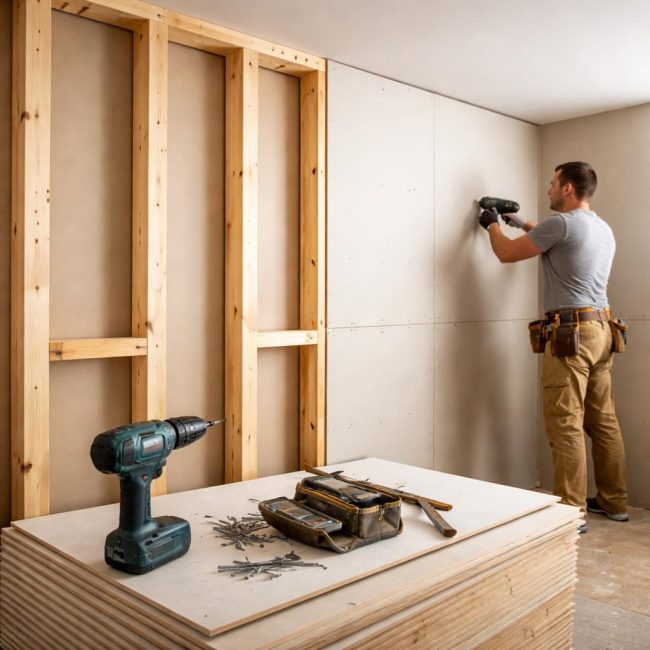
Wooden lathing is a structure made of wooden slats mounted on walls or ceilings. Drywall sheets are attached to these slats using screws or self-tapping screws. This is a fairly common technique, as wood is an affordable and relatively easy-to-work material, simplifying installation.
However, it's important to remember that the wood lath must be installed strictly level and strong enough to support the weight of the drywall. It's also important to remember that wood is susceptible to changes in humidity and temperature, which can lead to structural deformation. Therefore, it's crucial to use high-quality materials and properly prepare the lath to avoid future problems.
How it works in practice
Mounting drywall on wood lath has a number of advantages, but also some limitations. First and foremost, the wood base provides a secure attachment that is strong enough for standard use. However, in areas subject to significant mechanical stress or in rooms with high humidity, this mounting method may not be the best option. It's also important to consider that drywall mounted on wood lath will not be as resistant to deformation as drywall mounted on a metal frame.
In practice, this method is often used in residential spaces where increased structural rigidity is not required. This includes bedrooms, living rooms, hallways, and areas with low moisture resistance requirements.
Scenarios and consequences of use
Using drywall over wood sheathing has its uses. For example, in rooms where high moisture resistance isn't required or where the walls aren't subject to significant physical impact, this technology is a good solution. However, it's important to note that in high-humidity areas or in rooms such as kitchens or bathrooms, other fastening methods or materials that provide greater moisture resistance should be used.
It's also important to remember that installation on a wooden frame may not be the fastest option, given the need for precise adjustment of the structure and consideration of all the features of the room.
Limitations and nuances
Although drywall on wood lath is a fairly common option, it has several limitations. First of all, such structures are sensitive to changes in humidity. In high humidity conditions, the wood may begin to warp, causing a change in geometry and potentially damaging the drywall.
It is also worth considering that installation will require a fairly high level of precision when aligning and securing the lathing, as any imbalance will lead to a violation of the geometry and weakening of the structure.
Common misconceptions
One common myth is that installing drywall on wood sheathing is suitable for any type of space. This is not true—such structures do not withstand high humidity well and can cause damage to both the sheathing and the drywall.
Another misconception is that installing drywall on a wooden frame is easier than on a metal frame. In reality, installing a wooden frame requires careful preparation and precise installation, as well as additional effort to ensure load-bearing capacity.
Conclusion
Installing drywall on wood sheathing is a proven and fairly common solution suitable for most residential spaces. However, to ensure successful installation, it's important to consider all the specifics of working with wood, select the right materials, and prepare the sheathing. Following these recommendations will ensure a long-lasting, reliable, and durable finish.