In urban development, the choice of materials directly impacts the durability and safety of street infrastructure. Among the elements that are not always visible, but play a crucial role, are road curbs. In recent years, granite solutions have increasingly become the preferred choice over concrete. Granite road curbs are used not only in historic areas but also in new road construction projects. This is not due to fashion, but to specific technical and operational advantages, confirmed by research and practical application.
Functions of road curbs
The road curb performs several functions at once:
- separates the roadway from the pedestrian zone;
- prevents displacement of the road surface;
- directs streams of water during rain;
- protects pedestrians and green areas;
- provides visual and tactile delineation of movement zones.
Regardless of the material, curbs must withstand impact loads, temperature fluctuations, moisture, chemicals, and traffic pressure. This places high demands on their strength, geometry, and wear resistance.
Granite curbstone: technical characteristics
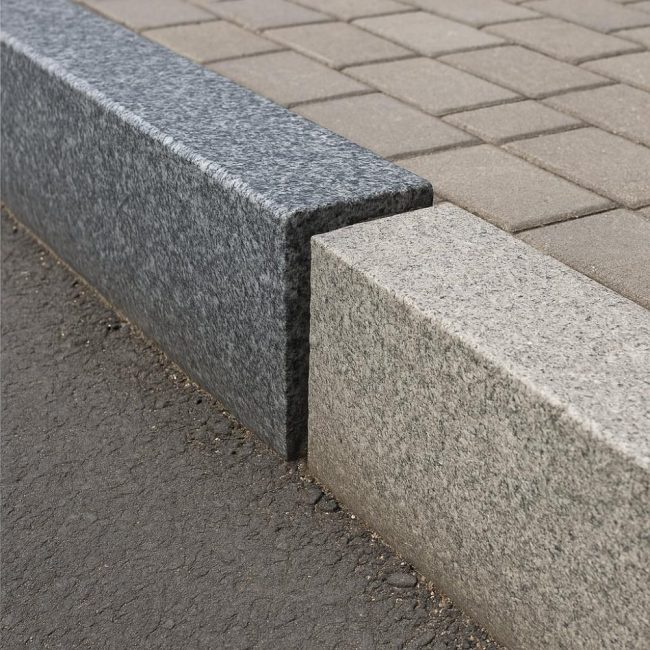
Granite — is a natural igneous stone with excellent physical and mechanical properties. Granite curbs are made from dense rocks, most commonly gabbro, amphibolite, or quartzite granite. According to GOST 32018-2012 and laboratory testing, it has the following properties:
- Compressive strength: from 120 to 300 MPa depending on the type of rock;
- Abrasion resistance: no more than 0.7 g/cm² (high durability);
- Frost resistance: F200–F400 (withstands 200 to 400 freeze-thaw cycles);
- Water absorption: from 0.2% to 0.5%;
- Density: 2,600–2,900 kg/m³;
- Service life: at least 50 years under normal use, in fact – up to 80–100 years.
These characteristics make granite road curbs particularly popular in conditions of heavy traffic and harsh climates.
Concrete curb: features and limitations
Concrete curbs are manufactured according to GOST 6665-91 using heavy-weight concrete, sometimes with additives (fiber, microsilica) and reinforcement. Standard specifications:
- Compressive strength: about 30–50 MPa;
- Frost resistance: F100–F200;
- Water absorption: about 5–8%;
- Density: 2,300–2,500 kg/m³;
- Service life: 10–20 years, under favorable conditions – up to 30 years.
The main vulnerabilities of concrete curbs include:
- high porosity and water absorption;
- tendency to crack in frost;
- poor resistance to salt reagents;
- the need for regular repairs or replacement.
Comparative Analysis: Granite vs. Concrete
| Parameter | Granite curb | Concrete curb |
|---|---|---|
| Strength | 120–300 MPa | 30–50 MPa |
| Wear resistance | Very high | Average |
| Frost resistance | F200–F400 | F100–F200 |
| Water absorption | 0.2–0.5% | 5–8% |
| Resistance to reagents | Excellent | Low |
| Service life | 50–100 years | 10–30 years |
| Visual aesthetics | Natural stone | Artificial, gray |
| Price | High | Low |
| Need for replacement | Rare | Frequent |
Economic feasibility
At first glance, concrete products appear to be more cost-effective: the average cost of a concrete curb is 200–400 rubles per linear meter, while granite can range from 1,200 to 2,000 rubles per linear meter. However, when considering the product's service life and replacement/repair costs, the difference evens out. Examples from municipal services (based on regional costing standards):
- Replacing concrete curbs every 10–15 years requires dismantling, removal, and re-laying;
- Granite curbs serve for decades, often only requiring adjustments to their position during road surface repairs.
According to calculations by the Moscow Department of Improvement (2022), investments in granite pay for themselves in an average of 18–22 years due to reduced costs for ongoing maintenance and aesthetic stability.
Ecological and architectural aspects
Granite curbs are a more environmentally friendly solution—they don't require complex chemical additives and don't emit harmful substances. Furthermore, natural stone retains its attractive appearance for decades and doesn't fade, unlike concrete, which is prone to fading, chipping, and cracking.
Granite is used in the restoration of cultural heritage sites and the design of embankments and streets in city centers, including in St. Petersburg, Moscow, and Kazan. It blends seamlessly with the natural landscape and architecture.
Conclusion
Granite road curbs significantly outperform their concrete counterparts in key performance parameters: strength, service life, resistance to climatic stress and chemical attack. Although they are more expensive, this is offset by lower maintenance costs and aesthetic durability. When designing facilities with high demands on wear resistance, safety, and appearance, granite remains the most effective choice.