In civil engineering, the term "Group 3 soil" is used not to describe the soil's geological origin, but to assess the conditions of excavation work. This refers to the classification of soils based on their difficulty of excavation, as defined in cost estimates and design documentation. Classifying soil into a particular group directly influences the choice of equipment, excavation technology, and labor cost calculations. Therefore, understanding what exactly is meant by Group 3 soil is important for both the designer and the developer.
- Why are soils divided into groups at all?
- Place of the third group in the general classification
- What soils are classified as group 3?
- How does the third group manifest itself on a construction site?
- The influence of soil type on the choice of equipment
- Why is the third group important for cost estimates?
- Relationship with engineering and geological surveys
- Difference from classifications by bearing capacity
- Common misconceptions surrounding the third group
- What does it mean to understand the soil group at an early stage?
Why are soils divided into groups at all?
Soil classification emerged as a practical tool. On a construction site, scientific classification by particle size distribution or genesis is less important than answering a simple question: how difficult is this soil to mine mechanically or manually?
In regulatory documents for cost estimates and labor standards, soils are divided into groups based on their resistance to excavation. The higher the group number, the more effort, time, and equipment are required for excavation. This allows for the actual site conditions to be taken into account in advance when calculating the timeframe and cost of the work.
Place of the third group in the general classification
In the classical system used in Russian estimating standards (GESN, FER), soils are usually divided from the first to the seventh group.
- The first and second groups are relatively light soils that can be developed without significant difficulty by excavators or even manually.
- The third group occupies an intermediate position: such soils can no longer be considered “light”, but they are not yet classified as heavy or rocky.
- The fourth and subsequent groups require more powerful equipment, loosening or special techniques.
Thus, soil of the 3rd group is a conditional boundary between simple and significantly more complicated conditions of excavation work.
What soils are classified as group 3?
The third group, as a rule, includes dense and cohesive soils that provide significant resistance during development, but do not require preliminary destruction by blasting or heavy loosening.
This category typically includes:
- dense loams and clays of natural moisture;
- dry or moderately moist loess-like soils;
- sands with an admixture of clay, if they are compacted and compacted;
- bulk soils that have become compacted over time.
What unites them is not their chemical composition, but their physical condition: they hold their shape, do not crumble easily, and require a noticeable amount of force when removed.
How does the third group manifest itself on a construction site?
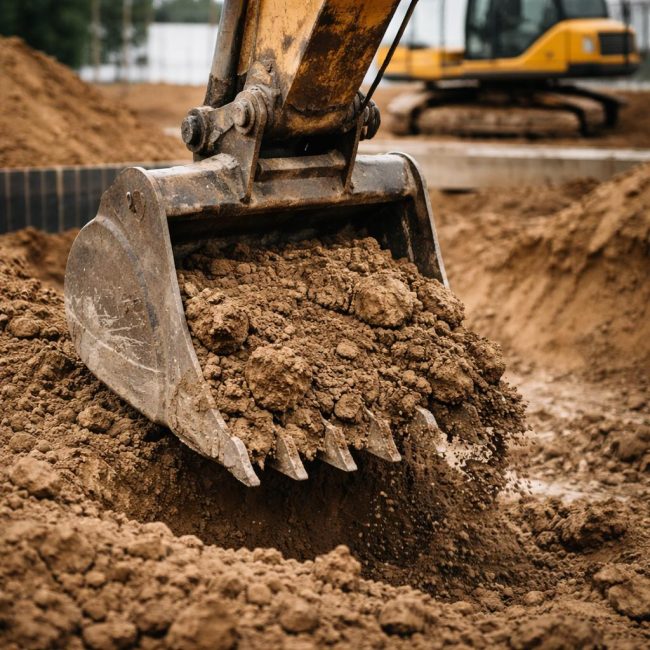
In practice, Group 3 soil is immediately noticeable. The excavator operates under noticeable strain, and the bucket doesn't fill as easily as in sand or loose soil. Manual excavation requires the use of crowbars and picks, and the shovel is used more for excavation than for breaking up the mass.
Moreover, such soils, unlike heavier categories, generally do not require mandatory preliminary loosening with heavy equipment. Standard excavators and bulldozers are adequate for the task, albeit with reduced productivity.
The influence of soil type on the choice of equipment
Classification of soil as group 3 is taken into account when selecting machinery and equipment. Suitable for these conditions are:
- medium-power excavators with heavy-duty buckets;
- loaders designed to handle dense masses;
- bulldozers for planning and developing shallow excavations.
Using equipment designed for light soils results in reduced productivity and accelerated wear and tear. On the other hand, using excessively powerful machinery is often economically unjustified.
Why is the third group important for cost estimates?
The estimate standards for each soil group include different labor intensity factors. For soils in Group 3, the standard development time is higher than for the first and second groups, but lower than for the fourth and subsequent groups.
This is reflected in:
- cost of excavation work;
- calculation of construction time;
- needs for labor and equipment.
Incorrect definition of the group leads to distortions: either the estimate is underestimated and does not cover actual costs, or it is overestimated without objective justification.
Relationship with engineering and geological surveys
Although difficulty classification is not a geological classification, engineering and geological survey data plays a key role. It is the results of drilling, laboratory testing, and section description that inform conclusions about soil density, moisture content, and cohesion.
Based on these characteristics, the designer or estimator classifies the soil into a specific group. Therefore, the designation "Group 3 soil" in documentation is always based on actual properties, not on arbitrary assumptions.
Difference from classifications by bearing capacity
It's important not to confuse soil classification based on development difficulty with classification based on foundation load-bearing capacity. Soil in Group 3 can be either a fairly reliable foundation or problematic, depending on moisture content, depth, and other factors.
The excavation grouping answers the question "how difficult is it to dig" but does not directly answer the question "how well does this soil support the building load?"
Common misconceptions surrounding the third group
One common misconception is that Group 3 soil is considered "poor" or "unsuitable" for construction. In reality, this is simply a characteristic of the development conditions. In many cases, dense loams or clays, when properly prepared, become reliable foundations.
Another mistake is mechanically transferring soil types from the estimate to foundation engineering solutions. These parameters are indirectly related and cannot replace a full calculation.
What does it mean to understand the soil group at an early stage?
When it's clear at the design stage that the site will have Class 3 soil, this allows for more accurate construction planning. The actual volume of excavation work is taken into account, appropriate equipment is selected, and reasonable timeframes are established.
As a result, the risk of unexpected cost increases and delays during construction is reduced. The soil grade no longer becomes an abstract figure in documentation, but a clear guideline describing the actual conditions of future work.