HDPE (low-density polyethylene) pipes are widely used for various purposes, including water supply, sewerage, and electricity. Particular attention should be paid to the selection and proper use of cable in these pipes, as the durability, safety, and efficiency of the entire system depend on it. In this article, we'll explain how to choose the right cable for HDPE pipes, what nuances to consider during installation, and what's important to know to avoid common mistakes.
What is HDPE pipe and what is it used for?
HDPE pipes are flexible pipes made of low-density polyethylene. They are highly resistant to aggressive chemicals, are resistant to low temperatures, and have excellent mechanical properties. HDPE pipes are often used for laying water supply and sewerage systems, as well as for protecting cables from mechanical damage and environmental influences.
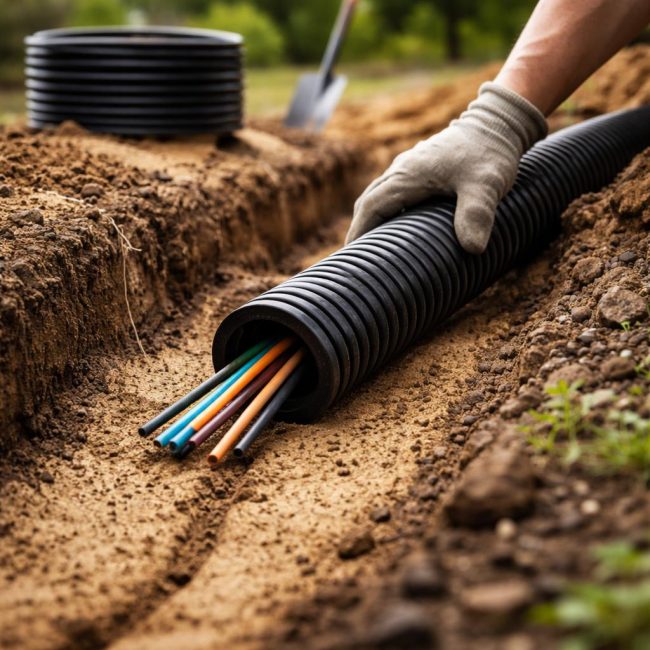
HDPE pipes for cables are typically used in cases where increased protection of wiring from moisture, chemical exposure or mechanical damage is required, as well as when laying cables underground or in hard-to-reach places is impossible without the use of additional protection.
How to choose the right cable for HDPE pipes?
When choosing a cable for installation in a HDPE pipe, it is important to consider several factors:
- Cable type.For the protection of underground cables, it is optimal to use cables with reinforced insulation, such as PVC-insulated cables or cables with a cross-section that meets the stated power and load requirements.
- Resistance to external influences.Cable installed in HDPE conduit must be resistant to chemicals, ultraviolet radiation, and mechanical damage. Keep in mind that HDPE conduits are often used for outdoor installations, and the cable must be protected from the elements.
- Heat resistance.The cable must withstand temperature fluctuations that may occur during operation. It is important to consider the climatic conditions of the region where the wiring will be installed. In some cases, cables with additional heat-resistant insulation will be required.
- Cable cross-section.The cable size must correspond to the power load it will carry. This is a key parameter for the proper functioning of the entire system. The cross-section should be selected based on the power of the connected devices or equipment.
- Additional insulation.It is important that the insulation of the cable that will be laid in the HDPE pipe meets safety standards and can provide protection against short circuits, overheating, and other unforeseen situations.
How does a cable in a HDPE pipe work in practice?
Using HDPE pipes to protect cables is a cost-effective and efficient way to install electrical wiring both inside and outside buildings. HDPE pipes provide reliable protection, preventing damage caused by mechanical impacts and extending the cable's service life by protecting it from environmental influences.
- Laying cable in HDPE pipe.The cable can be installed in a conduit using either open or closed installation methods. The conduit protects the cable from external environmental influences, prevents mechanical damage, and facilitates installation.
- Moisture protection.HDPE pipes can be used to install cables in high-humidity conditions. HDPE pipes effectively protect cables from moisture, which is an important factor when installing cables in the ground, underground, or in areas with high humidity.
- Laying on various types of surfaces.The cable in the HDPE pipe can be installed in both horizontal and vertical sections. This makes the system flexible and suitable for various installation types.
- Cable maintenance and replacement.Using HDPE pipe to protect wiring simplifies the procedure of repairing or replacing cables, since the pipe provides additional protection and makes it easier to access the cable.
Limitations and nuances
When laying a cable in a HDPE pipe, it is necessary to take into account several important factors:
- Need for additional protection.Although the HDPE pipe protects the cable from external influences, in some cases additional protection may be required, especially if the wiring is laid in areas with an increased risk of mechanical damage.
- Problems with the gasket.Some areas, such as areas with high groundwater levels or heavy traffic areas, may require additional measures to prevent cable damage.
- Leaks in tightness.When using HDPE pipes in high-humidity conditions or in areas with potential water leaks, it is important to ensure the tightness of the pipe connections to prevent moisture from entering the pipeline.
Common misconceptions
- Myth: HDPE pipes guarantee complete cable protection.Although HDPE pipe provides good protection, it is important to understand that it does not protect against all possible external influences, such as overheating or chemical exposure under certain conditions.
- Myth: All cables are equally suitable for HDPE pipes.In practice, it is important to take into account that not all cables have the same protection and heat resistance, so it is important to select a cable with suitable insulation and characteristics for the operating conditions.
- Myth: HDPE pipes do not require additional testing.Regular inspection of the piping system, including checking for leaks and cable integrity, is important to maintain the long-term reliability of the entire system.
Conclusion
Selecting a cable for HDPE pipes is a critical process that determines the safety and durability of the entire electrical system. HDPE pipes provide reliable protection for cables, but it's important to consider the type of cable used, its characteristics, and operating conditions. Adhering to these principles will help avoid installation errors and ensure the reliability of the entire system.