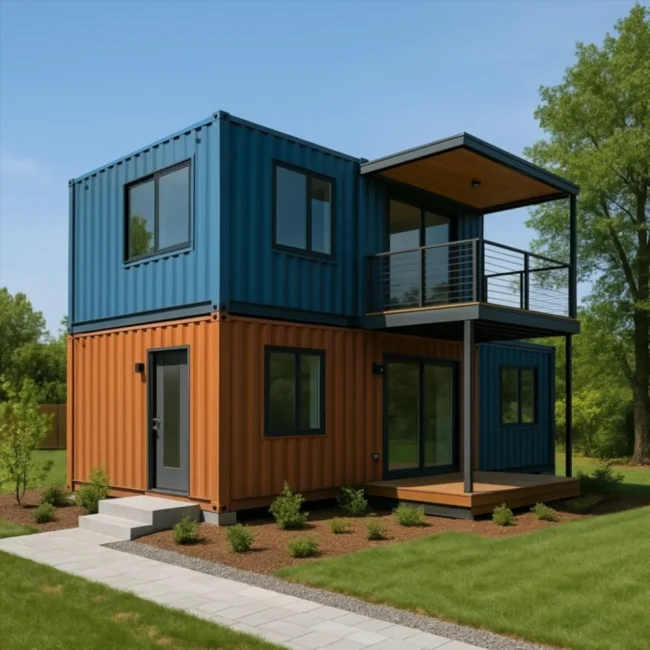
Modern construction is increasingly moving away from the traditional concrete boxes and classic brick walls. One of the most prominent trends of recent years has been the use of shipping containers as a building material. Container homes are attractive for their unique appearance, speed of construction, relative affordability, and high modularity. But how feasible is this choice from a technical and operational standpoint? This article will take a detailed look at how container homes are constructed, from module selection to finishing and utility connections.
- What is a container house?
- Why sea containers?
- Advantages of container homes
- The main stages of building a house from containers
- Design
- Selection and delivery of containers
- Foundation
- Preparing containers
- Heat and sound insulation
- Communications
- Interior decoration
- Exterior finishing
- Examples of container home configurations
- How much does a container house cost?
- Disadvantages of container homes
- Legal and regulatory aspects
- Prospects and relevance
- Conclusion
What is a container house?
A container home is a building constructed using standard shipping or railway containers as the structural core. These can range from single residential modules to complex structures made up of several units integrated into a single architectural structure. The main advantages are quick assembly, portability, and a lower cost compared to traditional construction.
Why sea containers?
Sea containers (ISO containers) are manufactured according to international standards, ensuring versatility and high strength. Here are their key characteristics:
- Length:6 or 12 meters (20 or 40 feet).
- Width:about 2.4 meters.
- Height:standard - 2.6 m, high-cube - 2.9 m.
- Material:steel with anti-corrosion treatment.
- Permissible load:up to 30 tons.
The containers are designed to withstand extreme transport conditions, making them durable, corrosion-resistant, and suitable for use in a wide range of climates.
Advantages of container homes
- Construction speed.The house can be assembled in 2–4 months.
- Cost-effectiveness.The cost of one container is from 2000 to 4000 dollars.
- Environmentally friendly.Reusing metal structures reduces the environmental footprint.
- Mobility.If desired, the house can be moved to a new location.
- Flexibility of architecture.Containers can be easily formed into various shapes: L-shaped, two-story, with a terrace and balcony.
The main stages of building a house from containers
Design
At this stage, an architectural and engineering project is created, which takes into account:
- Number of containers.
- Layout of premises.
- Location of windows, doors, partitions.
- Electricity supply, water supply, sewerage and ventilation.
- Insulation and finishing.
Good design ensures durability, energy efficiency and comfort of the home.
Selection and delivery of containers
Containers can be purchased used or new. Used ones are cheaper but require more extensive maintenance (rust removal, alignment, and sealing). Delivery is by truck or crane.
It is important to ensure that the containers:
- There is no damage to the frame.
- Not exposed to chemical contamination.
- Degassing and cleaning have been completed.
Foundation
Despite the lightweight design, a foundation is essential. The following are used:
- Pile foundation.
- Shallow strip foundation.
- Slab.
The choice depends on the soil type and the number of floors. The containers are secured to the foundation with anchor bolts.
Preparing containers
After installation, the main preparation begins:
- Cutting openings for windows and doors.
- Dismantling part of the walls to combine containers.
- Strengthening of frame structures.
- Treatment with anti-corrosion compounds.
- Installation of metal structures (frames, lintels).
Important: each cut weakens the container, so additional reinforcement with channels or profile pipes is required.
Heat and sound insulation
One of the main issues is insulation. Containers are made of metal, which heats up and cools down quickly. Two insulation options are possible:
- Outside:allows you to preserve the interior space and protects against condensation.
- From the inside:It's easier to implement, but it takes up valuable space.
Materials:
- Mineral wool.
- Polyurethane foam (spraying).
- Extruded polystyrene foam.
- Foil slabs + vapor barrier.
Particular attention is paid to the insulation of the floor and roof, as these are the most vulnerable areas for heat loss.
Communications
The container contains:
- Electrical wiring (in cable channels or corrugated pipes).
- Water supply and sewerage (if the house is connected to centralized systems).
- Heating (electric, underfloor heating, IR panels, stove).
- Ventilation and air conditioning.
All systems are designed taking into account the internal layout.
Interior decoration
The interior space is finished as in any frame house:
- Walls:plasterboard, plywood, clapboard.
- Ceiling:tension, rack, panel.
- Floor:laminate, linoleum, tiles, parquet.
Before finishing, internal partitions are installed, windows and doors are mounted.
Exterior finishing
To give the house an aesthetic appearance and protect the metal from corrosion, exterior finishing is done:
- Ventilated facades.
- Siding.
- Decorative plaster.
- Sheathing with wood, fiber cement boards or metal profiles.
It is possible to disguise the container so that it will be indistinguishable from a classic house.
Examples of container home configurations
- Single module— for a summer house or office.
- Two-container house— combined containers form a spacious studio.
- L-shaped structures— create a cozy courtyard.
- Multi-storey buildings— up to 3 floors with stairs and balconies.
- Combined solutions— container + wood, container + brick.
How much does a container house cost?
The cost depends on the region, type of foundation, insulation, finishing, and connection of utilities.
Estimated cost for a one-story house of 60 m² (2 containers):
- Containers (used) - from 600,000 ₽.
- Foundation — from 150,000 ₽.
- Insulation and finishing — 300,000–500,000 ₽.
- Communications — 200,000–300,000 ₽.
- Design and installation - from 200,000 ₽.
Total:From 1.5 to 2.5 million rubles. This is significantly cheaper than a brick house of similar size.
Disadvantages of container homes
- Good thermal insulation is required.
- Poor sound insulation.
- Inconvenient width (2.4 m) limits interior design solutions.
- Rust - if the metal is poorly processed, it will deteriorate.
- Legal complications: not all areas permit container construction.
Legal and regulatory aspects
Before starting construction, it is important:
- Specify the purpose of the land (individual housing construction, private household plots, etc.).
- Obtain a building permit.
- Order a project with load calculation and fire safety.
- After construction, register the house as real estate.
It is also worth considering sanitary, fire safety and energy efficiency standards.
Prospects and relevance
With rising prices for building materials and labor, container homes are becoming increasingly popular:
- They are used assummer houses, offices, hotels, campsites, shops and even schools.
- In Europe and the USA they are actively developingmicro-housesbased on containers.
- These houses are ideal for remote or hard-to-reach areas.
Conclusion
Shipping container homes are a modern, practical, and aesthetically pleasing solution that allows you to quickly and affordably own your own home. With proper design and high-quality construction, these structures can last for decades, rivaling traditional homes in every way. Their popularity stems not only from fashion but also from tangible advantages, from affordability to environmental friendliness. If you're considering owning your own home with minimal investment and timeframe, a shipping container is definitely worth considering.