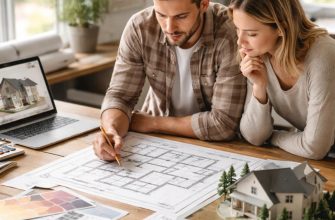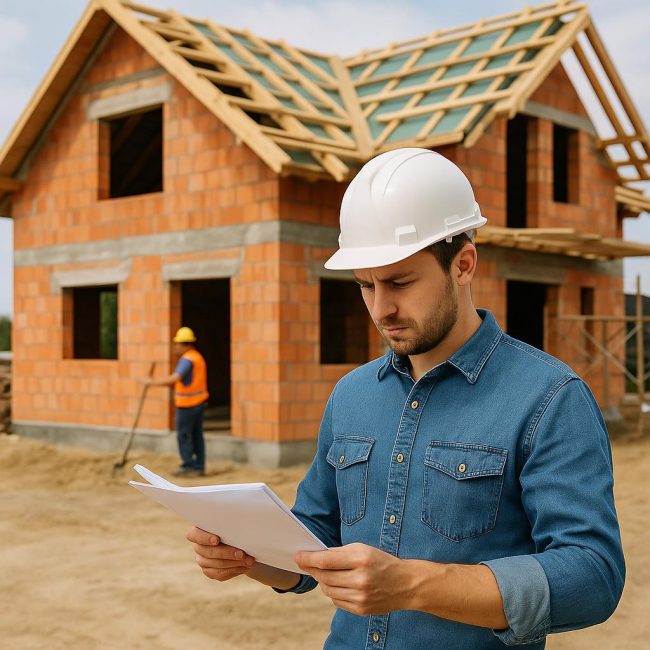
For many, building their own home becomes a lifelong endeavor. However, the joy of a new home is often marred by contractor errors, poor material choices, or poorly executed work. Proper preparation, careful monitoring at every stage, and consulting with specialists can help avoid many problems. For example, in disputed situations, homeowners increasingly turn to technical assessment agencies, where specialists can objectively assess the condition of structures and provide professional advice.
- Why are construction mistakes so common?
- Typical mistakes at different stages of construction
- Mistakes in site preparation
- Mistakes in foundation construction
- Mistakes in wall construction
- Roofing installation errors
- Mistakes in interior decoration
- Why construction mistakes are dangerous
- How to prevent problems during the construction phase
- The role of the technical expertise bureau
- Practical advice for future homeowners
- Conclusion
Why are construction mistakes so common?
Low-rise construction is rapidly developing, with custom designs, rapid construction, and a wide range of technologies. However, it's precisely this diversity of options and the desire to save money that often leads to unpleasant consequences.
The most common causes of errors:
- Lack of a proper project plan. Many believe they can get by with sketches and verbal agreements with the team. The result is a lack of coordination and technical miscalculations.
- Cutting corners on materials. Cheaper alternatives that can't withstand loads are sometimes sold under the guise of high-quality products.
- Lack of supervision by the author and technical staff. Contractors perform the work "in their own way," and the client is not always able to ensure compliance.
- Violations of technology. Rushing to complete a project or insufficiently qualified workers often result in cracks, distortions, and other defects.
Typical mistakes at different stages of construction
Mistakes in site preparation
- Ignoring engineering and geological surveys. Incorrect assessment of soil and groundwater levels leads to foundation subsidence.
- Incorrect house placement on the site. Violating solar exposure standards, compass orientation, or minimum distances to neighbors can cause not only household inconveniences but also legal problems.
Mistakes in foundation construction
- Saving on foundation depth. The house can warp after just a few seasons.
- Use of low-grade concrete or improper pouring.
- Lack of waterproofing, which can lead to dampness and mold in the basement.
Mistakes in wall construction
- Incorrect bonding of bricks or blocks.
- Use of low-quality adhesive solution.
- Violation of the masonry geometry, which causes distortions.
Roofing installation errors
- Incorrectly calculated slope angle.
- Saving on insulation and vapor barrier.
- Errors in the installation of the rafter system.
Mistakes in interior decoration
- Finishing works begin before the supporting structures are completely dry.
- Incorrect installation of engineering systems.
- Use of materials not suitable for specific operating conditions.
Why construction mistakes are dangerous
Even seemingly minor defects can lead to serious consequences:
- cracks in load-bearing walls threaten the safety of residents;
- distortions of door and window openings make operation inconvenient;
- dampness causes the appearance of mold, which is dangerous to health;
- Incorrect electrical wiring may cause a fire.
Moreover, correcting mistakes is much more expensive than preventing them.
How to prevent problems during the construction phase
- Development of a full-fledged project. It's best to entrust this task to professionals: the designer takes into account the load on the foundation, layout, ventilation, and energy efficiency.
- Selecting reliable contractors. It's worth focusing not only on cost, but also on the company's reputation, experience, and the presence of contracts with clearly defined responsibilities.
- Technical and author's supervision. Monitoring must be carried out regularly to identify violations at an early stage.
- Purchasing high-quality materials. It is advisable to check certificates of conformity and storage conditions.
- Stages of work. There is no need to rush: every technological process requires time for shrinkage and drying.
The role of the technical expertise bureau
Sometimes, despite all efforts, clients encounter conflicts with contractors or doubts about the quality of the work performed. In such cases, independent specialists come to the rescue.
The Bureau of Technical Expertise performs the following tasks:
- Checks that the work complies with building codes and the project.
- Assesses the quality of the materials used.
- Reveals hidden defects that are not noticeable at first glance.
- Prepares an official expert report that has legal force.
This conclusion can be used in court, in negotiations with the contractor, or for planning further repair work.
Practical advice for future homeowners
- Don't be afraid to ask builders questions and demand clarification.
- Keep a photo and video diary of the construction – this will help in case of disputes.
- If you have any doubts, contact independent experts before the work goes too far.
- Remember that a house is built to last for decades: quality is more important than speed.
Conclusion
Mistakes in the construction of a private home can lead to significant costs and even safety risks. However, they can be avoided with careful preparation, the involvement of specialists at every stage, and oversight of the process. And in controversial situations, a technical expertise agency can help objectively resolve the issues and protect the owner's interests.
A smart approach to construction is an investment not only in square meters, but also in the peace of mind of the whole family for many years to come.