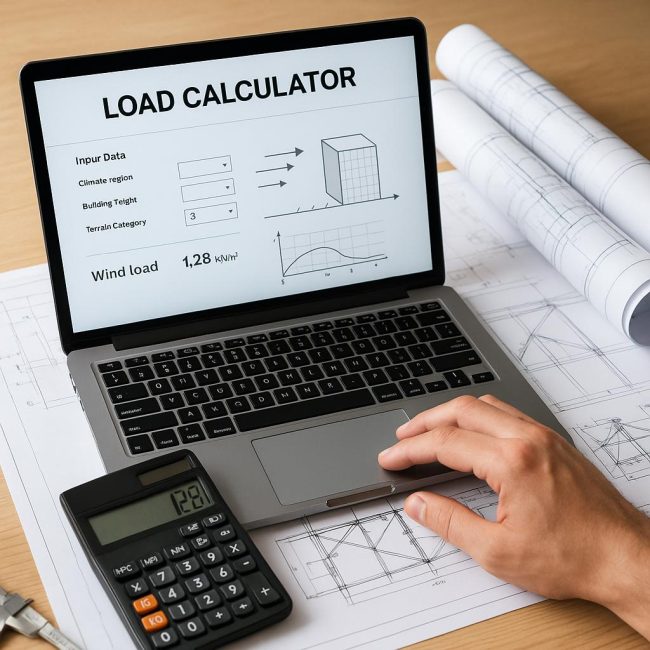
Designing steel structures involves more than just drawings; it also requires dozens of calculations: climate, wind, snow, crane, seismic, and other factors. The accuracy of these calculations determines the safety of the future facility and its compliance with regulations. Previously, all of this was done manually or in cumbersome Excel files, requiring intense concentration and considerable time from the engineer. Today, online calculators are increasingly used, integrated with regulatory frameworks and significantly simplifying routine work.
So, on engineering portals like EVRAZ STEEL ENGINEERINGYou can find a whole range of specialized tools for designers. These calculators allow you to quickly and accurately calculate wind loads for a specific region, determine snow loads according to SP (Spring Standards), calculate overhead crane beam loads, or determine the effective cross-section of a steel element. The convenience lies in the fact that everything is at your fingertips: regulatory references, built-in coefficients, explanations, and often visualizations.
- Why manual calculation is becoming a thing of the past
- Speed
- Minimizing errors
- Update according to standards
- What loads are most convenient to calculate using calculators?
- Where are the limits of calculator applicability?
- What's important when choosing an online calculator?
- How does this affect the project's economics?
- Conclusion
Why manual calculation is becoming a thing of the past
Although many engineers still use traditional formulas or homemade tables, modern online calculators offer a number of advantages:
Speed
Manually calculating wind load according to SP 20.13330 can take up to an hour, especially if the property is located in a challenging climate zone. The calculator takes just a few clicks: select the region, building height, and terrain category, click "Calculate," and you'll get a precise value.
Minimizing errors
Even an experienced engineer can make a sign error, incorrectly apply a coefficient, or use an outdated value from a table. The online calculator already contains up-to-date data and eliminates most common errors.
Update according to standards
SP standards are updated regularly. Platforms like fixit.washerhouse.com promptly update the regulations, ensuring users are always up-to-date. This is especially important in regions where calculations depend on local adjustment factors.
What loads are most convenient to calculate using calculators?
Online tools are especially useful when calculations require a large number of variables or tabular data. Here are some examples:
- Snow load: automatic selection of a region on the map and display of the standard load taking into account reliability factors.
- Wind load: taking into account altitude, aerodynamic coefficients, terrain category.
- Crane structures: calculation of loads from cranes, dynamic coefficients, impacts on beams and columns.
- Dead weight of elements: especially for non-standard profiles (for example, bent Z-beams), when calculating this manually is time-consuming and inconvenient.
Where are the limits of calculator applicability?
An online calculation is no substitute for engineering judgment. No calculator can account for the unique layout of a structure, unusual loads, or construction situations that don't meet the required standards. Therefore, a competent designer uses a calculator as a substitute. tool, not how the ultimate truth.
For example, the calculator allows you to quickly obtain baseline values and then use them in your own calculation model (for example, in SCAD or LIRA). This is especially useful during the preliminary design and concept stages.
What's important when choosing an online calculator?
Not all calculators are created equal. When choosing, consider the following:
- Transparency of calculations — is there a derivation of formulas and intermediate steps?
- Relevance of the joint venture — Are the latest edition standards used?
- Export possibility — Is it possible to save the calculation or download it as a PDF?
- Support and development — Is the calculator updated? Is there any feedback?
How does this affect the project's economics?
Even saving just one working hour is a plus for a design agency. But something else is far more important: using proven calculation tools. the probability of a critical error is reduced, which can cost tens and hundreds of thousands of rubles during construction. A quick check of wind or snow loads at an early stage helps avoid over- or under-reinforcement.
Conclusion
Online calculators are no longer an auxiliary thing, but standard tool A modern engineer. They don't replace professionalism, but they provide that "second head" that calculates quickly, accurately, and tirelessly. And the proper combination of such tools with engineering intuition and knowledge of regulations is the key to a high-quality and safe project.
And if previously an engineer would search for the required table in the SP, rewrite the coefficients, and check them manually, now they simply open a tab and work faster, more efficiently, and with less risk.