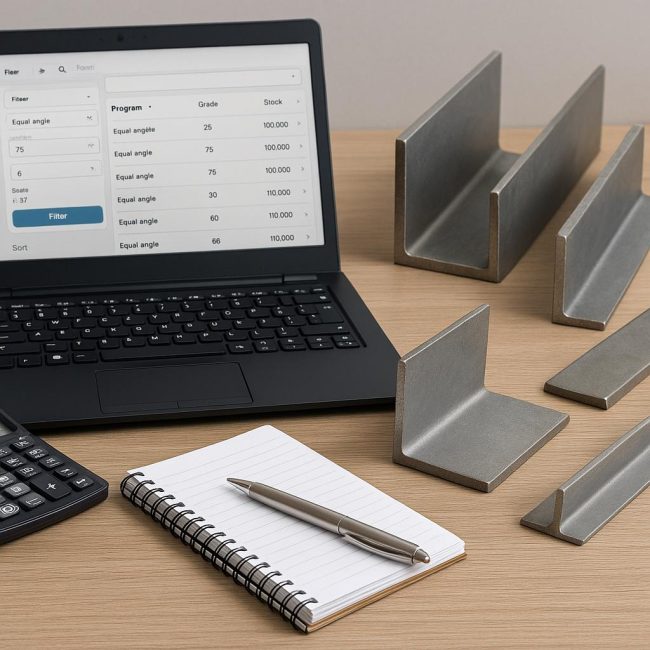
The Russian rolled metal market encompasses thousands of products, dozens of GOST standards, regional price differences, and constant fluctuations in demand. Previously, to find the price of the desired profile, you had to call dozens of suppliers, check price lists, consolidate the data in Excel, and hope the information was at least 24 hours old. Today, with the development of digital platforms, determining a fair price has become easier. These platforms quickly filter offers by profile type, GOST standard, region, and availability, providing an objective picture of the market without unnecessary fuss.
Why is it difficult to determine the "market" price of rolled metal products?
Rolled metal is not just a commodity, but a category with many variables:
- Steel grade (C255, 09G2S, 20, etc.)
- Profile type (angle, channel, I-beam, pipe)
- Dimensions (width, thickness, length)
- GOST or TU
- Delivery region
- Payment and delivery terms
Even minor differences—for example, a bevel or non-standard length—can alter the price. Suppliers set their prices based not only on cost but also on inventory, regional competition, logistics, and order urgency.
As a result, the buyer, especially if he is not from a professional environment, has a question: What price is considered reasonable—and am I overpaying?
What doesn't work: calls, price lists, Excel
Calls to suppliers They take time, information quickly becomes outdated, and prices quoted over the phone may differ from actual prices. They are often given with a "reserve" to cover market fluctuations.
Price lists in PDF or Excel They're difficult to analyze: it's difficult to filter the desired profile, quickly compare regions, or account for availability. Furthermore, many such documents are updated manually—once a week, or even less frequently.
Excel summariesManually collected by supply chain staff, these are good for internal needs, but they are time-consuming and vulnerable to human error. Furthermore, they almost always reflect the past rather than the current situation.
What works: aggregators with current inventory
Modern aggregation services, are moving the rolled metal market into the digital realmThis is not just a bulletin board, but a full-fledged database where you can:
- select the required profile (for example, corner 63×63×5 according to GOST 8509),
- filter by steel grade and region,
- see current balances in warehouses,
- Compare prices on one page - no calls or Excel.
This approach allows you to quickly understand:
- what is it average price by market (not by one supplier),
- How proposals are distributed - where it is more expensive, where it is cheaper,
- How many actually available in stock, not in theory.
What influences a "fair" price?
When analyzing, it's important to understand that price isn't absolute. However, a well-structured platform can identify a range within which the offer is appropriate given the current situation.
Factors to consider:
- RegionIn Siberia and the Far East, metal is more expensive due to logistics.
- Availability: what is “in stock” is cheaper than what is ordered from the factory.
- Standardization: rolled products according to GOST are more stable in price than those according to TU.
- Volume: wholesale quantities may come with a discount.
Example: corner 75×75×6
Let's say you need to purchase 5 tons of 75x75x6mm C255 steel angle. When you open the aggregator, you'll see:
- in Moscow - from 65,000 ₽/t with 12 t remaining;
- in Tula - from 63,500 ₽/t with 4 t remaining;
- in Nizhny Novgorod - 66,500 ₽/t, but with delivery.
If you're from the Moscow region, a Tula supplier might be preferable. However, if you need a larger volume, it's wiser to choose a Moscow supplier.
Result: the fair price in this case is 63,500–66,500 ₽/t, and not the hypothetical “from 58,000” voiced in the outdated price list.
When it's especially important to focus on the real market
- For tenders and estimates — you can set the actual cost, not the conditional “average” one.
- When purchasing within a limited time period — It is important to see what is actually in stock.
- For comparative analysis — understand how competitive your current supplier is.
Conclusion
Understanding the fair price of rolled metal isn't magic or intuition, but data analysis. The more parameters you compare and the more current the information, the more accurately you can determine the true market range.
Platforms seem to make this analysis accessible even to non-professional buyers: filters by GOST, inventory, region, and steel grade transform a complex market into a transparent field for rational choice. And all this— no phone calls, no Excel, no guesswork.