Every parent dreams of their child having their own space for play and creativity. A corner where they can run, jump, build, and imagine is essential for harmonious development. For this reason, many consider purchasing a children's play structure for their apartment or cottage, as this solution helps create a functional and safe area for active play, either indoors or outdoors.
A well-organized play area is more than just a collection of toys, but a complete environment where a child learns to interact with the world around them, tries new activities, and gradually becomes independent. Let's look at where to start and what nuances to consider.
Why is a children's play area so important?
Children need space that belongs only to them. When a child has their own territory:
- A sense of independence is formed. Even a small area with a play structure or a rug allows a child to feel like the master of the space.
- Imagination develops. The play corner encourages children to come up with new games, stories and scenarios.
- Physical activity is increasing. This is especially important in the age of gadgets: the presence of sports elements motivates the child to move more.
- Security is ensured. Parents can rest assured that their child is playing in a specially equipped area where all risks are taken into account.
Where is the best place to locate a children's corner?
In the apartment
- Living room. This is a great option if space allows. Your child will always be in full view, and the space can be designed to blend seamlessly with your decor.
- Children's room. A classic choice: the corner will become part of a personal space where the child can play and relax.
- Loggia or balcony. With insulation and secure fencing, this area could become a mini-play area.
- At the dacha
- Garden or yard. Here you can install a full-fledged play complex with a slide, swings and horizontal bar.
- Veranda. An excellent solution for playing in bad weather, especially if it is indoors.
- A separate corner in the garden. It is important to place it so that parents can watch the child from the window or from the terrace.
What to include in a children's corner
The organization of the space depends on the age and interests of the child, but there are several universal elements:
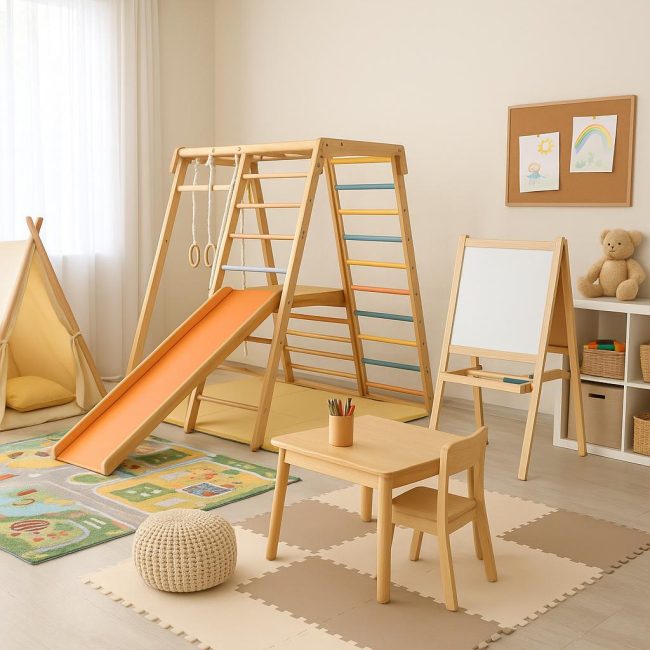
- Play complex. It can be a small indoor or a full-scale outdoor facility. It includes ladders, slides, ropes, and wall bars. It's a great way to develop physical activity.
- Area for creativity. A table, an easel, a modeling or drawing set—all of this helps develop imagination and fine motor skills.
- Soft modules. Cubes, tunnels, and pillows are safe elements for children who love to build and jump.
- Play mat. The option with thematic drawings (roads, cities) encourages story-based games.
- Storage of toys. Baskets, boxes or containers teach a child to be tidy.
- Privacy zone. A small tent, house or hut is a place where a child can hide and be “alone”.
How to arrange a corner taking into account age
- 1–3 years. A minimum of complex elements, more soft toys, cubes and safe structures.
- 3–6 years. Active games become a priority: small slides, swings, ropes, and a drawing area.
- 6–10 years. You can add sports elements: horizontal bars, ladders, and climbing frames. A table for crafts and board games is a must.
- Over 10 years old. The play area is gradually being transformed into a space for hobbies: exercise equipment, table football, and a reading area.
Important safety rules
- Materials. All coatings must be environmentally friendly, without toxic dyes.
- Strength. The play complex must be able to withstand the weight of the child with some reserve.
- Floor covering. In the house - a rug or soft panels, outside - rubber tiles or grass.
- No sharp corners. All furniture and structural elements must be rounded.
- Lighting. It is important that the corner is well lit, especially if it has a creative area.
Tips for organizing space
- Use modular solutions. They are easy to rearrange and add new elements.
- Maintain balance. The play area should not take up the entire room or garden, otherwise the child will quickly lose interest.
- Involve the child. Discuss together what he would like to see in his space.
- Update the content. Change toys or add new pieces from time to time to keep things interesting.
- Think ahead. It is better to choose elements that can be used for several years, and not just at an early age.
Outdoor children's play area: pros and cons
Pros:
- fresh air and active games;
- possibility of installing large complexes;
- development of physical skills.
- Cons:
- the need for equipment maintenance;
- weather dependence;
- higher requirements for strength and safety.
Result
Creating a children's corner is an investment in a child's development and happiness. Whether in an apartment or a summer cottage, it's important to consider their age, interests, and safety. Buying a children's play structure is often the best option: it saves parents time, creates a diverse space, and keeps the child engaged for hours.
The key is to remember that a play area is more than just a fun zone. It's a place where personality is formed, imagination is nurtured, and health is strengthened. Therefore, ensuring its proper organization is one of the most important tasks for parents.