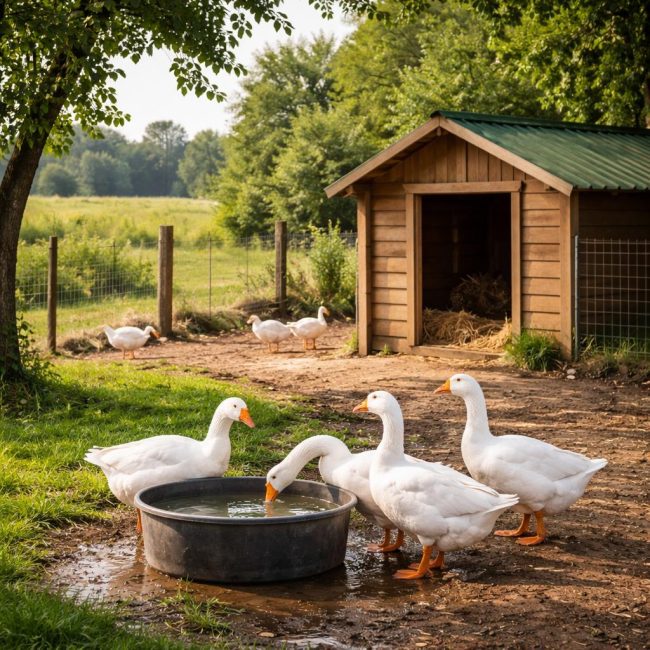
When keeping geese on a private plot, the main practical question is how to organize their habitat so that the birds grow normally, stay healthy, and don't cause problems for the owners and neighbors. This isn't about commercial farming, but rather about small-scale home-based geese kept near a house, summer cottage, or outbuildings.
This article addresses one specific issue: how to select and set up a goose farm on your property using sustainable and proven private farming practices.
- Conditions of applicability
- Principles for choosing a location for a goose yard
- Distance from residential areas
- Dry base
- Access to water and pasture
- Basic layout of the containment area
- Sequence of arrangement of the place of detention
- Step 1. Defining the zone boundaries
- Step 2. Preparing the base
- Step 3. Organizing the enclosed space
- Step 4. Arrangement of the walking area
- Step 5: Placing the Water Zone
- Step 6. Organizing access and maintenance
- Element placement logic
- Typical mistakes when choosing a location
- Lowland placement
- Neighborhood with the house
- Lack of shadow
- Weak fencing
- Poorly thought-out placement of water
- Limitations and when the scheme is not suitable
- The final logic of organizing conditions
Conditions of applicability
The described scheme is suitable if the following conditions are met:
- geese are kept for personal use, not in industrial quantities;
- the site has a free area for outbuildings or an aviary;
- the bird is outdoors for most of the year;
- there is no need for special production facilities.
If geese are planned in large numbers, in densely populated areas, or near public areas, these recommendations may not be sufficient.
Principles for choosing a location for a goose yard
Distance from residential areas
In practice, they try to place the goose house and the walking area:
- not close to the house;
- not near the terrace, bedroom windows, or recreation areas;
- taking into account the prevailing wind direction.
This reduces the impact of odors, noise and high humidity on the residential part of the site.
Dry base
Geese don't tolerate constant dampness well. Therefore, the location for their housing should be:
- without stagnant water;
- not in the lowlands;
- with a natural or artificial slope.
If the area is prone to flooding, drainage issues are addressed first, and only then are the birds placed.
Access to water and pasture
For normal behavior of geese it is important to have:
- containers with water for bathing;
- green area for walking.
This could be a pond, a large bathtub, a trough, or a specially prepared area with grass.
Basic layout of the containment area
In private practice, a combination of three elements is usually used:
- A closed space for overnight stays and inclement weather.
- Open range.
- Water area.
These elements are arranged compactly so that the bird can move freely between them.
Sequence of arrangement of the place of detention
Step 1. Defining the zone boundaries
First, a section is identified that:
- does not intersect with paths;
- does not interfere with traffic and household chores;
- has some space to spare.
For a small farm, a separate corner of the plot is usually chosen.
Step 2. Preparing the base
Before installing buildings:
- remove trash and vegetation;
- level the surface;
- If necessary, add sand or crushed stone.
The goal is to obtain a dense and relatively dry area.
Step 3. Organizing the enclosed space
Goose housing is typically used for:
- overnight stays;
- protection from wind and precipitation;
- maintenance during cold weather.
In private households they use:
- wooden sheds;
- frame buildings;
- converted utility buildings.
It is important that there are no drafts or constant dampness inside.
Step 4. Arrangement of the walking area
The run is placed next to the premises and enclosed with a net or fence.
Experience shows that walking should:
- have a hard and grassy area;
- to be partially in the shade;
- easy to clean.
In the absence of grass, the area gradually becomes trampled, so sometimes zones are alternated or greenery is sown.
Step 5: Placing the Water Zone
Geese need to be able to enter water.
In private settings the following are used:
- plastic containers;
- metal troughs;
- old bathtubs;
- small artificial ponds.
The water is positioned so that the runoff does not fall under the goose house and create dirt.
Step 6. Organizing access and maintenance
When planning, leave room for:
- human passage;
- cleaning;
- feed delivery;
- change of bedding.
If this is not provided, caring for the bird becomes inconvenient.
Element placement logic
In practice, the elements are arranged according to the “dry-wet” principle:
- goose house - at the driest point;
- walking area - below;
- the reservoir is in the lowest part.
This way, water does not flood the place where you spend the night and rest.
Typical mistakes when choosing a location
Lowland placement
The most common mistake is installing a goose coop in a water-collecting area. This leads to:
- dampness;
- mud;
- increased morbidity;
- rapid destruction of the building.
Neighborhood with the house
Attempts to place geese "closer" often end with complaints from household members due to the smell and noise.
Lack of shadow
A completely open area overheats in the summer, causing the bird to become lethargic and constantly seek shelter.
Weak fencing
Geese move actively and can go beyond the boundaries of the site if the fence is conditional or damaged.
Poorly thought-out placement of water
If the bath is placed near the entrance to the room, dirt is quickly carried inside.
Limitations and when the scheme is not suitable
The described scheme may be insufficient in the following cases:
- the area is very small;
- there are dense residential buildings nearby;
- year-round maintenance in a harsh climate is planned;
- The number of birds exceeds household levels.
In such situations, a more complex infrastructure is required, which cannot be described universally without taking into account specific conditions.
The final logic of organizing conditions
When setting up a place to keep geese on a site, the following sequence of thoughts is usually followed:
- First, choose a dry, remote location.
- Then a zone is formed from three elements: a room, a walking area, and water.
- They are positioned taking into account moisture drainage.
- Provide ease of maintenance.
- They check whether the zone does not create discomfort for the residential part of the site.
This approach allows us to create stable conditions without complex structures and constant modifications.