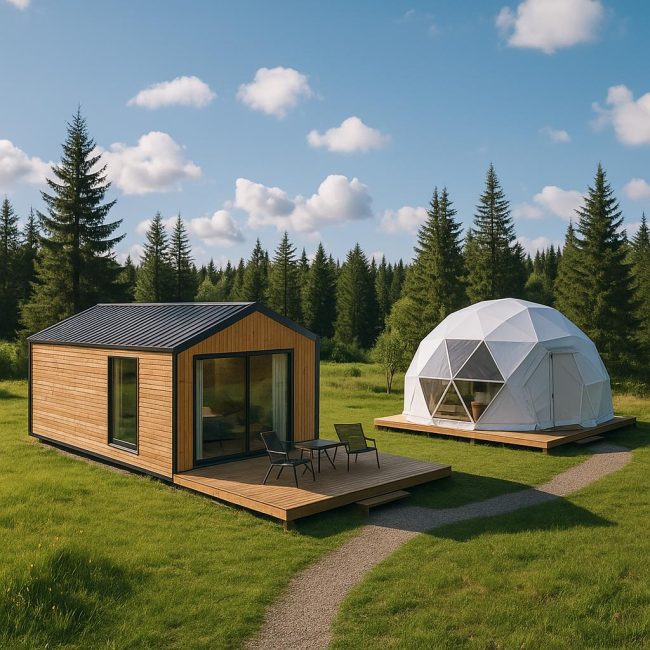
Glamping is a modern format for outdoor recreation with a familiar level of comfort. This "glamorous camping" is especially popular among city dwellers who want to get away from the hustle and bustle but aren't willing to sacrifice amenities. Glamping is increasingly being used to accommodate guests. modular houses — compact, warm, and aesthetically pleasing structures that can be easily installed in scenic locations without the need for extensive construction.
Demand for glamping continues to grow, and with it, interest in this business from aspiring entrepreneurs. Building a turnkey glamping site and making it profitable is entirely possible with a smart approach. In this article, we'll explore where to start, how to choose the right site, what you shouldn't skimp on, and what's important to consider to ensure your project not only breaks even but also generates a stable income.
- Step 1. Market analysis and format selection
- Step 2: Selecting a suitable site
- Step 3. Design and selection of buildings
- Step 4. Infrastructure and Engineering
- Step 5. Documents and business legalization
- Step 6. Financial planning
- Step 7. Promotion and brand
- Step 8. Service and reviews
- Step 9. Scaling
- Conclusion
Step 1. Market analysis and format selection
Before launching a project, it's essential to research the market: who the key players are, what locations are in demand, and what formats are popular. Glamping concepts vary:
- Eco-glamping – minimal intervention in nature, natural materials.
- Family - with an emphasis on comfort, kitchen, and children's areas.
- Romantic - privacy, SPA, panoramic views.
- Thematic - for example, Scandinavian style, retro, safari, etc.
Target audience It's important to determine in advance: these could be couples without children, newlyweds, families, groups of friends, freelancers, or corporate clients. The design, service, and pricing will depend on this.
Step 2: Selecting a suitable site
A good location is one of the key factors for glamping success. Consider the following:
- Picturesqueness and accessibility (views, water bodies, forests, mountains).
- Distance from major cities (optimally 1.5–3 hours by car).
- Availability of roads, electricity, water supply.
- Legal status of land: individual housing construction, private household plots, agricultural purposes.
It is important to find out in advance whether construction is permitted in the chosen area and what type of economic activity is permitted.
Step 3. Design and selection of buildings
Here the foreground is modular houses, which are ideal for glamping:
- Fast assembly (1–2 weeks to home).
- Possibility of year-round operation (with insulation).
- Aesthetic appearance and modern interior.
- Minimal maintenance costs.
In addition to modular structures, dome tents, safari tents, eco-huts, and wooden bungalows are also popular. It's important that the accommodation combines comfort and uniqueness—this is what guests are willing to pay more for than a standard campsite.
Don't forget to think about it common areas: terraces, kitchens, showers, sauna, fire pit area, gazebos, parking.
Step 4. Infrastructure and Engineering
A comfortable stay is the key to high ratings and repeat visits. Please note the following:
- Electricity: connection to the grid or autonomous sources (solar panels, generators).
- Water supply: well, borehole, filtration system.
- Sewage: septic tank or bio-toilets.
- Heating: stoves, electric convectors, heated floors.
It is important to calculate the network load in advance, especially if you plan to operate the glamping site year-round.
Step 5. Documents and business legalization
Legalization is an important and often challenging stage. It is necessary:
- Register an individual entrepreneur or LLC.
- Obtain permission to accommodate tourists (depending on the format).
- Pass the classification (optional).
- Notify Rospotrebnadzor and the fire inspection.
- Connect to the OFD (online cash register) and fiscalize payments.
Some regions offer tourism support programs, including grants, subsidies, and preferential loans. It's worth exploring them and applying.
Step 6. Financial planning
A business plan is not a formality, but a necessary tool. It includes:
- Costs for purchasing land and development (construction, engineering, improvement).
- Operating expenses: personnel, utilities, marketing, taxes.
- Revenue: number of rooms, average price per night, seasonality.
Payback Depends on investment and occupancy. With good traffic, a profitable glamping site can pay for itself in 2-3 years.
Step 7. Promotion and brand
Without quality promotion, glamping risks going unnoticed. Effective channels:
- Own website with online booking system.
- Instagram, TikTok, and Pinterest are visually oriented platforms.
- Booking platforms: Booking, AirBnB, Yandex.Travel, Sutochno.
- Partnerships with travel bloggers and eco-influencers.
- SEO and targeted advertising.
Special attention - photo contentUnique design, beautiful nature, and interior details should be showcased as expressively as possible.
Step 8. Service and reviews
Glamping is not only about beautiful houses, but also emotionsGuests appreciate:
- Personalized approach.
- Cleanliness and tidiness of the territory.
- Unconventional features: breakfast in a basket, an open-air bath, quests, master classes.
- Flexibility: late check-in, pet-friendly, gift certificates.
Positive online reviews and high ratings on booking platforms are the foundation of long-term profitability.
Step 9. Scaling
Once glamping becomes successful, you can think about scaling up:
- Expansion of the site - installation of new modules.
- Opening a second location in another region.
- A franchise is the sale of a ready-made model to other entrepreneurs.
- Participation in tourist festivals and glamping guides.
Conclusion
Creating a profitable turnkey glamping site requires serious preparation and attention to detail. But if executed correctly, it can become not only a business but also a lifestyle, combining entrepreneurship, ecology, and creativity. Modern modular homes, accessible marketing tools, and a growing demand for unique experiences create fertile ground for entering this segment. The key is to understand that glamping is more than just accommodations; it's an experience guests are willing to pay for.