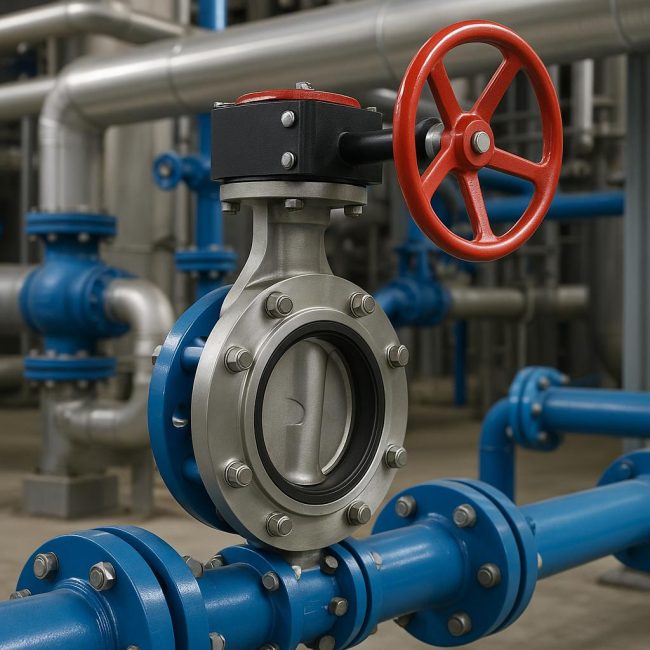
Modern industry is unthinkable without extensive pipeline systems transporting liquids, gases, and process mixtures. The energy, chemical, food, oil and gas, and utilities industries all depend on the stability and safety of pipeline infrastructure. Any malfunction, leak, or failure can lead not only to production downtime but also to serious environmental and financial consequences. Therefore, pipeline reliability today goes far beyond an engineering challenge—it's a strategic priority.
One of the key aspects of increasing system durability is the selection of high-quality valves. Eccentric butterfly valves are particularly important, as their design and performance characteristics ensure high levels of tightness, wear resistance, and ease of maintenance. However, pipeline reliability depends on many factors, from proper design to proper operation.
- Step 1: Reliability Starts with Design
- Stage 2. The role of reinforcement in ensuring reliability
- Advantages of Eccentric Butterfly Valves for Reliable Systems
- Stage 3. Installation and quality control
- Stage 4. Maintenance and operation
- Stage 5. Materials and anti-corrosion protection
- Stage 6. Automation and digital control
- Stage 7. Economic effect from increased reliability
- Conclusion
Step 1: Reliability Starts with Design
Errors made at the design stage often cause problems years later. Therefore, it is this stage that determines the system's resilience to loads, pressure fluctuations, and temperature changes.
Basic principles of robust design:
- Analysis of operating conditions — it is necessary to accurately determine the characteristics of the transported medium: its chemical composition, temperature, viscosity, abrasiveness, aggressiveness.
- The right choice of materials — steel, stainless steel, cast iron, or composites are selected depending on the environment and external factors. For example, stainless alloys are used for aggressive liquids, while heat-resistant steels are used for steam systems.
- Optimization of pipeline route — minimizing the number of turns and connections reduces the risk of turbulent zones and leaks.
- Selection of fittings — shut-off and control devices must comply with operating conditions and ensure tightness with minimal flow resistance.
At this stage, it's important to consider not only the technical specifications of the equipment but also the ease of subsequent maintenance. For example, if the pipeline runs in hard-to-reach areas, preference is given to compact and lightweight mechanisms—such as eccentric butterfly valves, which are easily integrated even in confined spaces.
Stage 2. The role of reinforcement in ensuring reliability
Shut-off valves are not just auxiliary components, but active participants in the flow regulation process. Depending on their purpose, they perform shut-off, throttling, reverse protection, and emergency shutdown functions.
In industrial systems, special requirements are imposed on fittings:
- high tightness during multiple operating cycles;
- resistance to corrosion and temperature fluctuations;
- minimal maintenance costs;
- Possibility of control automation.
Among the many types of devices, eccentric butterfly valves stand out for their sophisticated design. Unlike traditional (central) models, eccentric valves have an offset axis of rotation, preventing the disc from rubbing against the seat when opening and closing. This reduces wear and increases the service life of the equipment.
Advantages of Eccentric Butterfly Valves for Reliable Systems
- Durability — reducing friction during disk movement extends the service life of seals by 3–5 times.
- Tightness — the tight fit of the disc ensures class “A” sealing standards, which is especially important when transporting gas, oil and chemicals.
- Compactness — the devices take up minimal space and are suitable for installation on horizontal and vertical sections of pipelines.
- Energy efficiency - less effort is required to rotate the disk, which reduces the energy consumption of the drives.
- Versatility — applicable for water, steam, air, oil, acids and alkalis.
Thus, the correct choice of fittings is the basis for the trouble-free operation of the entire system.
Stage 3. Installation and quality control
Even the most reliable fittings will not ensure safety if installation procedures are not followed correctly. Installation errors are a common cause of leaks and deformations.
Installation recommendations:
- Before installation, the pipeline must be cleaned of scale, dirt and foreign particles.
- It is not permitted to use fittings with damaged seals or worn out elements.
- Installation must be carried out without distortions, especially on flange connections.
- After installation, a pressure test is mandatory.
Quality control is not a one-time procedure, but a systematic process. Periodic inspection of seals, torque, disc, and housing condition allows us to detect early signs of wear and prevent accidents.
Stage 4. Maintenance and operation
Regular maintenance is key to equipment longevity. Manufacturers of industrial valve systems recommend performing preventive inspections at least quarterly.
What does the service include:
- visual inspection for corrosion and mechanical damage;
- checking the tightness and condition of the sealing rings;
- lubrication of moving parts;
- checking the drive and its response;
- torque control.
For automated systems, it is additionally used real-time monitoring — sensors record the disk position, pressure, temperature, and signal any deviations. This allows us to move from reactive maintenance to predictive, that is, preventative - when a malfunction is eliminated before it causes a failure.
Stage 5. Materials and anti-corrosion protection
Corrosion is the main enemy of any pipeline. Internal damage, which remains undetected for a long time, is particularly dangerous. High humidity, chemical reagents, and high temperatures accelerate wear.
To extend the service life, it is necessary to use:
- stainless steel housings or cast iron with anti-corrosion coating;
- fluoroplastic and elastomer seals, resistant to aggressive environments;
- protective coatings (epoxy, zinc, polyurethane) to prevent oxidation;
- high-quality welded joints, manufactured according to GOST and ISO.
Eccentric valves are often equipped with PTFE or Viton sealing rings, which are resistant to acids, alkalis, and hydrocarbons. This makes them ideal for the chemical and oil and gas industries.
Stage 6. Automation and digital control
Modern pipeline systems are increasingly equipped with automated control systems. Eccentric butterfly valves are compatible with a variety of actuators— electric, pneumatic, hydraulic, which allows them to be integrated into automated systems.
The implementation of digital technologies provides a number of advantages:
- remote control and flow regulation;
- automatic diagnostics of the state of the fittings;
- recording of pressure, temperature, and response time parameters;
- preventing accidents through early warning of faults.
Technologies Smart Valve Monitoring are becoming the new standard: sensors monitor the status of equipment 24/7, transmitting data to a server or control station.
Stage 7. Economic effect from increased reliability
Investments in reliable pipeline solutions pay for themselves many times over. Avoiding cheap but short-lived valves helps avoid downtime, accidents, and equipment replacement costs.
Benefits for the enterprise:
- reduction of repair and maintenance costs;
- reduction of product losses due to leaks;
- increasing the energy efficiency of systems;
- compliance with environmental and industrial safety standards;
- increase in the overall equipment availability (OEE).
So reliability is not only about safety but also economic stability of the enterprise.
Conclusion
The reliability of industrial pipelines is the result of a comprehensive approach. Everything matters: competent design, the right choice of materials, high-quality valves, and regular maintenance. Today's industry relies not only on capacity and performance, but also on sustainability, safety, and cost-effectiveness. And the higher the quality requirements, the more important are solutions proven by time and engineering practice.