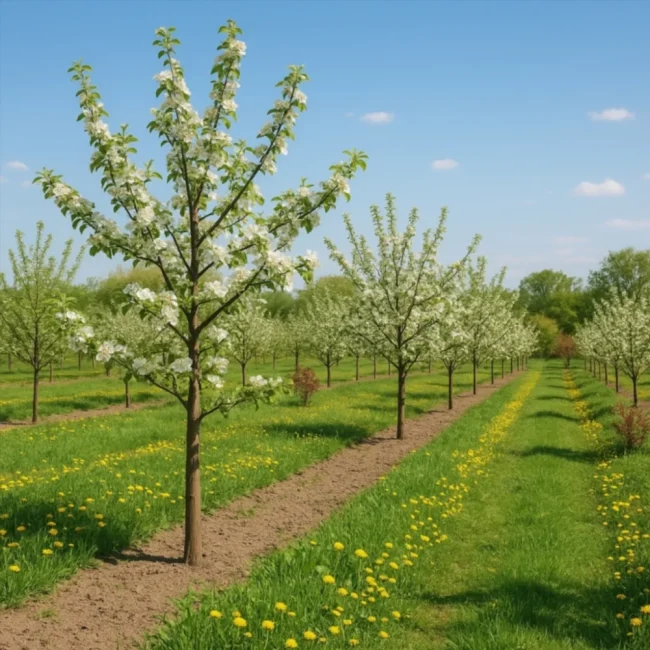
Starting your own orchard isn't just a way to provide yourself and your family with delicious and healthy fruits, it's also a long-term investment in your garden. However, the success of this endeavor directly depends on proper planning. Mistakes made at the planting stage can come back to haunt you years later: trees will become diseased, produce little, or even die. Therefore, before picking up a shovel and seedlings, it's important to understand how to properly and effectively plan an orchard.
- Goals and approach: why do you need an orchard?
- Site Analysis: What's Important to Consider
- Drawing up a planting plan
- Choosing varieties: what to look for
- The importance of pollination and pollinator selection
- Terrain features and wind protection
- Soil preparation: an important step
- Organizing an irrigation system
- Combination with berries and herbs
- 10. Mistakes when planning an orchard
- 11. Accounting for maintenance and seasonal work
- Conclusion
Goals and approach: why do you need an orchard?
The first step to effective planning is understanding your goals. There are several options:
- Personal harvest for the family.In this case, versatility is important: you want different fruits that bear fruit at different times.
- Commercial direction.Then the priorities are productivity, disease resistance and transportability of fruits.
- Aesthetics and landscape.If trees are needed as decorative elements, compact, beautifully flowering and neat varieties are selected.
Once you have defined your goals, you can move on to more technical aspects of planning.
Site Analysis: What's Important to Consider
Each site has its own characteristics. Before creating a planting plan, you need to study:
1. Climatic conditions of the region.
Different species and varieties of fruit trees tolerate frost, drought, and frequent rainfall differently. In central Russia, for example, apple, pear, cherry, and plum trees thrive. In the southern regions, peaches, apricots, and figs thrive.
2. Microclimate of the site.
A single site can have shaded and sunny areas, lowlands with stagnant water, and wind-exposed elevations. This determines the choice of planting site: for example, peach and apricot trees do not tolerate drafts and require a south-facing location.
3. Soil type and composition.
Fertile loamy or sandy loam soil with a neutral pH is ideal. If the soil is acidic, lime it; if clayey, improve drainage and add sand and humus.
4. Groundwater level.
Deep soil (below 2 m) is favorable. High soil levels will require drainage or raising the planting site.
Drawing up a planting plan
A proper planting plan helps avoid overcrowding, ensure light, and simplify maintenance and harvesting. It's important to consider:
1. Distance between trees.
It depends on the type and variety of trees:
- Apple tree on a vigorous rootstock - 5-6 m.
- Apple tree on dwarf rootstock - 3-4 m.
- Pear - 4-5 m.
- Plum, cherry, sweet cherry - 3-4 m.
- Bushes (currants, gooseberries) - 1.5-2 m.
2. Rows - oriented from north to south.
This ensures maximum illumination.
3. Tall trees are on the north side.
They will not shade low-growing crops.
4. Accounting for future growth.
It is important to remember that after 10–15 years the trees will grow – their crowns can reach up to 5 meters in diameter.
Choosing varieties: what to look for
Selecting varieties is one of the most important tasks. Mistakes at this stage often result in crop failure and tree diseases.
The main criteria for choosing varieties:
- Winter hardiness.Especially relevant for apple, pear and apricot trees.
- Disease resistance.For example, to scab in apple trees, moniliosis in stone fruits.
- Self-fertility.Some varieties require pollinators (for example, cherry, pear).
- Ripening periods.It is advisable to have early, mid-season and late varieties to extend the fruiting season.
- Fruit quality.Taste, size, shelf life, purpose (for eating, drying, canning).
The importance of pollination and pollinator selection
Some trees cannot bear fruit without cross-pollination. For example, many apple and pear varieties require a pollinator—another variety with a similar flowering time. Ideally, plant two or three varieties together.
Examples of matching pairs:
- Apple tree Antonovka + Zhigulevskoe.
- Pear Lada + Chizhovskaya.
- Cherry Valery Chkalov + Revna.
Terrain features and wind protection
Fruit trees don't like constant wind, especially cold wind. Wind not only breaks branches but also impairs pollination. Solutions:
- A hedge around the perimeter of the site (for example, made of acacia, hawthorn).
- Planting shrubs or conifers on the north side.
- A fence or wall as a windbreak.
If the site is located on a slope, it is better to plant trees in terraces or along horizontal lines to avoid erosion.
Soil preparation: an important step
The season before planting (preferably in the fall), the area needs to be prepared:
- Remove weeds, especially perennials.
- Add organic matter: humus, compost, wood ash.
- Apply lime if the soil is acidic.
- Dig to a depth of 30–40 cm.
A separate planting hole is dug for each tree—usually 60 x 60 x 60 cm, or up to 1 m deep for larger trees. A mixture of fertile soil, humus, superphosphate, and potassium salt is added to the bottom.
Organizing an irrigation system
Young trees require regular watering, especially during the first 2-3 years after planting. It's best to:
- Drip irrigation.The most effective option is economical and directed to the root zone.
- Annular grooves around the tree trunk circle.A cheap way to water by hand.
- Barrels and containers.For gravity irrigation and solar water heating.
Combination with berries and herbs
A garden can become a multi-level ecosystem if you plant the following under the trees:
- Currants, gooseberries, raspberries - along the edges or between the trees.
- Shade-tolerant herbs: mint, oregano, lemon balm, strawberries.
- Flowers: calendula, nasturtium and marigolds - they repel pests.
10. Mistakes when planning an orchard
To avoid common pitfalls:
- Do not plant trees too close to each other.
- Do not choose varieties that are not adapted to your climate.
- Don't forget about the future height and width of the crown.
- Do not plant heat-loving crops on the north side.
- Do not use untested or weak seedlings.
11. Accounting for maintenance and seasonal work
Even the most well-planned garden requires maintenance:
- In spring: pruning, treatment against diseases and pests, fertilizing.
- In summer: watering, thinning out ovaries, protection from the sun.
- In autumn: harvesting, sanitary pruning, preparation for winter.
- In winter: protection from rodents, insulation of tree trunks.
If you are planting a large garden, it is worth considering in advance access for wheelbarrows, equipment, and water supply on the site.
Conclusion
Planning an orchard is a process that requires knowledge, patience, and a strategic approach. But investing in a well-designed orchard will pay off handsomely in just a few years: healthy, properly planted trees will delight you with a consistent harvest each year, be a joy to behold, and increase the value of the plot. The more carefully you plan, the fewer problems you'll face in the future.