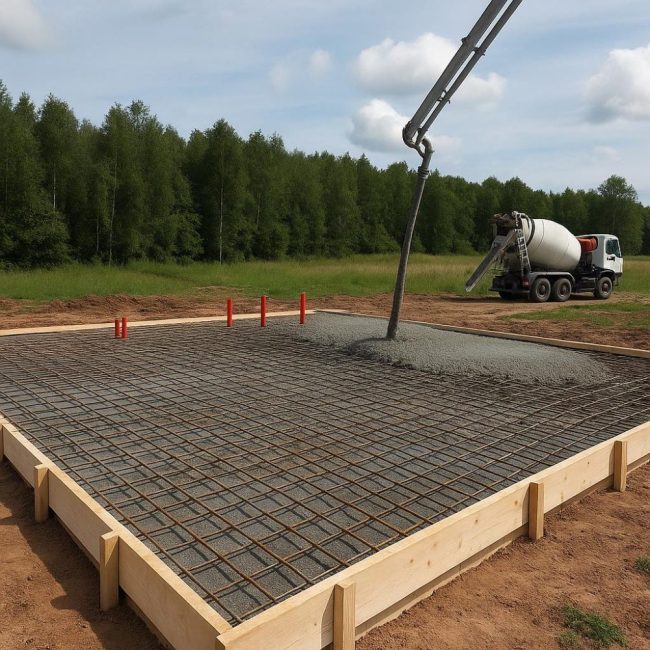
Construction on a summer cottage or country property always begins with the foundation. The foundation is the "root" of the house, determining whether the building will stand for decades without cracks or warping. Mistakes at this stage can be costly: foundation repair is a labor-intensive and expensive process. Therefore, choosing the right type should be carefully considered in advance, taking into account the specific features of the site, the future structure, and the operating conditions.
One of the key stages of foundation construction is pouring concrete. To ensure the process proceeds smoothly and without risks, it's crucial to arrange high-quality concrete delivery to the site in advance. Only freshly prepared concrete will ensure the strength of the monolith.
Why the foundation plays a key role
The foundation performs several tasks at once:
- accepts and evenly distributes the load from walls and ceilings;
- protects the building from the effects of moisture and seasonal soil movements;
- prevents the building from settling.
If the wrong choice is made, cracks may appear within a couple of years, doors may stop closing, and walls may begin to warp. These problems are especially acute in suburban areas, where soils are often unstable and groundwater levels can be high.
What to consider before choosing
1. Soil characteristics
- Sandy soils withstand loads well and do not retain water.
- Clays and loams tend to heave when frozen.
- Peatlands and wetlands require piles or slab solutions.
2. Humidity and groundwater level
If the water comes close to the surface, additional waterproofing and drainage will be required.
3. Freezing depth
The foundation must go below this mark, otherwise the building will “lift” in winter.
4. Building mass
A lightweight bathhouse will only need a columnar or pile foundation, while a brick cottage will require a more massive slab or deep strip foundation.
5. Site relief
On uneven surfaces, piles are the most convenient option: they compensate for differences in elevation.
Main types of foundations
Ribbon
The most common option for private homes, it consists of a continuous concrete strip beneath load-bearing walls.
- For light buildings, a shallow foundation is used.
- For heavy ones - buried below the freezing level.
Pros: reliability, basement option.
Disadvantages: high consumption of materials and time.
Pile
Consists of buried piles connected by a grillage. Suitable for marshy and soft soils.
Pros: speed of installation, cost-effective.
Disadvantages: difficulty in insulation and limitations on building weight.
Slab
Monolithic reinforced concrete slab under the entire area of the building.
Pros: strength, versatility, stability on heaving soils.
Disadvantages: high cost and large volume of concrete that needs to be poured at one time.
Columnar
It consists of supports located under the supporting elements.
Pros: simplicity and low cost.
Cons: Not suitable for heavy buildings.
How to avoid mistakes
- Order a geological survey - even a simple soil test will help you make a decision.
- Take the climate into account: in cold regions, the freezing depth is significantly greater.
- Ensure a continuous supply of concrete: pouring it intermittently will weaken the structure.
- Don't skimp on waterproofing and drainage systems.
- Calculate possible loads in advance, including future extensions or floors.
Results
The choice of foundation for a country house depends on many factors: soil composition, building features, groundwater levels, and climate. For lightweight structures, pile and columnar options are suitable, while for more substantial structures, a slab or deep strip foundation is suitable.
A well-chosen foundation guarantees a house will stand for decades. But even the most successful design will be useless without a high-quality pour. Therefore, along with choosing the right foundation type, it's important to ensure timely concrete delivery to Domodedovo and a well-organized construction process.