When choosing aluminum entrance doors with thermal breaks, you often hear that they're "warm" and "freeze-proof." But what exactly is behind these words? What technology allows a metal door to remain warm to the touch when the frost is cracking outside?
The secret of a “warm” aluminum door lies in one key, but invisible from the outside, element - polyamide insert, or thermal breakThis component, made of a special low-thermal-conductivity polymer, physically separates the outdoor and indoor sections of the metal profile. Aluminum itself is an excellent conductor, and without this insert, the door would turn into an ice slab in winter, pumping cold into your home.
A thermal break acts as a barrier: it prevents frost from outside from "flowing" through the metal to the inside of the frame, keeping it warm even at -30°C. Understanding this simple physical principle is the key to choosing a door that will save you money on heating and create true comfort.

- Summary Table: Thermally Break Doors vs. Non-Thermal Doors
- Problem: What is a cold bridge and why does it occur in metal?
- Solution: How does a thermal break "break" this bridge?
- An integrated approach: thermal break not only in the frame
- Technology that makes aluminum ideal for harsh climates
- Frequently asked questions about thermal break operation in aluminum entry doors
Summary Table: Thermally Break Doors vs. Non-Thermal Doors
| Characteristic | "Warm" profile (with thermal break) | "Cold" profile (without thermal break) |
| Profile design | Three-component: 2 aluminum contours connected by a polyamide insert. | Monolithic: solid aluminum profile. |
| Operating principle | Polyamide blocks transfer of temperature from the external part of the profile to the internal one. | Metal directly transmits temperature from the street to the room. |
| Indoor temperature | Warm, close to room temperature. | Icy, almost equal to the outside temperature. |
| Risk of condensation and ice | Absent or minimal at normal humidity. | Guaranteed at sub-zero temperatures. |
| Energy efficiency | High, keeps the house warm, reduces heating bills. | Zero is a source of huge heat loss. |
| Main application | Entrance doors to heated houses, cottages, apartments. | Doors inside buildings, into unheated vestibules, warehouses, and technical rooms. |
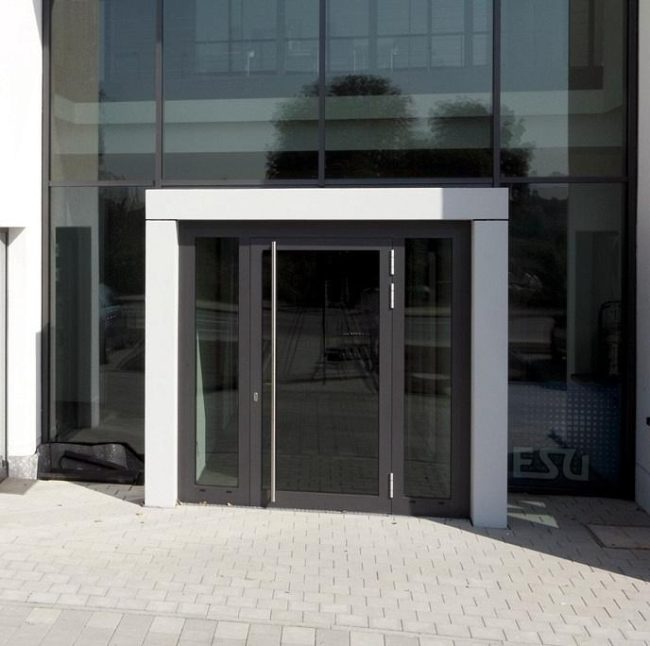
Problem: What is a cold bridge and why does it occur in metal?
To truly appreciate the genius of thermal break technology, one must first understand the fundamental problem it solves.
- A simple analogy with a spoon in tea. Imagine dipping a metal spoon into a cup of very hot tea. After a few seconds, the handle of the spoon, which doesn't even touch the water, becomes scalding hot. This is a clear example of how it works. heat bridge (or "cold bridge," if we're talking about winter). Metal has high thermal conductivity—the ability to transfer temperature very quickly and efficiently from one part to another.
- Aluminum is an ideal conductor of cold. A standard ("cold") aluminum profile is the same metal spoon, only scaled to the size of a door. When it's -20°C outside, its outer surface cools to the same temperature. And since the profile is a single, monolithic piece of metal, this frost easily "runs" along it to the inside of the door, located inside your warm room.
- Inevitable consequences: The inner surface of the frame and sash becomes icy. Warm, humid air from the room comes into contact with this cold surface. The moisture from the air instantly condenses on it as water droplets (the door is said to "cry"). In severe frost, this condensation freezes, forming a layer of frost and ice. This is not only unsightly but also leads to damage to the window frame and the appearance of mold.
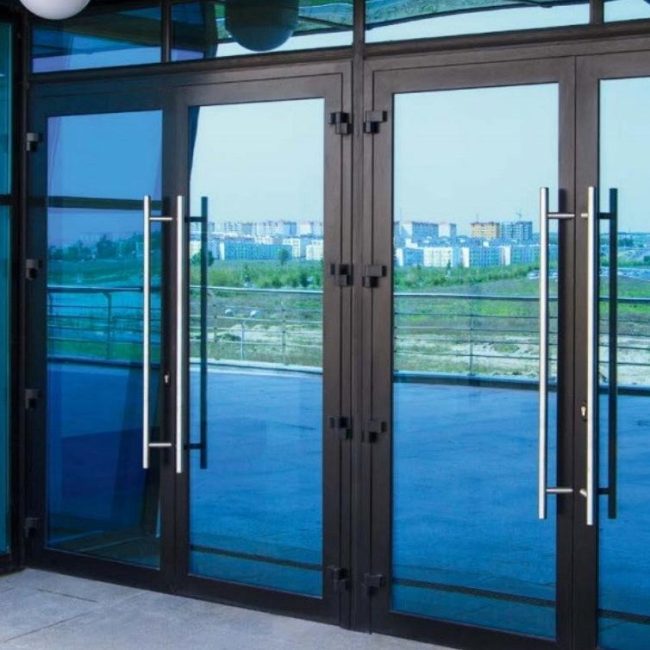
Solution: How does a thermal break "break" this bridge?
A thermal break is a simple and elegant engineering solution that literally breaks the thermal bridge, preventing it from forming.
- What is this? Thermal break (or thermal bridge) is a durable insert-profile made of glass fiber reinforced polyamideIt is installed between the outer (outdoor) and inner (indoor) aluminum sections of the door profile. As a result, the solid profile becomes a kind of "sandwich": outdoor aluminum + polyamide insert + indoor aluminum.
- Why polyamide? This polymer material was chosen for two key reasons:
- Strength and durability: It is strong enough to securely connect two metal profile sections and withstand weight and operational loads for decades. Its coefficient of linear expansion is close to that of aluminum, preventing deformation.
- Extremely low thermal conductivity: This is the key property. The thermal conductivity of polyamide is approximately 0.25-0.30 W/(m K), which is approximately 700-800 times lower than that of aluminum (≈200 W/(m K)). Simply put, it acts as a highly effective thermal insulator.
- How it works in practice, step by step:
- The outer aluminum part of the profile absorbs all the street frost and cools down to -20°C.
- The cold reaches the border with the polyamide insert.
- Polyamide, being a very poor conductor of heat (and cold), blocks and does not let the temperature pass further.
- The internal aluminum part of the profile remains completely insulated from the outside frost and maintains a temperature close to room temperature.
As a result, the warm inner surface of the door simply doesn't provide the physical conditions for condensation and ice to form. Problem solved.
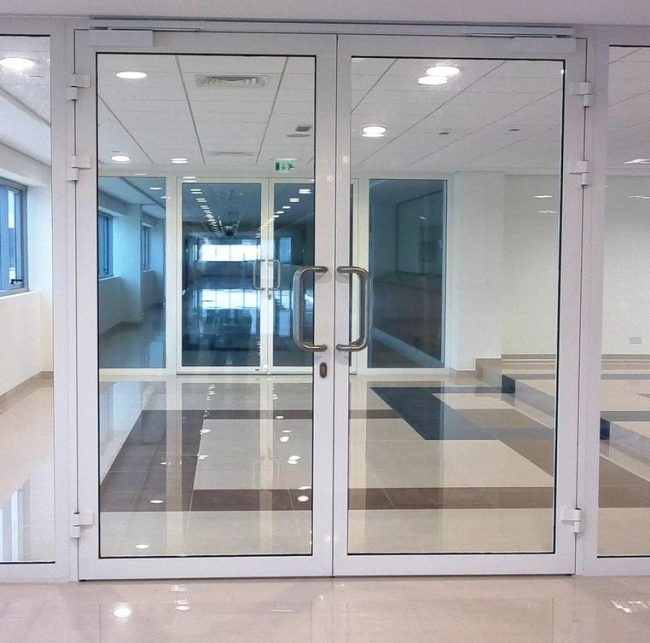
An integrated approach: thermal break not only in the frame
To create a truly warm and energy-efficient door, a thermal break in the frame and sash profile alone is not enough. At least two other elements operating on the same principle are essential.
- "Warm" threshold. The threshold is the lower part of the door frame, which also directly contacts the outside. If it's made of solid aluminum, it will freeze, and the cold will radiate through the floor, creating discomfort. Therefore, high-quality entrance doors also have a thermal break to insulate them from freezing.
- Energy-saving glass unit. If a door design includes a glass insert, it should not create a "hole" in the thermal insulation. Instead of standard glass, at least a double-glazed unit (three panes) is used. One pane has a special low-emission coating (i-glass), which reflects heat back into the house, and the space between the panes is filled with an inert gas (argon), which conducts heat worse than air. This type of double-glazed unit has thermal performance comparable to a solid wall.
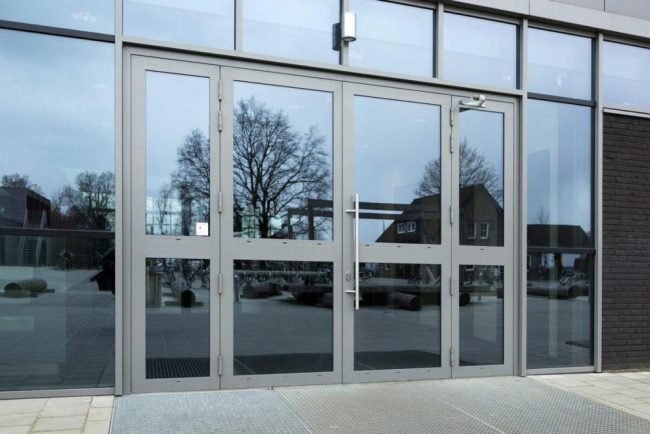
Technology that makes aluminum ideal for harsh climates
Thermal break is not a marketing gimmick, but a fundamental and time-tested technology that has transformed aluminum, which is inherently "cold," into one of the warmest and most energy-efficient materials for entry doors.
It solves the main problem of metal – its high thermal conductivity – in a simple and elegant way, creating a reliable barrier to the cold.
Thanks to the thermal break, your aluminum door will not freeze, "weep," or ice over, ensuring a comfortable indoor climate and significantly reducing your heating costs throughout its entire service life.
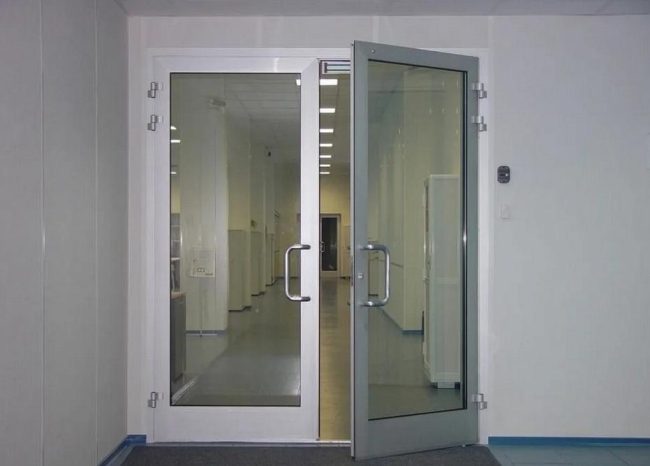
Frequently asked questions about thermal break operation in aluminum entry doors
Question: What is a thermal break in an aluminum door in simple terms?
Answer: This is a special plastic (polyamide) insert inside the metal profile, dividing it into external and internal sections. It acts as a thermal barrier, preventing cold from the outside from penetrating the interior surface of the door, keeping it warm to the touch.
Question: How can I visually determine if there is a thermal break in a door?
Answer: Open the door and look at the edge of the door leaf or frame. If you see that the profile consists of three clearly separated parts (metal-plastic-metal), then there is a thermal break. The plastic insert is usually black and has a noticeably different texture from the metal. In a "cold" profile, you'll see only a single, monolithic piece of metal.
Question: Can a door with a thermal break still “sweat” (form condensation)?
Answer: On the profile itself—almost never, if the thermal break is high-quality. However, condensation may appear on the double-glazed unit if it's not energy-efficient, or on adjacent slopes if the door installation process was improper (poor sealing of the joint). Very high humidity in the room itself (above 55-60%) combined with poor ventilation can also be a cause.
Question: Is a thermal break required for the entrance door to a private home?
Answer: Yes, it's absolutely necessary for any heated space directly exposed to the outdoors in climates with sub-zero winter temperatures. Installing a door without a thermal break will guarantee freezing, ice formation, significant heat loss, and, as a result, mold growth on the window sills.
.