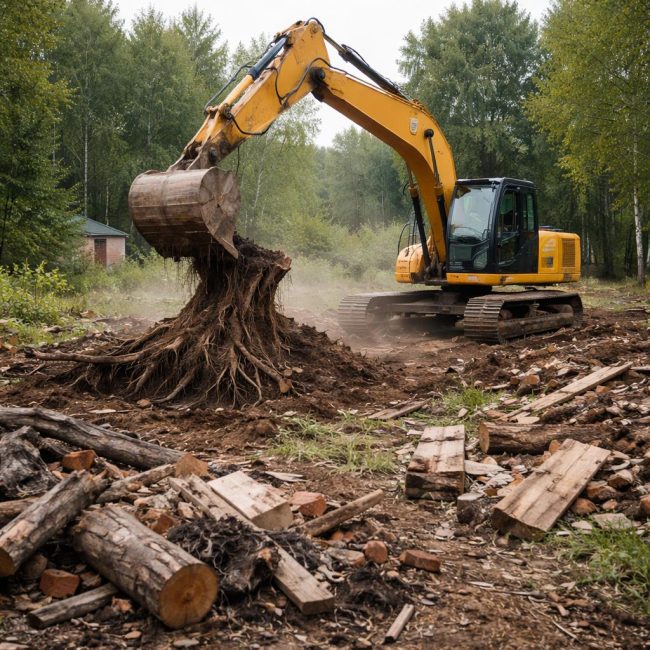
Before construction, the site is usually unprepared. Grass, bushes, old buildings, roots, and construction debris remain, making it difficult to properly mark out the house and move equipment. Therefore, the site is first cleared: excess debris is removed, old structures are dismantled, and waste is removed, including through companies such as https://fixit.washerhouse.com/en/If this isn't done in advance, the work will have to be done as construction progresses. This results in lost time, increased complexity, and increased costs.
Next, it's important to understand the stages involved in such preparation. Site clearing isn't a single action, but rather several sequential tasks, each of which impacts the progress of construction. Below, we'll discuss what's done before construction begins, the order in which it's done, and what's typically considered important, so you don't have to revisit these issues later.
- Why clear the area in advance at all?
- What usually hinders construction?
- Vegetation
- Old buildings
- Garbage
- Stage One: Inspection and Planning
- Clearing grass and bushes
- What they do:
- Tree and root removal
- Options:
- Dismantling of old buildings
- Usually dismantled:
- Removal of waste and soil
- What is exported:
- Leveling the site
- At this stage:
- Preparation of entrances and work areas
- They do:
- When clearing is done partially
- Common mistakes when clearing
- Result
Why clear the area in advance at all?
Construction doesn't begin with the foundation. First, you need to ensure that the site is suitable for equipment operation and that the house's layout is accurate.
If this is not done:
- the excavator will not be able to reach the required point;
- geodetic markings will be inaccurate;
- the soil under the foundation will be loose or contain debris;
- drainage and communications will have to be redone.
Clearing is not about “putting things in order,” but about preparing the ground for further work.
What usually hinders construction?
Even an "empty" site often has hidden problems.
Vegetation
- tall grass;
- shrubs;
- young trees;
- root system of old plantings.
Roots are one of the main problems. They remain in the ground, interfere with digging, and can cause soil to rise over time.
Old buildings
- sheds;
- portable cabins;
- greenhouses;
- fences;
- foundations from previous buildings.
Often, some of the structures have already been dismantled, but the concrete, pillars, and foundations remain in the ground.
Garbage
- construction waste;
- old boards;
- brick;
- slate;
- metal.
Some of the waste goes deep into the ground and is only discovered when digging.
Stage One: Inspection and Planning
Before work begins, the entire site is inspected. It's important to understand:
- where will the house be;
- where is the equipment access;
- where to store soil and waste;
- which areas can be left untouched.
At this stage, a simple map of the area is often drawn, even by hand. This helps avoid clearing away unnecessary material and returning to the same area multiple times.
Clearing grass and bushes
Work almost always starts from the top layer.
What they do:
- mowing grass;
- shrub removal;
- cutting down small trees;
- collection and removal of green waste.
If you simply mow the grass and leave the roots, the area will re-grow within a couple of months. Therefore, for construction, grass is usually removed along with the root layer in the development area.
Tree and root removal
Trees are a separate stage.
Options:
- sawing down leaving the stump;
- felling with uprooting;
- complete removal with removal.
For construction, stumps are almost always removed completely. A stump left behind:
- interferes with digging;
- decomposes and subsides;
- creates voids in the soil.
Tree uprooting can be done manually or mechanically. The choice depends on the diameter and number of trees.
Dismantling of old buildings
Before construction, everything that is located on the construction site and in the area where equipment will pass is removed.
Usually dismantled:
- sheds;
- old houses;
- foundations;
- concrete pads;
- fences and posts.
It's important not just to dismantle the above-ground portion, but to remove everything below ground. Any remaining concrete or rebar will interfere with drilling and digging.
Removal of waste and soil
Clearing without removal is half the job.
What is exported:
- construction waste;
- concrete and brick;
- tree;
- roots;
- excess soil.
If left on the property, trash will interfere with equipment and take up valuable space. Often, it's stored temporarily and then has to be cleared out again.
Leveling the site
After dismantling and clearing, the area almost always looks uneven.
At this stage:
- fill in the holes;
- cut off the bumps;
- compact the soil;
- form a general slope.
This is important for:
- precise marking of the house;
- normal water drainage;
- work of construction equipment.
Without leveling, the foundation may be installed at an angle.
Preparation of entrances and work areas
Even if the house is built later, an entrance is needed immediately.
They do:
- temporary entry;
- area for equipment;
- a place for storing materials.
If this is not taken into account, the equipment will begin to ruin the entire area, and dirt will be spread everywhere.
When clearing is done partially
Sometimes the area is not cleared completely.
This is done if:
- construction will be carried out in stages;
- part of the plot is used as a garden;
- There are budget constraints.
In this case, only the building site, entryway, and work areas are cleaned. The rest is left for later.
Common mistakes when clearing
- They remove only the top, leaving the roots and concrete in the ground.
- They don't plan garbage removal in advance.
- They clear more than necessary and ruin the area.
- They don't make access for equipment.
- They start construction without leveling.
Each of these errors then entails additional costs.
Result
Clearing a construction site isn't a one-time effort, but a consistent process. It includes inspection, vegetation removal, demolition, removal, leveling, and access preparation.
If you do everything at once and in the right order, construction goes faster and smoother. If you skip steps, problems arise later in the project, when fixing them is more difficult and expensive.
That's why many people first study how such work is typically performed, look at examples and lists of services, and only then decide how to proceed on their own property.