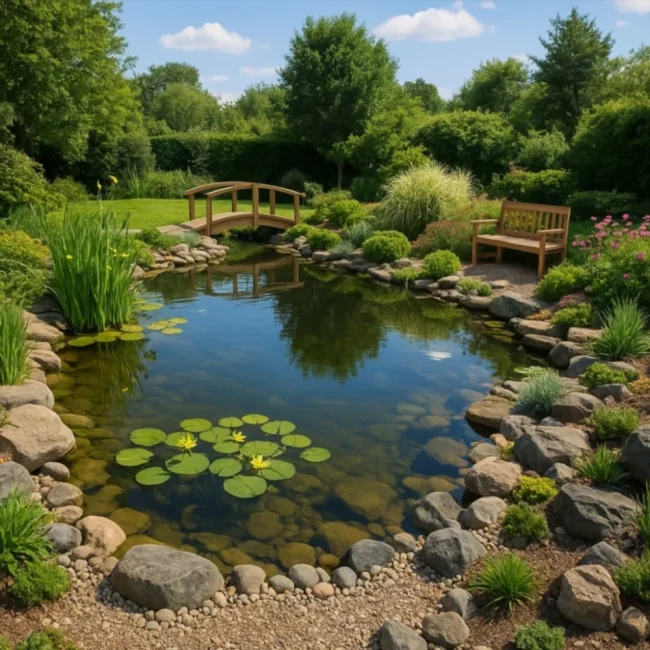
Building an artificial pond in your garden isn't just a way to enhance your landscape design, it's also a great way to create a cozy atmosphere. Water in the garden is visually appealing, creates harmony, and offers relaxation, and can also become a home for fish and aquatic plants. In this article, we'll discuss how to properly build an artificial pond yourself, what materials and tools you'll need, what mistakes to avoid, and how to maintain it so it remains a joy to behold for years to come.
Why do you need a pond at your dacha?
Before you begin, it's important to understand why you need a pond. This will determine its size, depth, shape, and equipment. Possible purposes include:
- Aesthetics and decor.For beauty and atmosphere. Often complemented with stones, bridges, and fountains.
- Environment for fish.In this case, depth, filtration system, and oxygen saturation are important.
- Aquatic plants.Moderate depth and protection from siltation are required.
- Bathing.The pond is turning into almost a font - careful filtration and safety are needed.
- Irrigation reservoir.If properly designed, a pond can also serve a utilitarian function.
Choosing a location for a pond
The success of a pond depends largely on its location. Proper placement solves several problems at once: minimizing siltation, reducing debris accumulation, and preventing overheating and algal blooms.
Basic rules:
- Sunlight - 4-6 hours a day.Full shade will suppress aquatic plants, while constant sun will cause algal blooms.
- Distance from trees.Roots can damage the waterproofing, and fallen leaves pollute the water.
- Level place.It is possible to make a pond on a slope, but additional reinforcement of the banks will be required.
- Away from drainage pipes and sewers.To avoid contamination and erosion of the structure.
Types of artificial ponds
There are several main types of country ponds based on the method of creation and operation:
- Plastic molds.
- Ready-made containers made of polypropylene or fiberglass.
- Easy to install, but limited in shape and size.
- Film ponds.
- The base is lined with a special PVC or butyl rubber film.
- Flexibility in design, you can create any shape and depth.
- Concrete structures.
- Strong and durable, but require serious training and skills.
- Often used for large bodies of water.
- Combined options.
- For example, a concrete bowl with film insulation on top.
Calculation of dimensions and depth
The size of the pond depends on the available space and the purpose:
- For a decorative mini-pond, 1.5–2 m² is enough.
- An average pond – 4–6 m² – is suitable for plants and a couple of fish.
- A swimming pond or one with livestock requires an area of at least 10 m².
By depth:
- Decorative:40–60 cm.
- For fish:at least 100–120 cm, so that it does not freeze in winter.
- With water lilies:about 70 cm.
- Bathing:150 cm and deeper.
Stages of pond construction
1. Marking and excavation of the pit
- Outline the shape of the future pond on the ground.
- Remove the top layer of sod.
- Dig a pit, forming several levels (terraces) for plants.
- Try to make gentle banks (angle no more than 45°).
2. Compacting the bottom and removing stones
- The bottom is compacted.
- Sharp objects that could damage the waterproofing are removed.
- A layer of sand (5–10 cm) is poured in; geotextile can be added.
3. Waterproofing
- Film:The tiles are laid with an overlap, without tension. The edges are secured with stones or covered with earth.
- Concrete:poured with reinforcement, requires a waterproofing layer.
- Plastic form:It is installed flush with the ground level, and the space around the edges is filled with sand and water.
4. Decorating the banks
- Stones, pebbles, driftwood, turf.
- Using coastal plants for a natural transition between water and land.
5. Equipment installation
- Filtration.Necessary if there are fish or plants.
- Fountain/aerator.Provides water circulation and oxygenation.
- Lighting.LED lights underwater and around the perimeter.
- Pump.To supply water to a fountain or waterfall.
6. Pond stocking
- Wait 1-2 weeks after filling with water - it should “mature”.
- Add plants, then fish.
- Select plants taking into account the depth: irises, cattails, water lilies, pondweed.
What materials will be needed?
Basic list:
- Film (PVC or butyl rubber) or plastic bowl.
- Geotextile.
- Sand and gravel.
- Shovel, level, wheelbarrow.
- Stones for decoration.
- Pump and filtration equipment.
- Plants, fish, fertilizers (if necessary).
Pond maintenance
To prevent the pond from turning into stagnant mud, it needs regular maintenance:
- Garbage removal.A net is the best helper.
- Water level control.In hot weather, water evaporates and needs to be topped up.
- Cleaning the filter and pump.According to the instructions, usually once every 2–3 weeks.
- Prevention of flowering.Avoid excess organic matter. You can use special preparations.
- Wintering.If the pond is shallow, drain it. If it's deep, install an aerator and leave a hole in the ice.
Typical mistakes
- A pond on a slope without reinforcement.
- Film without liner.
- There is no water circulation.
- Overabundance of fish.
- Planting trees nearby.
- Insufficient depth during wintering of fish.
Alternative ideas and additions
- Fountain or waterfall.Improves oxygen levels and creates an atmosphere.
- Bridge or decorative path.
- Lighting - lamps, garlands.
- Combined cascades - two levels of ponds.
- There is a bridge and benches nearby.
Conclusion
An artificial pond at your dacha is a project that requires thought, but the investment pays off handsomely in aesthetics and comfort. It can be built in 2-5 days with proper preparation and high-quality materials. The key is to consider your goals, follow the proper procedures, and ensure regular maintenance. Such a pond will enhance any property, add a natural touch, and delight both owners and guests for many years to come.