A carousel is one of the most captivating elements of outdoor play areas. Its movement captivates, evokes laughter and excitement, and teaches children to interact with each other and feel the rhythm of rotation. Even the simplest design can provide a wealth of excitement and become a focal point in a private home or garden. It's no coincidence that children's carousels have remained a popular attraction for decades, enjoyed by both toddlers and schoolchildren alike.
Building your own carousel allows you to take into account the children's ages, the site's features, and your own safety requirements. Furthermore, it allows you to create a durable and long-lasting structure tailored to specific operating conditions.
- Types of carousels: which one to choose for your own home-made one
- Classic spinning carousel
- Carousel-balancer
- Low rotating platform without a central column
- Materials: What to Choose for a Strong and Durable Construction
- Metal
- Tree
- Combined options
- Step-by-step construction of a carousel
- Stage 1. Preparing the base
- Step 2. Installing the rotating mechanism
- Stage 3. Platform assembly
- Step 4. Installing seats and handrails
- Safety: A Key Priority
- Surface treatment
- Fastenings
- Safety zone
- How to harmoniously integrate a carousel into playgrounds
- Additional operating tips
- Conclusion
Types of carousels: which one to choose for your own home-made one
Before starting work, it's important to determine the type of structure. This will determine the choice of materials, the complexity of the assembly, and the amount of preparatory work.
Classic spinning carousel
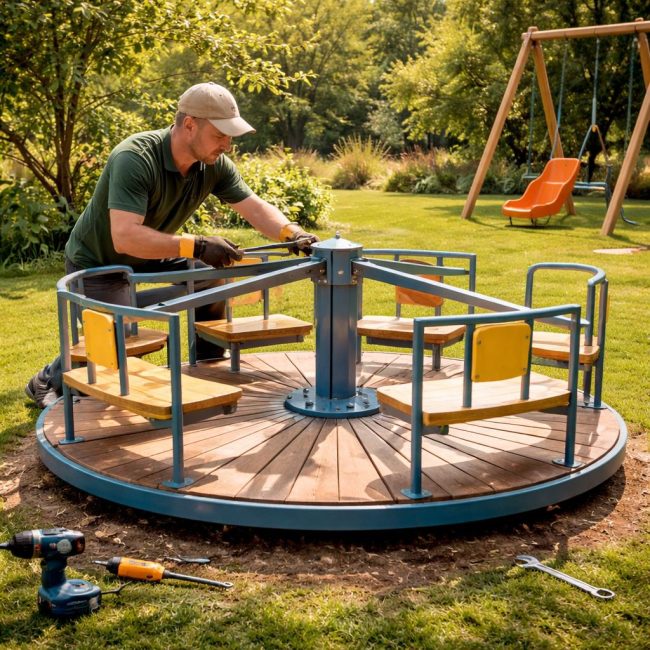
This is the most common design: a round platform with a central pole and handrails. Children stand or sit at the edges, holding onto the handles and spinning the platform with their feet.
Peculiarities:
- Simple geometry;
- Possibility of installing 2-6 seats;
- Suitable for children aged 4-5 years;
- Requires a reliable rotating mechanism.
This type is ideal for a private yard where there is enough space for a safe area around the structure.
Carousel-balancer
A combination model that combines swing and rotation elements. The base rotates around an axis, and the seats can move up and down.
Peculiarities:
- More complex mechanics;
- Suitable for older children;
- Requires precise calculation of the center of gravity.
This model is interesting, but requires more experience in working with metal.
Low rotating platform without a central column
A minimalist option is a round platform with a ball bearing in the center, without a vertical post. Children sit or lie on the surface, holding onto built-in handles.
Peculiarities:
- Compactness;
- Minimum of protruding elements;
- Increased requirements for bearing quality.
Materials: What to Choose for a Strong and Durable Construction
The correct selection of materials determines the service life of the carousel and its safety.
Metal
The most reliable option for the base and central axis.
Advantages:
- High strength;
- Load resistance;
- Durability.
A steel pipe with a diameter of 60–100 mm and a wall thickness of at least 3 mm is suitable for the support post. For the platform frame, use a 40×40 mm or 50×50 mm profile pipe.
Tree
Often used for flooring and seating.
Advantages:
- Eco-friendliness;
- Ease of processing;
- Aesthetic appearance.
It's best to use dry, planed boards at least 30 mm thick. The wood must be treated with a preservative and coated with weather-resistant paint or varnish.
Combined options
The optimal solution is a metal base and a wooden top. This design combines strength and comfort. The metal provides rigidity and stability, while the wood creates a warm, pleasant surface.
Step-by-step construction of a carousel
Stage 1. Preparing the base
- Select a level area.
- Mark the center of the future structure.
- Dig a hole 80–100 cm deep.
- Install the metal pipe strictly vertically.
- Fill with concrete and let the base stand for at least 3-5 days.
It's important to carefully check the verticality of the rack with a level. Any deviation will result in rotational distortion.
Step 2. Installing the rotating mechanism
The base is a bearing assembly. Two options are possible:
- Ready-made industrial rotary unit;
- Self-assembly from two radial thrust bearings.
The bearing must be rated for a minimum load of 200–300 kg. It is placed between the central pillar and the platform frame. The unit is protected by a metal shroud to prevent water and dirt from entering.
Stage 3. Platform assembly
- Weld a round metal frame with a diameter of 1.2–1.8 m.
- Reinforce it with radial crossbars.
- Secure the frame to the rotating assembly.
- Check for ease of rotation.
After the metal frame is installed, wooden planks are laid. They are secured with countersunk bolts to eliminate protruding elements.
Step 4. Installing seats and handrails
Seats are placed around the perimeter of the platform. They can be made from 30–40 mm thick boards or moisture-resistant plywood.
Handrails are made from metal tubing with a diameter of 25–32 mm. They should be:
- Rounded at the edges;
- Securely welded or screwed;
- No sharp corners or burrs.
The optimal height of handrails is 60–80 cm from the platform level.
Safety: A Key Priority
A homemade carousel requires especially careful attention to child protection.
Surface treatment
- Wooden elements are carefully sanded.
- The metal is cleaned of scale and covered with an anti-corrosion primer.
- Non-toxic paints are used.
Fastenings
- All bolts are secured with nylon insert nuts.
- Threaded connections are checked regularly.
- Welded seams are inspected for cracks.
Safety zone
A clear space of at least 1.5–2 meters must be left around the structure. It is advisable to use a soft surface: sand, rubber crumb, or compacted grass.
The platform load must be adequate for the intended use. Avoid allowing multiple children to use the carousel at the same time.
How to harmoniously integrate a carousel into playgrounds
The carousel should be part of the overall play area. It should be positioned so that it doesn't interfere with swings, slides, or other sports equipment. It's best to choose a central or slightly remote area of the playground where adults have a good view.
If the playground is designed in a specific style, the structure can be painted in matching colors or decorated with decorative elements. However, it's important not to overload it with decorations that could interfere with safe spinning.
Modern playgrounds often feature several active elements, and a carousel is a perfect complement to the complex, adding dynamism and variety to the games. It promotes the development of coordination, vestibular skills, and interaction skills among children.
Additional operating tips
- Lubricate the bearing periodically.
- Inspect the concrete base for cracks.
- Tighten fasteners at least once per season.
- It is advisable to cover the mechanism with a protective cap for the winter.
- Regular maintenance significantly extends the life of the structure.
Conclusion
A homemade carousel is more than just a play element; it's a well-thought-out design tailored to the specific needs of the site and the children's ages. It allows you to control the quality of materials, safety, and appearance. A homemade version can last for many years with proper installation and maintenance.
These structures provide children with movement, joy, and lively interaction. And with the right approach, they are just as good as factory-made solutions, while maintaining their individuality and durability.