Homeowners are well aware of how significant heating costs can be, especially during the colder months. As energy prices rise, more and more people are considering how to optimize these costs without sacrificing comfort. One solution is heat pumps—a modern alternative to traditional heating sources that not only saves money but also helps protect the environment. In this article, we'll explore other technologies and approaches that can significantly reduce heating costs and how to implement them in your home.
- Why Heating Eats Up the Budget: Understanding Key Factors
- Heat pumps: a modern alternative to traditional heating
- Types of heat pumps:
- Advantages of heat pumps:
- Insulating your home is the key to smart energy consumption.
- Automation and smart heating control
- What can be implemented:
- Alternative heat sources: are they worth installing?
- Solar collectors
- Fireplace with a water circuit
- Infrared panels
- How much can you realistically save?
- Conclusion
Why Heating Eats Up the Budget: Understanding Key Factors
Before moving on to saving methods, it's important to understand where high heating bills come from:
- Low energy efficiency of the building — drafts, thin walls, uninsulated roof or foundation lead to constant heat loss.
- Old or inefficient heating systems — traditional boilers with low efficiency consume more fuel to achieve the required temperature.
- Dependence on expensive energy resources — gas, fuel oil or electricity, if the heating system is not properly organized, are extremely expensive.
- Incorrect settings or lack of automation — systems that operate without taking into account the actual temperature in the premises and outside the home consume energy inefficiently.
Understanding these reasons is the first step toward reducing costs: switching to modern solutions that operate efficiently and adapt to operating conditions.
Heat pumps: a modern alternative to traditional heating
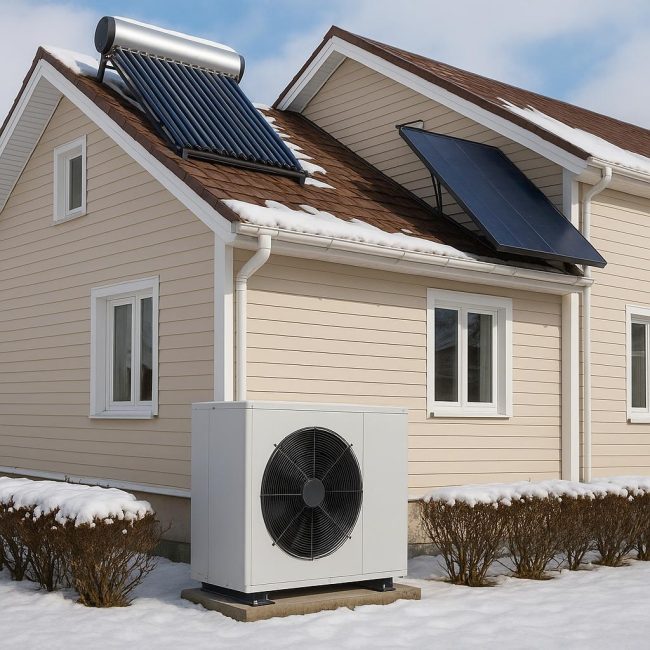
Heat pumps are considered one of the most promising heating technologies. These devices transfer heat from the external environment (air, ground, or water) into the home while consuming minimal energy. Their efficiency can reach 300–500%, meaning the user receives up to 5 kW of heat for every 1 kW of energy consumed.
Types of heat pumps:
- Air-to-air — extract heat from the outside air and transfer it inside the room through a ventilation system or fan coils.
- Air-water — transfer heat to the water heating system (radiators or heated floors).
- Soil-water — obtain heat from the ground using horizontal or vertical geothermal probes.
- Water–water — use the heat of underground waters or lakes, which is especially important in regions with a mild climate.
Advantages of heat pumps:
- Economy — significantly reduce energy consumption compared to direct electric heating.
- Durability — service life of 15–25 years when properly installed.
- Automation — operate autonomously and easily integrate with a smart home.
- Eco-friendliness — do not emit harmful substances into the atmosphere, suitable for energy-efficient and “green” homes.
Insulating your home is the key to smart energy consumption.
Even the most modern heat pump will be useless if the house doesn't retain heat. Here are some insulation options worth considering:
- Facades and walls
The use of thermal insulation materials (mineral wool, extruded polystyrene foam, polyurethane foam) reduces heat loss by 30–40%. - Windows and doors
Double or triple glazing, energy-saving films, and sealed joints all directly impact the microclimate and bills. - Attics and roofs
Up to 25% of heat can escape through the roof. Insulation with mineral wool or foam eliminates this. - Floors and foundations
This is especially important for homes with basements. Insulation with expanded polystyrene or foil-lined materials prevents freezing from below.
Automation and smart heating control
Additionally, it helps to reduce costs automation of heating processesModern technologies allow you to control the temperature in your home depending on the time of day, the presence of people, and the weather outside.
What can be implemented:
- Programmable thermostats — allow you to set a temperature schedule by day and hour.
- Temperature and humidity sensors — provide a stable microclimate.
- Mobile applications — allow you to remotely control the heating system via a smartphone.
These solutions are especially effective if residents are frequently absent—for example, during the day on weekdays. Reducing the temperature by just 2–3 degrees for a few hours already yields significant savings.
Alternative heat sources: are they worth installing?
In addition to heat pumps, there are a number of other solutions that can either complement the heating system or partially replace it.
Solar collectors
- They heat water using solar radiation.
- Effective in spring, summer and sunny winter days.
- It is better to use it as an additional source (for example, for hot water supply).
Fireplace with a water circuit
- Suitable as a backup system.
- It gives a feeling of comfort and is also capable of heating radiators or heated floors.
Infrared panels
- They have a localized point effect.
- Effective in rooms with high ceilings or poor insulation.
How much can you realistically save?
Let's look at an example:
- House with an area of 150 m² in central Russia.
- An old gas boiler and poor insulation mean annual heating costs of 100,000–120,000 rubles.
- After installing an air-to-water heat pump and insulating the façade and roof, costs are reduced to 35–50 thousand rubles per year.
- Additionally, smart thermostats have been introduced, reducing overall consumption by another 5–10%.
Thus, savings can reach up to 60–70% annual expenses. The payback period for all investments is 5–7 years, after which the system begins to generate net financial benefits.
Conclusion
Reducing heating costs is not a temporary measure, but a comprehensive approach that requires investment but pays off over time. Heat pumps They become a central element of an energy-efficient home, especially when combined with high-quality insulation, automation, and additional energy sources. By approaching this issue systematically, you can not only achieve a comfortable temperature in your home year-round but also significantly reduce your monthly expenses. And, just as importantly, you can contribute to environmental stewardship.