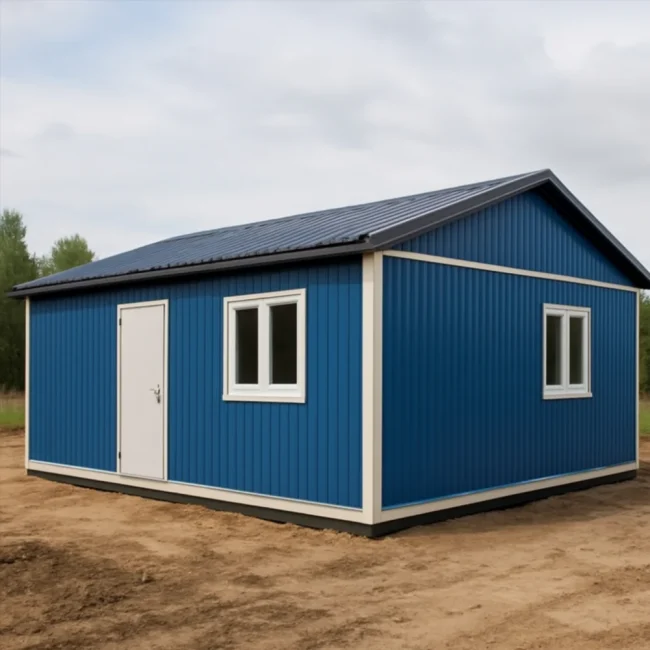
Modular buildings are gaining popularity among summer cottage and landowners, as well as builders. These affordable, mobile, and versatile structures are often used as temporary living or working spaces. However, their limited space may be unsuitable for those seeking greater comfort. This raises a logical question:Is it possible to combine two portable cabins into one?and get a more spacious and functional space? The answer is yes, you can, and in this article we'll take a detailed look atHow to do it yourself.
- The benefits of combining two cabins
- Preparing for the unification of cabins
- Assessment of the condition of the cabins
- Layout of a combined space
- Selecting an installation location
- Foundation for a combined utility building
- Stages of combining cabins
- Step 1: Installing the cabins on the foundation
- Step 2: Dismantling common walls
- Step 3: Connecting the frames
- Roofing works
- Floor and ceiling
- Floor:
- Ceiling:
- Insulation and vapor barrier
- Exterior finishing
- Interior decoration
- Communications
- Features and pitfalls
- Conclusion
The benefits of combining two cabins
Before we get into the technical details, let's look at the advantages of this solution:
- Increasing living space— instead of a cramped space, a full-fledged room appears.
- Saving— cheaper than building a full-fledged house.
- Mobility— the module is easy to disassemble and move.
- Variability of layout— you can organize two rooms, a combined kitchen-living room, a bathroom and even a vestibule.
Combining two portable cabins is a kind of modular construction in miniature.
Preparing for the unification of cabins
Assessment of the condition of the cabins
Before starting work, you need to make sure that both structures:
- are in satisfactory condition;
- have a strong frame and are not damaged by fungus, rust or insects;
- stand on a level and stable base.
If one of the cabins has already been used, it is advisable to inspect its floor, walls and roof for any sagging, mold or deformations.
Layout of a combined space
Layout options:
- Linear connection— the cabins are connected along the long side, forming an elongated room;
- Gusset- in the shape of the letter "G";
- Parallel placement with a common wall— an ideal option for creating two rooms with a corridor.
Determine the purpose of the combined space: will it be a living space, a workshop, a warehouse, or an office.
Selecting an installation location
The site for the combined structure must be:
- even;
- with minimal risk of flooding;
- away from large trees (to avoid damage from crowns).
Foundation for a combined utility building
Although cabins are often installed directly on the blocks, for a combined structure it is better to providesingle foundationto avoid distortions and cracks.
Suitable options:
- Block foundation- inexpensive and strong enough for lightweight structures.
- Pile screw foundation- ideal for uneven areas.
- Monolithic slab- expensive, but the most reliable option.
The foundation must be strictly horizontal and able to support the weight of both cabins plus the load from the interior decoration and furniture.
Stages of combining cabins
Step 1: Installing the cabins on the foundation
- Place the cabins on the foundation in the selected configuration.
- Check the horizontal level with a level.
- The gaps between the cabins should not exceed 5 mm.
Step 2: Dismantling common walls
- In utility rooms, it is necessary to remove adjacent walls or part of them (depending on the layout).
- Leave itpart of the supporting pillarsto maintain the rigidity of the frame.
- It is important to maintain diagonal stability - for this purpose, corner or central posts are left.
⚠️Important:Before dismantling, make sure you do not weaken the structure - install temporary supports if necessary.
Step 3: Connecting the frames
- Connect the frames with metal corners, plates and screws.
- Strengthen the connecting posts with additional spacers.
- It is advisable to additionally treat the connecting areas with an anti-corrosion impregnation.
Roofing works
If the roofs of the trailers are flat and of the same level, they are sufficientsewhermetically through a connecting profile (for example, an additional metal element).
At different levels you will need:
- create a common roof structure;
- eliminate differences in height (by adding lathing, boards and sheet material);
- ensure sealing at the joint (bitumen tape, sealant, roofing mastic).
A good solution might be to createcommon gable roof- this will not only improve the appearance, but also increase heat and moisture protection.
Floor and ceiling
Floor:
- After dismantling the internal wall, it is necessary to eliminate the gap between the cabins.
- Build a subfloor over both floors using plywood, OSB, or boards.
- Be sure to check the horizontal.
- The gaps between the cabins are filled with polyurethane foam and covered with a metal profile or decorative threshold.
Ceiling:
- The partition is being dismantled.
- The ceilings are leveled and, if necessary, additionally covered with plasterboard, MDF or clapboard.
Insulation and vapor barrier
If you plan to use the combined structure as a residential one, it is necessary to ensure good insulation:
- Walls: basalt wool, penoplex, EPS.
- Ceiling: it is necessary to insulate, especially in the northern regions.
- Floor: thermal insulation is laid between the joists.
All insulated surfaces are coveredvapor barrier filmfrom the inside.
Exterior finishing
The connection point between the cabins must be protected from moisture and temperature fluctuations. To achieve this, use:
- metal flashing;
- silicone sealant or mounting foam;
- finishing panels (siding, corrugated sheets, facade cassettes).
The sheathing must be continuous, without gaps. This will give the structure a uniform aesthetic appearance and protect it from damage.
Interior decoration
At the completion stage, you can:
- cover the walls with plasterboard, clapboard, laminated boards;
- wallpaper or paint;
- install electrical wiring, sockets and lighting;
- organize heating - electric convectors, a stove or underfloor heating.
You can create a fully functional house with an entrance hall, kitchen, bedroom, and bathroom—it all depends on your goals and imagination.
Communications
Electricity:
- The common cable is pulled out from the distribution board.
- All connections are in distribution boxes only.
Water supply and sewerage:
- If desired, you can lay HDPE pipes, install a tank with a pump and a septic tank.
- It is advisable to place the drain point at an angle and insulate the pipe for the winter.
Features and pitfalls
- If the joining technology is not followed, a cold bridge may form.
- Uneven foundations will cause the structure to creak and warp.
- If the frame of the utility building is weak, additional reinforcement with metal profiles will be required.
- Do not allow one portable building to be installed higher than another, as this will put stress on the roof connection.
Conclusion
Combining two portable cabins into one space -a real and affordable way to get comfortable modular housing or premisesFor temporary or permanent use. With the right approach and proper technology, you can create a comfortable space that will last for many years. The key is to carefully consider the design, avoid skimping on materials, and adhere to building codes.
If everything is done well, you will get not just two cabins under one roof, buta single, integral room, which can become either a summer house or a full-fledged part of a country plot.