- Concealed installation in frame construction
- Water supply and sewerage – protection from leaks and freezing
- Rules for laying and masking pipes
- Layout and insulation scheme
- Electrical Wiring – Safety, Accessibility, and Electrical Installation Codes
- Comparison of methods for protecting electrical wiring
- Ventilation – hidden air ducts for a healthy microclimate
- Questions and answers about concealed installation of communications
- Conclusion
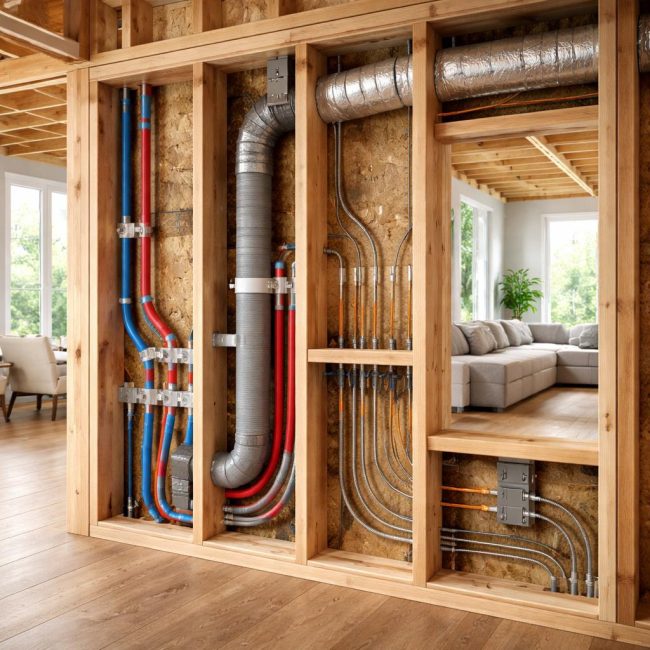
Concealed installation in frame construction
Frame construction offers unique freedom for engineering solutions. Unlike stone houses, where chasing walls is a labor-intensive process, in a frame house, all the components are installed during the construction of the walls and floors. This allows for perfectly smooth walls without protruding boxes or pipes, which is especially valuable in modern interiors. However, this "freedom" requires the utmost discipline. Every utility line must be designed with physical processes in mind: thermal expansion of pipes, condensation on cold surfaces, heating of electrical wiring, and air movement. Errors hidden behind the cladding are extremely difficult and expensive to correct. Therefore, the key principle is: measure (design) twice, sew once. This guide will help you approach this issue systematically.
We'll examine the installation and concealment features of each system step by step, but let's start with a general rule: all concealed utilities must be either detachable (with detachable connections in inspection hatches) or extremely reliable, with a lifetime warranty, and must comply with current SNiPs and SP codes.
Of course, the price of a turnkey frame house with hidden utilities is somewhat higher, but the aesthetics of the house outweigh the cost. Such a house is pleasant to live in, and its resale value increases by up to 30%.
Water supply and sewerage – protection from leaks and freezing
Concealed installation of plumbing systems is the most critical stage. Here, issues of watertightness and protection from the cold come to the fore.
Rules for laying and masking pipes
- Selection of pipe material: For concealed installation, polypropylene (PPR) for hot/cold water supply with reinforcement (aluminum, fiberglass) to prevent linear expansion, or cross-linked polyethylene (PEX) in press fittings, are recommended. Metal-plastic compression fittings are not the best choice for flush-mounting, as they require periodic tightening.
- Tracing: Pipes are laid strictly vertically and horizontally along the shortest route from the manifold or riser to the consumer. All bends are at 90-degree angles. This is necessary to accurately determine the location of utilities in the future.
- Freeze protection: Laying pipes in the exterior walls and floors of the first floor is not recommended. If no other solution is available, continuous cylindrical thermal insulation made of foamed polyethylene or rubber at least 20-30 mm thick is required. Pay particular attention to water inlet points.
- Soundproofing: To reduce noise from water hammer and water flow, pipes are secured with special clips with rubber inserts, and sections in the walls can be wrapped with soft sound-absorbing material.
- Inspection hatches: Be sure to leave access to all detachable connections (fittings, valves, filters, pressure reducers), meters and collectors through decorative hatches.
"The main problem with concealed plumbing is condensation on cold water pipes and thermal expansion of hot water pipes. In a framed wall, if the cold water pipe is simply wrapped in insulation, it will "sweat" inside, leading to dampness and mold. The solution is to use pipes with their own thermal insulation and ensure a ventilation gap between the pipe and the vapor barrier membrane. For hot water, always install expansion joints or reinforced pipes. And never seal an unpressurized system! The pressure during testing should be 1.5 times the operating pressure and maintained for at least 30 minutes."
Anton Tarasov, Technical Director of the construction company Nadezhnost, Nizhny Novgorod
Layout and insulation scheme
| Element of the system | Preferred location for laying in the "pie" | Requirements for thermal and waterproofing | Masking method (finishing) |
|---|---|---|---|
| Cold water supply pipes | Interior partitions, first floor floor (between joists). Avoid exterior walls. | Thermal insulation to prevent condensation. Waterproofing is not required. | Sheathing with plasterboard, clapboard, pouring into the floor screed. |
| Hot water and heating pipes | Interior walls, partitions, floors. Permissible in exterior walls with enhanced insulation. | Mandatory thermal insulation to reduce heat loss and prevent heating of the structure. | Sheathing with plasterboard, clapboard, false boxes in bathrooms. |
| Sewer risers and horizontal branches (50-110 mm) | Vertical shafts in partitions, first floor subfloor, interfloor ceilings. | Soundproofing (mineral wool, polyurethane foam shells). Insulation in unheated areas (basement). | Prefabricated plasterboard boxes with inspection hatches on each floor and at each turn. |
| Sewer traps and pipes | Under sinks, bathtubs, in the space behind the toilet. | Not required. | Furniture (vanity units), installations, false panels. |
Fact from the company "Reliability": With concealed installation in turnkey frame houses, over 80% of warranty cases related to leaks are not due to the quality of the pipes, but to improper installation of fittings or inadequate thermal insulation at the entrance to the house. Investment in high-quality materials and the work of trusted plumbers pays off a hundredfold.
Electrical Wiring – Safety, Accessibility, and Electrical Installation Codes
Concealed electrical wiring in a frame house is a hotly debated topic. The main thing is to eliminate any fire risk.
- Selecting cable and protection: Use only cable with non-flammable insulation (e.g., VVGng-LS or NYM). The wire cross-section should be calculated based on the planned load, with a margin. Installation of RCDs and circuit breakers on each line in the electrical panel is mandatory.
- Gasket in metal hoses or corrugation: According to current regulations (SP 31-105-2002), electrical wiring in frame wall cavities must be protected from possible mechanical damage. Best practice is to install cables in metal pipes or corrugated metal sleeves, which also provide additional protection against rodents.
- Tracing: Wiring is laid strictly vertically above outlets/switches and horizontally at the same height (e.g., 30 cm from the ceiling). This "safe zone rule" allows future drilling of walls without the risk of hitting a wire.
- Socket boxes and junction boxes: Use special boxes for drywall. All wiring connections must be accessible for inspection – only in the boxes, never in the wall using twisted connections. Boxes should not be sealed tightly; they should be accessible through hatches or decorative covers.
- Overheating protection: Avoid running cables close to thermal insulation, especially near chimneys and hot pipes. Leave an air gap.
Comparison of methods for protecting electrical wiring
| Method of protection | Material | Advantages | Flaws | Application in frame construction |
|---|---|---|---|---|
| metal pipe | Galvanized steel, copper | Maximum protection against mechanical damage and rodents, shielding, non-flammability. | High cost, difficult installation (cutting and bending required). | Recommended for wooden floors, floor installations, and installation during frame assembly. |
| Metal sleeve (corrugated) | Galvanized steel | Flexibility, relatively easy installation, good protection. | Less resistant to point impacts than pipe. | The main method for laying in walls and ceilings after the frame has been erected. |
| Plastic corrugated pipe | PVC, HDPE | Low price, non-conductive, bends easily. | Does not protect against rodents and is not a fire-resistant barrier. | Can only be used inside non-combustible structures (e.g., a brick internal partition) or in concrete screeds. Not recommended for use in timber-frame walls. |
| Cable channel (box) | Plastic | Full access to wires, aesthetically pleasing for open wiring. | Open installation, not hidden. | For surface mounting in utility rooms, garages, basements. |
Ventilation – hidden air ducts for a healthy microclimate
Without proper ventilation, a frame house, as airtight as a thermos, will become a breeding ground for damp. The challenge is to conceal the system without compromising its effectiveness.
- System selection: For constant air exchange, a supply and exhaust ventilation system with heat recovery is optimal. It helps conserve heat. A simpler option is natural exhaust (in bathrooms and kitchens) and supply valves in walls or windows.
- Air duct installation: Main trunk ducts (100-150 mm in diameter) are installed in the interfloor ceilings, attic spaces, or specially constructed false ducts. Flexible corrugated ducts are easier to install, but they create greater aerodynamic drag than rigid smooth ducts (plastic or galvanized).
- Soundproofing: Fans and air movement create noise. To reduce noise, use sound-absorbing ducts or line them with mineral wool. Flexible connectors between the fan and the duct are essential.
- Thermal insulation: Air ducts passing through unheated spaces (attic, basement) must be insulated to prevent condensation from forming inside.
- Grilles and hatches: Decorative grilles should match the interior. Provide access to dampers, filters, and fans through removable panels or inspection hatches.
Questions and answers about concealed installation of communications
1. Is it possible to lay water pipes in the floor of a frame house?
Yes, this is one of the best methods. The pipes are laid in the space between the floor joists before the subfloor is laid. Thermal insulation underneath (from the subfloor or basement side) and pipe fixing to allow for thermal expansion are mandatory. All connections should be above the finished floor level in accessible locations.
2. What if I need to add an outlet after the walls have been paneled?
There are several options: 1) Run the cable openly in a cable duct. 2) Make a vertical groove in the existing drywall, run the cable in a metal sleeve, and seal it. 3) Run the line from the nearest junction box or outlet through the basement or attic space, lowering the cable into the wall. The best option is to provide spare empty corrugated conduits in the walls during construction.
3. How to hide a thick 110 mm sewer pipe in a partition?
A thicker frame partition (for example, 150-200 mm instead of the standard 100 mm) is assembled. The pipe is placed inside, wrapped in soundproofing (cylinders of foamed polyethylene or mineral wool), and then covered with drywall. An inspection hatch is installed on each floor and at each turn.
4. Do I need to enclose the electrical wiring in steel conduits throughout the entire house? It's very expensive.
According to current interpretations of the regulations, for frame houses, it is sufficient to install cables in a non-combustible sheath (VVGng-LS) in metal corrugated conduits. This provides protection against mechanical damage. Steel pipes offer the highest level of protection and are recommended for use in fire-hazardous areas (boiler rooms, behind suspended stoves) or when passing through wooden floors.
5. How to deal with condensation on hidden cold water pipes in an external wall?
The rule is simple: the cold water supply pipe in the exterior wall should be completely surrounded by a layer of insulation on the room side, but a ventilation gap should be left between the vapor barrier and the insulation. Alternatively, use pre-insulated pipes, which already have a moisture-proof casing. The best solution is to avoid installing such pipes in exterior walls altogether.
6. Is it possible to hide ventilation ducts in the ceiling?
Yes, flat (flattened) plastic ducts with a height of 50-60 mm are specially designed for installation in the inter-ceiling space of suspended or stretch ceilings. Please note that their flow capacity is lower than that of round ducts of the same cross-section and must be carefully sealed.
7. Is it necessary to insulate the sewer riser if it is in a heated house?
In terms of heat loss, no. However, insulation (preferably soundproofing) is necessary to significantly reduce the noise from the water drain. This is especially important for bedrooms and living rooms adjacent to the bathroom.
8. How to find hidden communications if there is no diagram, but you need to hang a shelf?
Use special detectors (scanners) that detect metal and live wiring. Remember the "safe zone" rule: do not drill or drive nails vertically above or below outlets and switches, or horizontally in line with them. Leave at least 10-15 cm (4-6 inches) clear.
9. What is a “cold attic” and how to install utilities through it?
A cold attic is an unheated space. All pipes (water supply, ventilation) passing through it must be insulated to prevent freezing. Electrical wiring in the attic must be protected from UV radiation (cables must be in black corrugated tubing) and installed in trays.
10. Is it possible to embed water-heated floors into the screed of a frame house?
Yes, this is standard practice. The underfloor heating system (pipes, manifold) is installed on the insulation over the subfloor, poured with a cement-sand screed (at least 5 cm above the pipes), and then the final flooring is laid. It is important to calculate the floor load and use plasticizers for the screed.
Conclusion
Concealed installation of utility systems in a frame house is a high art, based on a thorough understanding of technology, physics, and safety standards. It's not just a matter of aesthetics, but a comprehensive engineering solution that determines the durability, comfort, and reliability of your home for decades to come. The key to success is integration: all systems should be designed simultaneously, during the architectural planning stage, coordinating routes and outlets. Don't skimp on materials or the skills of installers. Remember that every hidden pipe or wire must remain accessible for maintenance through inspection hatches. Properly planned and executed concealed utility systems will transform your frame house into a model of modern, safe, and impeccably beautiful living, where technology serves people while remaining invisible.