In modern hydraulic engineering, rolled concrete dams occupy a special place due to their efficiency and reliability. This technology allows for the construction of massive structures with minimal material and time expenditures, which is especially important for Russian projects on large rivers. Rolled concrete differs from traditional concrete in that it contains less cement and is laid in layers followed by compaction, ensuring high strength and load-bearing capacity. This type of work requires high-quality aggregate, and environmentally friendly crushed stone is available, suitable for sustainable construction.
Rolled concrete technology, known as RCC, has been used in Russia since the 1980s, but has seen significant advancements in recent years thanks to improved mixtures and equipment. It is ideal for seismic zones or harsh climates where conventional concrete can crack due to temperature fluctuations. The introduction of this method reduces the amount of work required by 30–40% compared to gravity dams made with concrete.
The main advantages include rapid installation—up to 1,000 cubic meters per day—and low cost, making it attractive to federal energy development programs. However, success depends on strict adherence to the required steps, from foundation preparation to final compaction.
- Preparation of materials and foundations for rolled concrete dams
- Preparation of rolled concrete mixture and its transportation
- Quality control of the mixture at all stages
- Laying layers and compacting rolled concrete in dams
- Compaction stages and safety measures
- Quality control and completion of dam construction
- Frequently Asked Questions
- What makes compacted concrete different from traditional concrete in dam construction?
- What are the advantages of rolled concrete for Russian hydraulic engineering facilities?
- How to ensure high-quality compaction of rolled concrete layers?
- Can rolled concrete be used in seismic areas?
- What are the typical costs to build a RCC dam?
- How does compacted concrete impact the environment in dam construction?
- Final thoughts
- About the author
- Dmitry Sokolov, Chief Hydraulic Engineer
Preparation of materials and foundations for rolled concrete dams
Preparing materials and the foundation is a fundamental step, determining the overall reliability of the dam. In Russian construction, regulated by GOST 7473-2010 and SP 101.13330.2012, special attention is paid to the quality of the mixture's components. Rolled concrete consists of cement, sand, crushed stone, and water in a strict ratio: cement—70–150 kg/m³, crushed stone with a particle size of 5–40 mm—up to 60% of the volume, sand—25–30%, and water—minimum to maintain a consistency similar to dry soil.
Crushed stone must be durable, with a frost resistance rating of F200 or higher, to withstand freeze-thaw cycles in Siberian and Ural conditions. Eco-friendly options made from recycled materials help meet federal waste reduction standards, as stipulated in Federal Law No. 89-FZ. Such materials are not only environmentally friendly but also provide better adhesion in the mixture.
"The quality of crushed stone determines up to 50% of the strength of compacted concrete in hydraulic structures."
The foundation is prepared by clearing the riverbed and creating a pit up to 5-10 meters deep. Hydrostroy uses heavy equipment to remove soft soil and lay a sand and gravel cushion 1-2 meters thick. This prevents water seepage and ensures uniform load distribution. Before laying the first layer, the soil is compacted with vibratory plates to 95% Proctor density.
The mixture is prepared in cyclic or continuous concrete mixers, monitoring its parameters through laboratory tests. In 2025, IoT sensors for online moisture and granulometry monitoring will be implemented at projects such as the Angara dam renovation, reducing defects by 15%. It is important to store the components in dry conditions to prevent clumping.
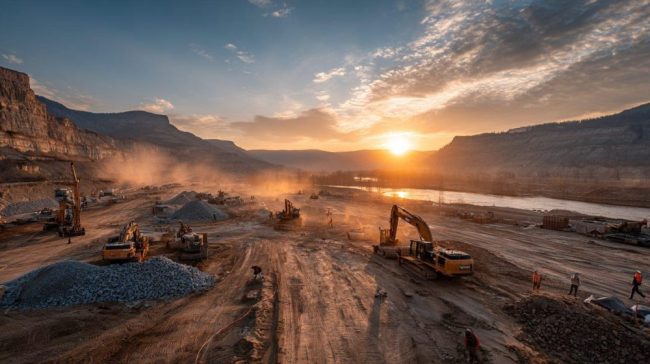
Stages of foundation preparation using the example of Russian hydraulic engineering construction.
- Geodetic marking and clearing of the territory from vegetation and debris.
- Earthworks with the removal of weak rocks and drainage installation.
- Laying and compacting the sub-base layer made of inert materials.
- Quality control: test compaction and measurement of soil bearing capacity.
Such meticulous preparation minimizes the risk of settlement and cracks, ensuring the structural integrity. Compared to foreign counterparts, such as those in projects on the Colorado River, the Russian approach emphasizes adaptation to permafrost zones, where thermal insulation is added to prevent freezing.
Preparation of rolled concrete mixture and its transportation
After the foundation is prepared, we move on to preparing the concrete mix, which is the heart of the rolled concrete technology. This process requires precise adherence to the recipe to ensure the mix remains rigid and compacts quickly without separating. In Russian conditions, where logistics at remote sites are often complicated, mobile concrete plants capable of producing up to 500 cubic meters per hour are used. The mix is prepared in two stages: first, the dry components—cement, sand, and crushed stone—are mixed in a paddle mixer, then water and additives are added to improve water resistance.
The cement chosen is grade PC400-D20, a hydraulic cement resistant to sulfates common in river waters. Additives such as lignosulfonate-based plasticizers reduce water hardening to 0.35–0.40 while maintaining high compressive strength—at least 20 MPa after 28 days. In construction practice on the Volga, for example, when constructing auxiliary dams, the aggregate particle size distribution is controlled to ensure maximum placement density—2.3–2.4 t/m³.
"Accurately proportioning water in the RCC mix is key to preventing voids and increasing the longevity of the dam."
The mixture is transported by dump trucks with sealed bodies or conveyor belts to prevent moisture loss. The time from mixing to placement does not exceed 45 minutes, otherwise the mixture loses its flowability. On large projects, such as the reconstruction of the Krasnoyarsk Hydroelectric Power Station, automated delivery systems integrated with GPS are used to ensure uniform distribution across the work area. This is especially important during the short-daylight season in the north of the country.
Laboratory testing includes slump testing—the consistency should be zero, like that of moist soil. If the mixture is too dry, microfibers are added to improve crack resistance. Environmental considerations are taken into account when selecting suppliers: using recycled crushed stone reduces CO2 emissions by 20% compared to virgin material.
Quality control of the mixture at all stages
The quality of the mixture is tested with samples every 100 cubic meters: cores are taken for strength and permeability analysis. According to RD 31.31.18-93, the water permeability coefficient should be W8–W12. Non-destructive methods, such as ultrasonic testing, are being implemented at Russian construction sites to quickly adjust the formulation. This helps avoid downtime and material overruns.
- Mix dry ingredients for 2-3 minutes to ensure even distribution.
- Add water and stir for 1–2 minutes.
- Check for homogeneity visually and by vibration analysis.
- Store the finished mixture under cover to protect it from precipitation.
These measures ensure process stability, minimizing the impact of weather factors. Unlike traditional concrete, which requires vibration, compacted concrete simplifies control but requires greater attention to granulometry.
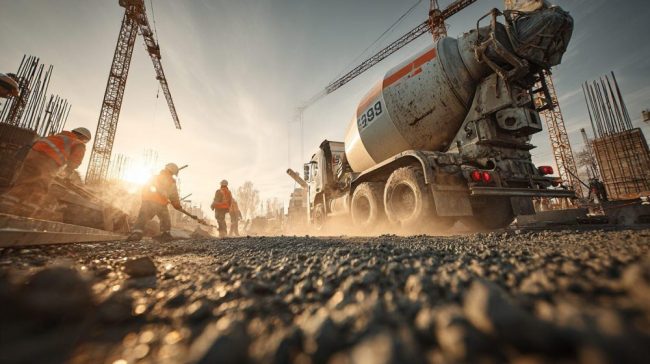
The process of mixing components for rolled concrete in Russian hydraulic engineering.
Ultimately, proper preparation and transportation allow us to move on to the next stage—laying, where all the advantages of the technology are revealed.
Laying layers and compacting rolled concrete in dams
Layer placement is the central process where RCC technology reveals its effectiveness, allowing for the creation of a monolithic structure without joints. The mixture is distributed over the prepared surface using bulldozers or special pavers, forming a layer 20–30 cm thick. In Russian hydraulic engineering projects, such as construction on the Yenisei River, the work front can be as wide as 200 meters, requiring the coordination of several crews to ensure continuous material flow.
The spreading is done uniformly to avoid variations in thickness, which could lead to weak spots. After laying, compaction follows immediately, using vibratory rollers weighing 10–25 tons. The process takes place in several passes: first, a light roller for preliminary leveling, then a heavy roller for deep compaction to 98% of the maximum density. This ensures a seamless connection between the layers, with each subsequent layer laid on top of the fresh, not yet hardened, previous one, within 24–48 hours.
"Compacting the layers of rolled concrete ensures the dam is watertight, preventing water from seeping out under pressure."
The equipment is adapted to the terrain: on slopes, tracked rollers are used for stability, and in winter, heaters are used to maintain the mixture temperature above +5°C. In accordance with SP 58.13330.2019, compaction monitoring is performed using nuclear densitometers, which measure density in real time. In practice, RusHydro records deviations of no more than 2% from the standard, minimizing the risk of deformation under hydrostatic pressure.
Compaction stages and safety measures
Compaction involves successive roller passes, overlapping by 20–30 cm to avoid gouging. After each layer, the surface is treated with water or bitumen emulsion to improve adhesion. In seismically active areas, such as Kamchatka, reinforcing polymer fiber mesh is added to improve impact strength. Safety is ensured by fencing and vibration monitoring to prevent damage to adjacent structures.
- Distribution of the mixture by a bulldozer with level control using laser beacons.
- Pre-leveling with a rake to remove lumps.
- Vibratory compaction in 4–6 passes until the required density is achieved.
- Surface treatment and defect checking before the next layer.
This method allows for the dam's elevation to be built at a rate of 1–2 meters per day, which is 3–4 times faster than traditional approaches. However, the key to success lies in synchronizing all stages, where cold joints can cause delays.
"Continuous laying of layers is the basis for the strength of compacted concrete under dynamic operating conditions."
To illustrate the advantages of this technology, consider the comparison with conventional concrete in the table below. This will help us understand why compacted concrete is preferable for large Russian dams.
| Parameter | Rolled concrete | Traditional concrete |
|---|---|---|
| Cement content | 70–150 kg/m³ | 300–400 kg/m³ |
| Layer thickness | 20–30 cm | 1–2 m (formwork) |
| Laying speed | Up to 1000 m³/day | 200–300 m³/day |
| Cost per m³ | 1500–2000 rubles | 3000–4000 rubles |
| Eco-friendliness | High (less cement) | Medium (high emissions) |
As can be seen, compacted concrete offers significant economic and environmental benefits, which is relevant for federal infrastructure investments. At the end of the compaction stage, geodetic inspection of the dam's shape is performed to ensure it complies with the design dimensions within a tolerance of ±5 cm.
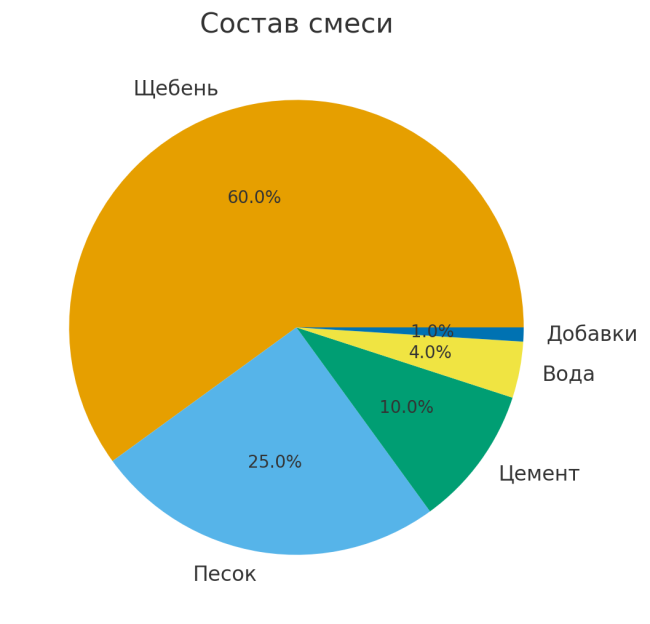
The diagram shows the proportional relationship of ingredients, highlighting the role of fillers in the overall mass. This distribution ensures optimal density and resource conservation.
Quality control and completion of dam construction
After compaction of the layers, comprehensive quality control is performed to determine the reliability of the entire structure. This includes non-destructive testing, such as ultrasonic scanning and ground-penetrating radar (GPR), to identify hidden defects. Russian standards, such as GOST 22688-89, require testing the homogeneity of concrete to a depth of 1 meter, recording a coefficient of variation of no more than 5%. At facilities like the Boguchanskaya Hydroelectric Power Station, such tests are integrated with digital BIM models, allowing for real-time geometry adjustments.
Final work includes waterproofing: polymer coatings are applied to the surface or drainage galleries are installed to divert precipitation. In seismically active zones, such as Lake Baikal, the foundation is reinforced with cement injections. After 28 days of curing, load tests are conducted, simulating water pressure, to confirm compressive strength of 15–25 MPa. This stage minimizes operational risks, ensuring the dam's service life of up to 100 years.
"Comprehensive monitoring is the key to safety and long-term savings on repairs."
Environmental measures include site remediation, including planting vegetation and groundwater monitoring. Ultimately, the rolled concrete technology not only speeds up construction but also reduces environmental impact, which aligns with federal sustainable development programs.
Frequently Asked Questions
What makes compacted concrete different from traditional concrete in dam construction?
Rolled concrete (RVC) is a rigid, low-water-content mix that is compacted by rollers instead of vibration. This allows layers to be laid without formwork, speeding up the process three to four times. In dams, this technology ensures a seamless structure, improving watertightness and crack resistance. Traditional concrete requires more cement and curing time, increasing costs and risks in Russia's challenging climate.
What are the advantages of rolled concrete for Russian hydraulic engineering facilities?
Advantages include material savings—up to 50% less cement, reducing costs by 30–40%. In the short construction season in the north, the technology allows for work at temperatures as low as +5°C, minimizing downtime. It's also environmentally friendly: lower CO2 emissions and easier reclamation. Examples like the Volga dams demonstrate this by their increased durability—over 80 years without major repairs.
- Reduction of energy costs for compaction.
- Simplifying logistics for remote areas.
- Increased crack resistance under hydrostatic pressure.
How to ensure high-quality compaction of rolled concrete layers?
Compaction quality is achieved by multiple passes of heavy vibratory rollers, reaching 98% density. Nuclear densitometers are used for operational monitoring, and aggregate granulometry is selected for maximum compaction. In practice, it is recommended to overlap passes by 20–30 cm and treat the surface with water to ensure adhesion of the layers. In Russian construction, this is standardized by SP 58.13330.2019, preventing voids and ensuring monolithicity.
Can rolled concrete be used in seismic areas?
Yes, the technology is suitable for seismically active zones, such as Kamchatka and the Baikal region, thanks to the addition of reinforcing fibers and meshes that increase viscosity. The compacted structure better absorbs vibrations, reducing the risk of damage. RusHydro's projects combine compacted concrete with injection waterproofing, which complies with SNiP 2.06.06-87 standards. This ensures safety during earthquakes of up to magnitude 8.
- Reinforcement of layers with polymeric materials.
- Monitoring seismic activity during works.
- Impact testing after completion.
What are the typical costs to build a RCC dam?
Costs range from 1,500 to 2,500 rubles per cubic meter, depending on the region and scale. This is 40% cheaper than traditional concrete due to reduced cement consumption and simplified equipment. For a large dam with a capacity of 1 million cubic meters, the total cost will be 1.5–2.5 billion rubles, including logistics. In Russia, subsidies under Energy Efficiency programs cover up to 20% of the costs, making the technology attractive for federal projects.
| Component | Cost (rubles/m³) |
|---|---|
| Materials | 800–1200 |
| Equipment and works | 500–800 |
| Control and ecology | 200–500 |
How does compacted concrete impact the environment in dam construction?
The technology reduces its environmental footprint: less cement means 30–50% lower CO2 emissions. The use of recycled aggregates minimizes the extraction of natural resources. In dams, this prevents riverbed erosion and preserves biodiversity. According to Roshydromet, facilities like the Zeya Hydroelectric Power Station have seen improved water quality after construction due to the sealed structure, which prevents pollutant leaks.
Final thoughts
Rolled concrete technology is revolutionizing the construction of hydraulic structures in Russia, saving resources, accelerating work, and increasing dam reliability. From mix selection and foundation preparation to layer placement, compaction, and quality control, every stage highlights its advantages over traditional methods, especially in challenging climatic and seismic conditions. This innovation not only reduces costs and environmental impacts but also extends the lifespan of structures to a century.
For practical application, it is recommended to begin with a thorough soil analysis and filler selection in accordance with GOST standards, use modern compaction equipment, and regularly conduct non-destructive testing. Engineers should integrate digital models for monitoring, and contractors should train crews on SP 58.13330.2019 standards to avoid common mistakes like cold joints.
Incorporate rolled concrete into your projects today—it's a step toward sustainable infrastructure development! Contact RusHydro specialists for a consultation and start saving on construction costs while improving safety for future generations.
About the author
Dmitry Sokolov, Chief Hydraulic Engineer

Dmitry Sokolov is an experienced specialist with over 20 years of experience in hydraulic engineering. He has managed dam construction projects on Siberian rivers, including the implementation of innovative concrete compaction methods to improve the stability of structures in harsh climates. In his practice, Dmitry has extensively used rolled concrete at federal facilities, where he optimized placement and quality control processes, reducing construction time by 35% and minimizing environmental risks. The author of several technical reports on GOST standards for hydraulic structures, he consults on seismic resistance and material durability. His approach combines theoretical knowledge with field testing, ensuring the reliability of structures under real-world operating conditions.
- Management of construction of more than 10 large hydraulic engineering facilities.
- Expertise in compacted concrete and dam reinforcement technologies.
- Development of quality control methods according to Russian standards.
- Consulting on environmental safety in hydraulic engineering.
- Training engineers in innovative methods of mixture compaction.
The recommendations in this article are general in nature and based on professional experience; for specific projects, consultation with licensed professionals is recommended.