The owner of a wooden house almost always faces the same practical situation: the walls look solid, the materials are high-quality, but the house still "leaks"—cracks appear in the corners, a cold draft bleeds in there in winter, and after a few seasons, traces of moisture and darkening of the wood become visible in these same areas. The main question in such a situation isn't about the appearance or the "correctness" of the technology in general, but about...Why are corners the weak point of a structure and what limitations do they impose on the operation of a house?.
- Why are corners loaded differently than the rest of the wall?
- How does a corner joint affect heat loss?
- Shrinkage and warping: why corners "float" first
- The Effect of Angles on Wood Durability
- Why a visually "beautiful" corner isn't always practical
- How angles affect the indoor microclimate
- Limitations that corners impose on further finishing
- Common Mistakes in Understanding the Role of Angles
- Why do corners determine the age of a wooden house?
Why are corners loaded differently than the rest of the wall?
A corner is an area where several processes converge: longitudinal and transverse shrinkage of wood, different grain directions, temperature fluctuations, and wind loads. In a straight section of a wall, timber or logs behave more predictably: the elements lie in the same plane and react to moisture in roughly the same way. In a corner, however, the materials are more rigidly connected, and any dimensional changes begin to "bump" against the adjacent wall.
Because of this, even minor changes in humidity or temperature are first felt in the corners. They are the first to react to seasonal fluctuations, and if the design doesn't account for this stress, the deformation becomes visually noticeable and perceptible at the microclimate level.
How does a corner joint affect heat loss?
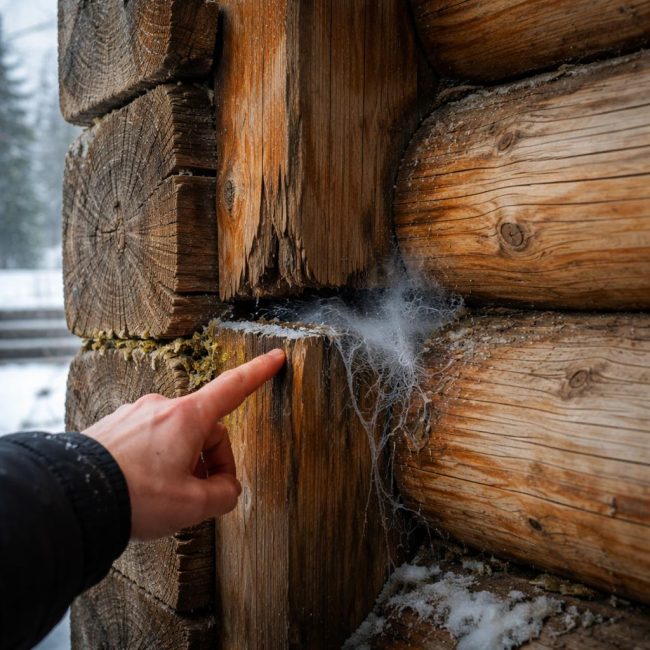
Heat loss through corners is rarely noticeable immediately after construction. The problem manifests itself gradually as the wood undergoes several wetting and drying cycles. Corner joints have more contact surfaces and joints than a flat wall, meaning more potential microgaps.
Even with careful installation, minor gaps will appear over time. These gaps are compensated for by the overall weight of the wall in straight sections, but not in corners. Cold air and moisture find these weak points. As a result, the corner can remain noticeably cooler than the rest of the wall, even though the house appears solid and undamaged.
Shrinkage and warping: why corners "float" first
Wood shrinks unevenly. A log or beam shrinks more across the grain and much less along it. At a corner, these directions intersect, causing the shrinkage forces to accumulate. If the joint is too rigid, the stress accumulates rather than dissipates.
In practice, this manifests itself as warped openings, microcracks near corners, and a characteristic "creaking" sound during the first few years of use. It's important to understand that this isn't necessarily a material defect—most often, it's a result of the corner not being able to easily accommodate shrinkage.
The Effect of Angles on Wood Durability
Corners are more prone to condensation than other areas. They are exposed to stronger winds from the outside and less warm from the inside. Meanwhile, the joints are more susceptible to moisture entrapment. If wood is exposed to damp conditions, it darkens and loses density over time.
Even high-quality treatment doesn't completely solve the problem if the corner is structurally prone to moisture accumulation. This is why, after several years of use, the first signs of aging are often visible not on the façade as a whole, but locally—in the corners.
Why a visually "beautiful" corner isn't always practical
It's tempting to judge corners by their neatness and geometry. Straight lines and tight fit create a sense of security. But it's precisely the excessive tightness of the joint that sometimes causes problems: the wood simply has no room to "breathe."
In practice, corners that allow minimal relative movement of elements without disrupting the overall geometry prove more stable. This isn't immediately apparent and is rarely perceived as an advantage when inspecting a new home, but these types of connections are the ones that best withstand years of use.
How angles affect the indoor microclimate
Even with good heating, corners remain the coldest areas of a room. This is due not only to the thermal conductivity of wood, but also to the fact that a corner is always the intersection of two external surfaces. If the joint is not designed with this factor in mind, the room will feel damp and chilly locally.
Over time, this affects the finish: corners show signs of wear more quickly, and furniture placed close to walls can experience increased humidity. These effects are rarely attributed specifically to the corner design, although the cause is often found there.
Limitations that corners impose on further finishing
After shrinkage has completed, corners remain a high-risk area for any interior or exterior finish. Rigid materials react to micro-movements of the wood, and if the corner continues to "work," the finish begins to crack or peel.
Therefore, when choosing interior or façade solutions, it's important to consider that corners aren't static elements. They continue to respond to seasonal changes even over the years, and any decorative solutions should accommodate this.
Common Mistakes in Understanding the Role of Angles
A common misconception is that corner problems are solely related to the quality of the wood. In practice, even perfectly dried wood does not eliminate structural limitations. Another mistake is the expectation that a tight joint automatically means warmth and reliability.
The impact of wind loads is also often underestimated. Corners bear more of this load than the center of the wall, and if this isn't taken into account, wear and tear occurs more rapidly in these areas.
Why do corners determine the age of a wooden house?
After 10-15 years of use, the condition of the corners often becomes an indicator of the overall lifespan of the house. If they are dry, tight, and free of visible deformations, the rest of the structure is usually in good condition. However, if the corners appear worn, this indicates accumulated stress and moisture in the walls.
That's why, when assessing the condition of a wooden house, paying attention to the corners provides more information than examining the flat areas of the façade. They capture all the key processes that occur with wood in real-life conditions, not during construction.