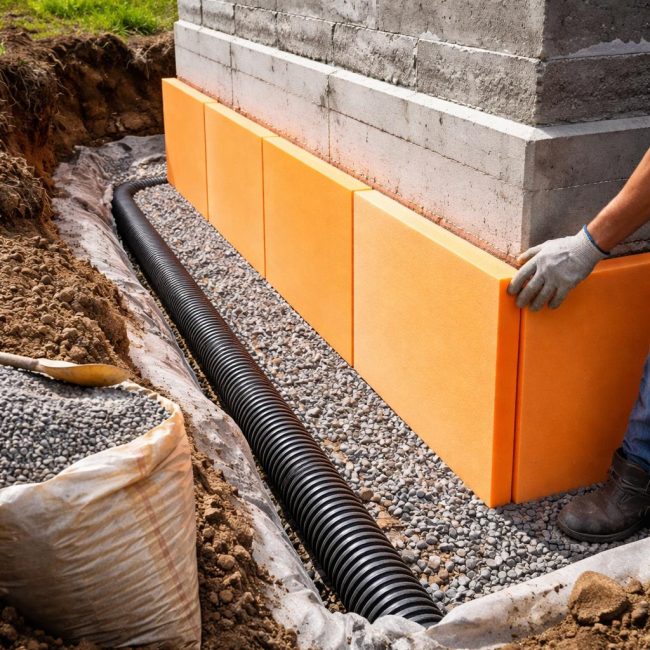
A strip foundation is one of the most common types of foundations for houses and other buildings. It provides reliable support for the building, evenly distributing the load. However, in cold climates, the issue of insulating a strip foundation becomes especially important. Proper insulation not only helps improve the building's thermal performance but also prevents the foundation from freezing, which can impact its longevity.
Why insulate a strip foundation?
Foundation insulation is an important stage in construction, helping to improve a home's energy efficiency. During cold weather, without proper insulation, indoor temperatures can drop significantly, especially in the basement or ground floor. Furthermore, a cold foundation can lead to cracks, structural damage, and even deformation.
Insulation of a strip foundation helps to avoid:
- Freezing of the soil around the foundation;
- Heat loss, which reduces heating costs;
- Effects of humidity on the structure;
- Formation of condensation and mold in the basement.
A properly insulated foundation will not only improve the comfort of your home, but also increase its durability.
Basic methods of insulating a strip foundation
There are several proven methods for insulating strip foundations. All of them can be used both during construction and during renovations to existing buildings.
- Insulation with foam plastic (expanded polystyrene)
Foam plastic is one of the most affordable and popular insulation materials. It boasts excellent thermal insulation properties, is lightweight, and is easy to install. Foundation insulation with foam plastic can be applied both externally and internally, depending on the design. For this purpose, foam plastic is laid along the external and internal walls of the foundation, then covered with a protective membrane to prevent moisture exposure.
- Use of extruded polystyrene foam
Extruded polystyrene foam (EPS) is a more advanced version of foam plastic, characterized by high strength and moisture resistance. It is often used for insulating the exterior of foundations, especially in cases where it is necessary to protect the foundation from external factors such as freezing and water penetration. EPS is used for thermal insulation around the foundation perimeter, as well as to create a thermal insulation layer beneath the foundation.
- Insulation with mineral wool
Mineral wool is another popular insulation material that has proven itself in construction. This material is more resistant to high temperatures than polystyrene foam. Mineral wool is suitable for insulating both external and internal foundations, but its main advantage is its ability to retain heat in humid conditions. It is important to note that mineral wool requires additional protection from water, as it can become saturated with moisture, losing its thermal insulation properties.
- Insulation with expanded clay
Expanded clay is a lightweight, porous material widely used in construction for insulation. It can be used as a filler in concrete mortars, creating a thermal insulation layer directly within the foundation structure. Expanded clay provides excellent frost protection and sound insulation. This insulation method is most often used when pouring foundations using concrete mix.
- Insulation using geotextiles and drainage
This method relies on geotextiles placed in the soil around the foundation to prevent moisture ingress and improve thermal insulation. To create effective drainage around the foundation, a perforated pipe collects excess water and diverts it away from the foundation. This is especially important in areas with high groundwater levels.
How does foundation insulation affect the durability of a building?
Proper foundation insulation plays a key role in the longevity and stability of the entire building. An inadequately insulated foundation can lead to:
- Violation of heat exchange in the room, increased humidity and mold formation;
- Freezing of the soil under the foundation, which can cause it to rise, and therefore, deformation of the foundation;
- Loss of strength of building materials that interact with cold.
Insulation reduces the likelihood of all these problems and helps increase the foundation's resistance to mechanical stress and atmospheric conditions.
Technical nuances when insulating a foundation
Insulating a strip foundation involves more than just using insulation materials; there are also important considerations to consider:
- Drainage systemIf groundwater is present in excess, it is essential to provide an effective drainage system to direct water away from the foundation.
- Vapor permeabilityIt is important that the selected insulation is sufficiently vapor-permeable to prevent condensation from forming within the insulated layer.
- Selection of materialThe insulation must be resistant to moisture and mechanical damage.
Mistakes when insulating a strip foundation
When insulating a foundation, several typical mistakes are often encountered that can negatively impact the effectiveness of the work:
- Use of moisture-sensitive materialsInsulation materials that quickly absorb water lose their thermal insulation properties and can cause mold growth.
- Underestimating the need for a drainage systemIf water is not drained away from the foundation, it will lead to its destruction.
- Failure to take into account climate characteristicsRegions with harsh winters require higher insulation requirements, and the choice of materials must be appropriate.
Conclusion
Insulating a strip foundation isn't just an additional measure to improve comfort. It's a necessary part of construction, ensuring the durability and energy efficiency of the home. By choosing the right materials and taking all technical details into account, you can significantly improve the building's performance, reduce heating costs, and avoid foundation problems.