Any heating, power, or mechanical engineering system requires reliable sealing, including flanges, pipe connections, hatches, doors, nozzles, and valves. These areas are where pressure losses and gas or heat leaks most often occur. Selecting the right sealing material is a key factor in ensuring the longevity and safety of equipment, especially when operating at elevated temperatures and pressures.
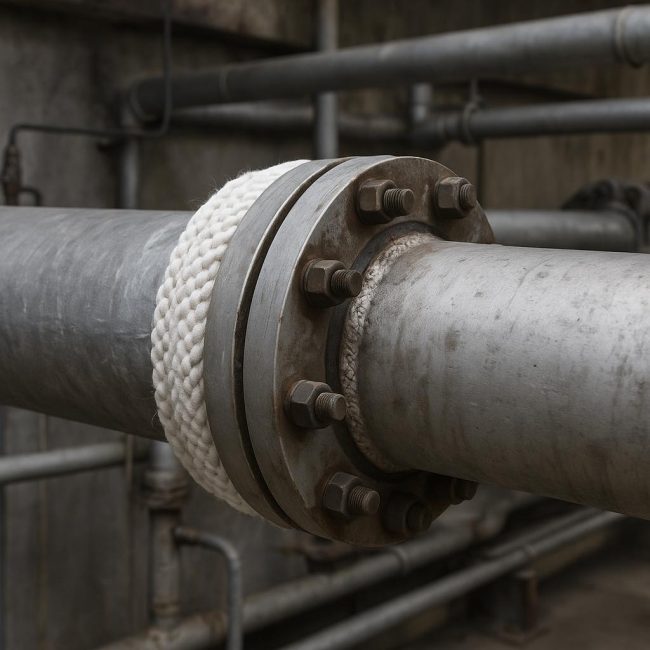
One of the common solutions remains asbosnurAsbestos cord is a flexible fibrous material used for sealing and thermal insulation of components in contact with hot water, steam, or gases. It withstands temperatures up to 400°C and pressures up to 0.1 MPa, ensuring reliable sealing of joints in a wide variety of installations—from heating mains to power equipment. Asbestos cord can be considered a classic example of a sealant that has become the standard for systems where stability and heat resistance are essential.
- Why are high-temperature seals needed?
- Classification of sealing materials
- Elastomeric seals
- Fibrous materials
- Metal and composite seals
- Plastic and paste-like sealants
- Basic parameters for material selection
- Temperature range
- Pressure
- Chemical resistance
- Mechanical load and vibration
- Applications of high temperature seals
- Energy
- Shipbuilding
- Mechanical engineering and transport
- Construction
- Aircraft manufacturing
- Installation and operation of seals
- Comparison with other materials
- Prospects and development of technologies
- Conclusion
Why are high-temperature seals needed?
When operating heating units and pipelines, extreme conditions are often encountered: temperatures exceed hundreds of degrees Celsius, and pressures reach atmospheric levels. Under such conditions, conventional rubber gaskets lose their shape, burn, or become brittle.
Sealing materials for high-temperature systems perform several functions simultaneously:
- sealing connections to prevent leakage of the working medium;
- expansion compensation materials during heating and cooling;
- vibration isolation — smoothing out vibrations and loads;
- thermal insulationso that heat is not transferred to adjacent areas of the structure.
In other words, a seal is not just a gasket, but a functional element that affects the stability of the entire system.
Classification of sealing materials
All sealing materials can be divided into several groups based on their composition and operating temperature range.
Elastomeric seals
They are used at low temperatures—up to 200°C. These include rubber, silicone, and fluororubber. They provide good sealing during vibration, but they cannot withstand overheating and quickly lose elasticity when exposed to hot air or steam.
Fibrous materials
This category includes asbestos, fiberglass, basalt, and ceramic cords. Their distinctive feature is their ability to maintain their shape at temperatures of 300–1200°C.
Asboshnur — a representative of this group, known for its versatility and dimensional stability. It does not melt or degrade under prolonged heating, making it used in pipelines, boilers, and hot gas chambers.
Metal and composite seals
They are used in high-pressure installations (0.5–5 MPa) and temperatures above 500°C. These are corrugated or spiral-wound gaskets made of steel, copper alloys, or graphite. They are more expensive and require precise fitting, so they are used in turbines, reactors, and heat exchangers.
Plastic and paste-like sealants
These are sealing compounds based on silicates or metal oxides. They are applied to hard-to-reach areas where it is impossible to install a cord or gasket. After drying, they form a heat-resistant layer that can withstand temperatures of 1000°C and above.
Basic parameters for material selection
Selecting a seal for high-temperature systems isn't a matter of chance. Engineers focus on several key characteristics.
Temperature range
The first thing to consider is the operating temperature. If a material is rated for 200°C and is installed in an area where the temperature exceeds 350°C, it will inevitably fail.
Asbestos cord is optimal for systems with temperatures up to +400 °C, where more expensive materials are redundant, and less heat-resistant ones are unreliable.
Pressure
It's equally important to consider the ambient pressure. At pressures above 0.1 MPa, the asbestos cord may lose its seal, in which case reinforced gaskets or metal rings are used.
Chemical resistance
The working environment—water, steam, gas, petroleum products—determines chemical resistance. Asbestos cord, for example, is stable in contact with water and air, but is not recommended for aggressive acids or alkalis.
Mechanical load and vibration
If equipment is subject to frequent heating and cooling cycles, it's important that the seal maintains its shape. Fibrous materials, including asbestos cord, withstand such variations well and do not crack or delaminate.
Applications of high temperature seals
Asbestos cord and similar materials have found application in a wide variety of industries.
Energy
It is used to seal hatches, furnace doors, flanges, and hot water and steam pipelines. In thermal power plants, it prevents steam leakage, maintaining temperature stability.
Shipbuilding
On ships and vessels, asbestos cord is used to insulate boiler rooms, exhaust systems, and steam pipe connections. It is vibration-resistant and resistant to seawater.
Mechanical engineering and transport
Used in engines, compressors and exhaust manifolds to insulate hot areas.
Construction
In building thermal engineering systems, asbestos cord is used to seal the joints of ventilation shafts, chimneys and heating ducts, where heat resistance and durability are important.
Aircraft manufacturing
In aviation, lightweight modifications of heat-resistant cords are used to ensure the tightness of components that are exposed to heat during flight or engine operation.
Installation and operation of seals
Even the most suitable material will not perform its functions if installed incorrectly.
When installing heat-resistant cords, it is important to follow several principles:
- Surface preparation - clean from old seal, dust, scale and traces of oil.
- Selecting the diameter — the cord should fit tightly into the groove, but without excessive tension.
- Using heat-resistant glue - it fixes the seal and prevents it from shifting when heated.
- Uniform laying — the cord must not have any kinks or twists.
- Control after the first launch — it is checked whether the material has changed shape and whether gaps have appeared.
The asbestos cord retains its shape well even after multiple heating cycles, but with intensive use, periodic replacement is recommended - usually every 2-3 years.
Comparison with other materials
To understand the place of asbestos cord in the range of modern solutions, it is useful to compare its characteristics with other types of sealants.
| Material | Operating temperature | Pressure, MPa | Flexibility | Vibration resistance | Typical application area |
|---|---|---|---|---|---|
| Asboshnur | up to +400 °C | up to 0.1 | high | high | heat exchangers, pipelines, boilers |
| Fiberglass cord | up to +550 °C | up to 0.2 | high | average | chimneys, furnaces, heating chambers |
| Basalt cord | up to +700 °C | up to 0.3 | average | high | energy, shipbuilding |
| Ceramic cord | up to +1200 °C | up to 0.5 | low | high | industrial furnaces, metallurgy |
| Metal gaskets | up to +800 °C | up to 5.0 | low | low | turbines, reactors |
From the table it is clear that the asbestos cord takes up universal niche — combines availability, sufficient heat resistance and ease of installation.
Prospects and development of technologies
Modern production requirements are increasing, and sealing materials are improving along with them.
Traditional fiber cords like asbestos cord remain in use, but they are being replaced by composite alternatives containing glass fibers, basalt fibers, and heat-resistant binders. These solutions increase the temperature limit to +600°C while maintaining flexibility and ease of installation.
The energy and shipbuilding industries are actively implementing seals with improved vibration resistance and moisture protection. In construction, materials with reduced thermal conductivity are being developed to improve the energy efficiency of buildings.
Conclusion
Selecting a sealing material for high-temperature systems is an engineering challenge that requires an understanding of the physical processes and properties of the medium.
Asboshnur It remains a reliable, time-tested solution for temperatures up to +400°C and pressures up to 0.1 MPa. It is used in applications requiring both sealing and thermal insulation, from the power industry to shipbuilding.
A properly selected seal improves equipment efficiency, extends its service life, and reduces maintenance costs. In a world where system reliability is increasingly important, choosing the right material is no small matter; it's the foundation for the stable and safe operation of any heating system.