Insulating a home's façade isn't just about comfort; it also means long-term savings on heating costs. Modern technologies allow you to combine thermal insulation with aesthetics, transforming ordinary walls into stylish and durable structures. However, the vast selection of materials, technologies, and design solutions can often be confusing. To ensure you'll enjoy the results even after 10–20 years, it's important to choose your façade carefully.
Today you can find it on the market ready-made facades from the manufacturer, which combine decorative coating and insulation. These solutions eliminate the need to waste time searching for and coordinating individual materials, allowing you to purchase a complete set optimized for thermal conductivity, moisture resistance, and appearance. But before making a choice, it's important to understand the different types of façade systems available, how they differ, and what to look for.
- The main types of facades for home insulation
- "Wet" facade (plaster systems)
- Ventilated facades
- Facade panels and thermal panels
- Materials for facade insulation
- What to look for when choosing a facade
- Climate conditions
- The architectural style of the house
- Service life and warranty
- Project budget
- Advantages of ready-made facades from the manufacturer
- Mistakes when choosing a facade
- Bottom line: how to make the right choice
The main types of facades for home insulation
There are several popular solutions, each with its own pros, cons, and price range.
"Wet" facade (plaster systems)
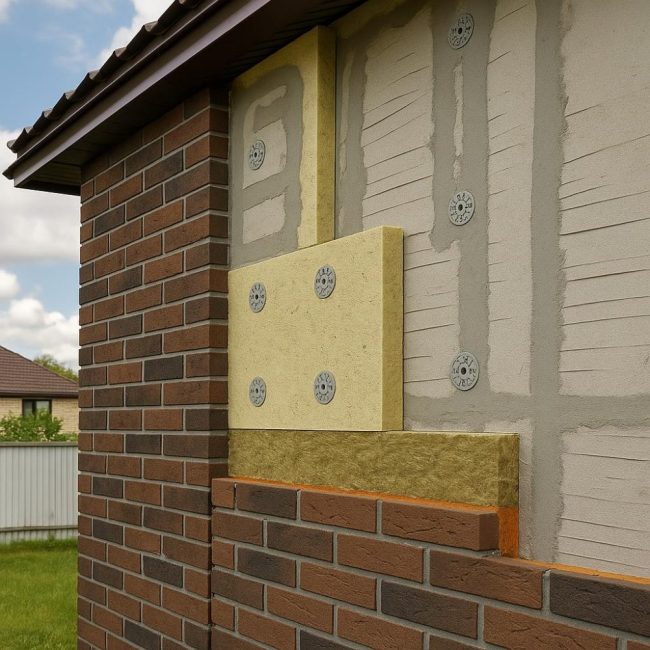
This is a technology in which insulation is attached to the wall, then reinforced with mesh and covered with decorative plaster.
Pros:
- good thermal insulation if installed correctly;
- a large selection of colors and textures;
- relatively low cost.
Cons:
- dependence on weather conditions during installation;
- risk of cracks appearing due to house shrinkage;
- requires qualified craftsmen.
Ventilated facades
This is a design where an air gap is left between the wall with insulation and the decorative cladding for ventilation.
Pros:
- excellent moisture protection;
- long service life;
- can be installed at any time of the year.
Cons:
- higher cost;
- complexity of installation.
Facade panels and thermal panels
Panels with built-in insulation are a practical solution for private homes.
Pros:
- quick installation;
- absence of "wet" processes;
- durability.
Cons:
- higher price per square meter compared to basic systems;
- limited choice of formats.
Materials for facade insulation
The correct choice of insulation is no less important than the cladding itself.
- Mineral wool — non-flammable, vapor-permeable, and retains heat well. Suitable for wet and ventilated facades.
- Expanded polystyrene (EPS) — lightweight, inexpensive, easy to install, but flammable. Most often used in plastering systems.
- Extruded polystyrene foam (XPS) - moisture-resistant, durable, but less vapor-permeable.
- Polyurethane boards - with high thermal insulation, but more expensive.
What to look for when choosing a facade
Climate conditions
In regions with high humidity, it's better to choose ventilated systems or moisture-resistant panels. In colder areas, the thickness and thermal conductivity of the insulation are important.
The architectural style of the house
The façade design should harmonize with the roof, windows, and landscape of the property. For example, brick-effect panels look good on classic cottages, while smooth composite panels complement modern homes.
Service life and warranty
Warranties on high-quality façade systems can reach 25–30 years. However, longevity largely depends on proper installation.
Project budget
The cost of a façade consists of the cost of materials, delivery, and installation. Sometimes it's more cost-effective to purchase a complete solution than to assemble the system piecemeal.
Advantages of ready-made facades from the manufacturer
- Complexity — the kit includes insulation, fasteners, facing materials, and sometimes decorative elements.
- Installation speed — the time for selection and installation is reduced.
- Quality assurance — the manufacturer tests the compatibility of all elements.
- Saving - less chance of overspending on materials.
Mistakes when choosing a facade
- Purchasing materials “by eye”, without taking into account heat engineering calculations.
- A choice of cheap but low-quality panels that quickly lose their appearance.
- Ignoring the climatic features of the region.
- Incorrect installation (especially important for “wet” facades).
Bottom line: how to make the right choice
The ideal façade is a balance between visual appeal, thermal insulation, durability, and budget. For those looking for a quick and lasting solution for insulation and finishing, prefabricated façades from the manufacturer are an excellent choice. They allow you to avoid many mistakes, save time, and be confident in the final result.
If the project is custom and requires a special design, you can assemble the system yourself, but it is important to consult with specialists, conduct heat engineering calculations, and select proven materials.