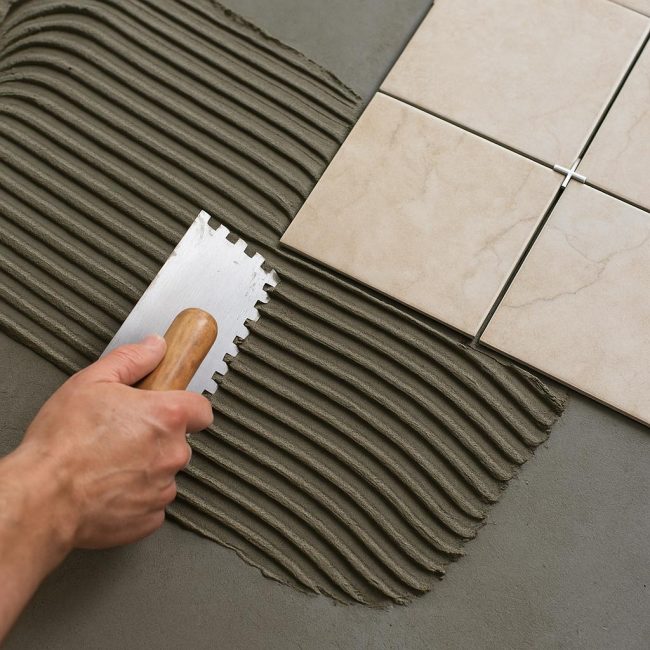
Selecting the right tile installation products is the foundation for a durable and reliable finish. Even the most expensive tiles and perfect installation won't save the situation if the wrong adhesive is used. It is the adhesive that bonds the tiles to the substrate, compensates for unevenness, supports weight, and protects the surface from moisture and temperature fluctuations. An error at this stage can lead to cracks, peeling, and the need for costly repairs.
There are dozens of types of adhesives on the market today: cement-based, dispersion-based, epoxy-based, heat-resistant, and quick-drying. Each type is designed for specific operating conditions and tile types. Navigating this diversity isn't difficult if you understand the principles of selection and know what to look for.
- Main types of tile adhesives
- Cement adhesives
- Dispersion adhesives
- Epoxy adhesives
- How to choose adhesive depending on the type of tile
- Ceramic tiles
- Porcelain tiles
- Mosaic and glass tiles
- Large-format tiles
- Operating conditions: where and how it is important to select the composition
- Interior spaces
- Wet areas (bathrooms, showers, kitchens)
- Outdoor work
- Warm floors
- Substrate preparation and the importance of priming
- Proper mixing and application of glue
- Common mistakes when choosing and using glue
- Advice from the pros
- How to calculate glue consumption
- Summary: What's important to remember when choosing
- Conclusion
Main types of tile adhesives
Modern adhesives vary in composition, purpose, and application conditions. Let's look at the main types and their features.
Cement adhesives
This is the most common and versatile type. It is based on Portland cement with mineral fillers and modifying additives.
- Advantages: affordable price, high strength, moisture and frost resistance.
- Flaws: Requires precise mixing proportions; not suitable for all surfaces.
- Application: laying ceramic tiles, porcelain tiles, mosaics on concrete, plaster or cement screed.
Modern cement mixtures are divided into classes:
- C1 — standard adhesion (for regular tiles and dry rooms);
- C2 — increased adhesion (for difficult conditions, facades, bathrooms);
- C2TE - improved adhesives with increased adjustment time and reduced creep.
Dispersion adhesives
They consist of a ready-made paste based on polymer resins.
- Pros: do not require mixing, have high elasticity, are ideal for plasterboard, chipboard and plywood.
- Cons: high price and limited moisture resistance.
- Application: wall tiles in living spaces, kitchens, corridors, hallways.
Epoxy adhesives
Two-component compounds (resin + hardener). Provide maximum strength and water resistance.
- Advantages: resistance to chemicals, high temperatures and mechanical stress.
- Flaws: high price, difficult to work with, fast setting.
- Application: swimming pools, saunas, laboratories, industrial kitchens, facades.
How to choose adhesive depending on the type of tile
Each material has its own characteristics, and these directly determine which adhesive will be optimal.
Ceramic tiles
For ordinary wall or floor tiles, cement adhesives of the class are suitable C1If you are laying tiles in a bathroom or kitchen, it is better to choose C2TE — with moisture-resistant and elastic additives.
Porcelain tiles
It is a dense, heavy material with low water absorption, so it requires an adhesive with increased adhesion - C2TES1Elasticity allows for compensation of temperature and mechanical deformations.
Mosaic and glass tiles
It's important that the adhesive doesn't show through the glass. White cement or dispersion adhesives with fine-grained fillers are used.
Large-format tiles
Slabs larger than 60x60 cm require an adhesive with high holding power and minimal shrinkage. It is best to use elastic adhesives with anti-slip properties and increased adjustment time.
Operating conditions: where and how it is important to select the composition
Interior spaces
For living spaces, standard cementitious or dispersion-based mortars are suitable. The main thing is to consider the humidity level and the type of substrate.
Wet areas (bathrooms, showers, kitchens)
A moisture-resistant and antifungal adhesive that can withstand temperature fluctuations is required. Cement-based adhesive is the best choice. C2TE or epoxy composition.
Outdoor work
Balconies, terraces, and facades are exposed to frost, moisture, and solar radiation. Here they use frost-resistant adhesives of class C2TES1 or C2TES2, designed for extreme conditions.
Warm floors
It's important that the adhesive remains flexible when heated. Choose mixtures labeled S1 (for moderate deformation) or S2 (for severe deformation).
Substrate preparation and the importance of priming
Even the best glue won't save you if the base isn't prepared.
- Surface cleaning - remove dust, grease, paint, and remnants of old glue.
- Alignment — it is better to eliminate any unevenness greater than 5 mm in advance to avoid wasting excess glue.
- Primer — increases adhesion and reduces surface absorption. Special adhesion primers are used for smooth and dense surfaces.
It is worth priming 4-6 hours before laying, so that the surface has time to dry, but not over-dry.
Proper mixing and application of glue
Cement adhesives are prepared manually or with a mixer at low speed.
- Add water strictly according to the instructions. Excess liquid reduces strength and causes shrinkage.
- After the first stirring, the mixture should “sit” for 5 minutes to allow the additives to activate.
- The adhesive should be applied with a notched trowel; the size of the notches is selected depending on the tile format (usually 6–10 mm).
For large tiles use double application method: the adhesive is distributed both on the base and on the back of the tile to avoid voids.
Common mistakes when choosing and using glue
- Incorrect type of glue selected. For example, using a conventional cementitious composition for large-format porcelain tiles will lead to delamination.
- Violation of water proportions. A solution that is too liquid will lose its strength, while one that is too thick will not adhere well to the tiles.
- Work on unprimed base. This reduces adhesion and speeds up the drying of the glue.
- Violation of temperature regime. The optimal temperature for operation is from +5 to +25 °C.
- Using glue after its "potability" has expired. After mixing, the solution is suitable for use within 2–4 hours, depending on its composition.
Advice from the pros
- Don't skimp on glue - this is not the place to save money without consequences.
- Check expiration dates and storage conditions—expired glue loses its properties.
- For porous surfaces, use deep penetration primers.
- When laying on old tiles, choose an adhesive with increased adhesion and elasticity.
- Don't forget about expansion joints on large areas - this will prevent cracking.
How to calculate glue consumption
Consumption depends on:
- tile format (the larger the tile, the more glue);
- foundation conditions;
- size of the spatula teeth.
On average, cement adhesives are consumed at the rate of 3–5 kg per 1 m², but the exact value is always indicated by the manufacturer on the packaging.
For an accurate calculation, you can use online calculators, where you simply enter the tile dimensions, surface area, and adhesive type.
Summary: What's important to remember when choosing
- Take into account tile type and base — the choice of composition depends on this.
- Determine terms of Use - inside, outside, humidity, presence of heating.
- Choose glue with the required strength and elasticity class (C1, C2, S1, S2).
- Follow expiration dates and proper mixing.
- Use integrated approach — glue, primer, and grout must be compatible in composition.
Conclusion
The choice of adhesive is more than just a technical matter; it's the key to the reliability of the entire tile installation. It determines not only the appearance but also the service life of the covering. If you approach the process responsibly and carefully, the tiles will last for decades, maintaining their strength and aesthetics even under challenging conditions.