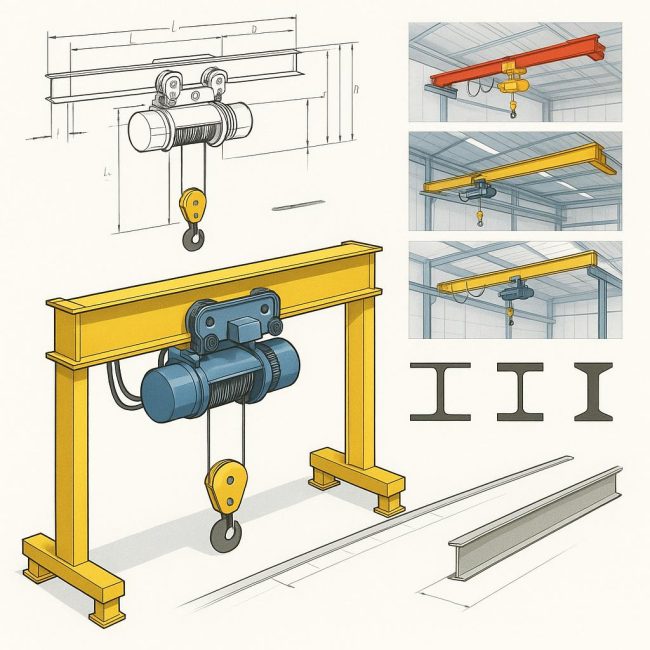
Selecting a crane beam is a key step in the design and equipment of production facilities, warehouses, assembly areas, or service areas. The correct choice determines not only operational efficiency but also personnel safety, equipment durability, and operating efficiency.
In practice, engineers and designers often begin their selection process by reviewing dimensional drawings and overhead crane capacity tables, which can be found at . These documents allow them to assess the equipment's compatibility with the room dimensions, supporting structures, and process processes. They can be used to quickly determine the permissible lifting height, span length, hoist type, and overhead crane parameters.
- What is a crane beam and where is it used?
- Main types of overhead cranes
- Key selection parameters
- Load capacity
- Span (beam length)
- Lifting height
- Speed of ascent and movement
- Opening hours
- How to use tables and drawings when choosing
- Operating conditions and environment
- Mistakes when selecting a crane beam
- Practical recommendations
- Economic aspects of choice
- Conclusion
What is a crane beam and where is it used?
A crane beam is a lifting mechanism consisting of one or two beams along which a hoist (electric or manual) moves. The primary purpose of this equipment is to lift, support, and move loads horizontally within the working span.
Overhead cranes are used in almost all branches of industry:
- in mechanical engineering - for assembly operations and movement of parts;
- in warehouses - for unloading and storing materials;
- in construction - for the supply of structures and equipment;
- in service and repair areas - for removal and installation of units;
- in small business workshops - for general loading and unloading tasks.
Each industry has its own specific requirements for lifting capacity, lifting height, speed, drive type, and mechanism layout. Therefore, it's impossible to choose a universal overhead crane for every application; an analysis of specific operating conditions is required.
Main types of overhead cranes
Depending on the installation method and design, there are several types of overhead cranes:
- Supporting — move along rails laid on crane runways. They are mounted on columns or special supports. They are used in workshops with high ceilings and long spans.
- Suspended — are attached directly to ceiling or rafter beams. They take up less space and are convenient for rooms with limited headroom.
- Single beam — the most common option for loads up to 10 tons. The design is simple and installation is relatively easy.
- Double beam — are used for heavy loads and large spans, providing increased rigidity and stability.
Overhead cranes also differ by drive type: manual, electric, or a combination of both. Electric models are more commonly used in manufacturing, where speed and stability are important, while manual models are more common in small warehouses and repair areas.
Key selection parameters
When selecting a crane beam, it's important to consider a range of parameters. Below are the key characteristics that influence your choice.
Load capacity
This is the maximum weight a crane can safely lift. The standard range is from 0.5 to 20 tons.
When choosing the lifting capacity, you should consider not only the weight of the load itself, but also the weight of the lifting devices (hooks, crossbars, magnets). In addition, it is recommended to include safety margin within 10–20% of the expected load.
Span (beam length)
It is determined by the distance between the tracks along which the trolley moves. The most common values range from 3 to 30 meters. If the span is too large, the beam deflection increases, requiring a more powerful and heavier structure.
Lifting height
The parameter depends on the room height and service area. This is where dimensional drawings, which allow you to accurately calculate the free space between the hook and the ceiling to avoid restrictions when working.
Speed of ascent and movement
For production lines where cycle speed is critical, electric hoists with variable speed are preferred. For assembly or repair areas, a standard speed of 4–8 m/min is sufficient.
Opening hours
According to the FEM and GOST classifications, overhead cranes are classified by load mode (from light to heavy). For example, a workshop where lifting is infrequent might use equipment of categories A1–A3, while a conveyor section might use equipment of categories A5–A6.
How to use tables and drawings when choosing
Load capacity tables contain not only weight but also references to beam type, span length, lifting height, and hoist type. This data helps determine the optimal combination of characteristics for a specific task.
Approximate selection sequence:
- Determine the maximum load weight.
- Find the model with the corresponding lifting capacity in the table.
- Check the overall dimensions according to the drawings - height, length, hook reach.
- Compare the obtained data with the parameters of the room.
- Make sure that the selected design does not require reinforcement of the building's load-bearing elements.
Using these tables eliminates mistakes such as installing a beam that is not the right height or selecting a hoist that is limited in movement.
Operating conditions and environment
It is equally important to take into account environmental factors:
- Temperature conditions. For cold rooms, models with heated gearboxes and electrical equipment are used.
- Dust and moisture protection. In chemical and food industries, crane beams made of stainless steel or with sealed housings are used.
- Explosive zones. Require the use of special explosion-proof electrical equipment.
- Noise and vibration levels. For rooms with a constant presence of people, low-noise gearboxes and a soft start are important.
Mistakes when selecting a crane beam
Even with technical tables, many people make typical mistakes:
- Underestimation of cargo weight. The weight of containers, fasteners, or non-standard accessories is often not taken into account.
- Ignoring the height of the room. The beam can be “resting” against the ceiling or utility lines.
- Selection without taking into account the frequency of ascents. Light-duty equipment wears out quickly under heavy use.
- Incorrect selection of cart. Sometimes they choose a model with insufficient travel length or an unsuitable turning radius.
- Lack of safety margin. This is especially critical under dynamic loads.
Practical recommendations
- Always start your selection with an analysis of the technological process and room conditions.
- Use the load capacity tables not as a reference, but as a tool to check the compatibility of parameters.
- If the project is new, plan ahead for the possibility of increasing the load-bearing capacity—strengthening the structure later is more difficult and expensive.
- Check the possibility of installation and maintenance: access to gearboxes, brakes and power supply must be free.
- For non-standard spaces, order custom drawings—they'll allow you to precisely tailor the equipment to your dimensions.
Economic aspects of choice
The cost of a crane beam consists of the metal structure, hoist, drives, electrical equipment, and installation. The optimal choice is not the most powerful or expensive option, but one that fully meets the work requirements without excess capacity.
For example, installing a 10-ton beam where the load rarely exceeds 3 tons will result in excess metal consumption, increased load on the supports, and unnecessary costs. Conversely, underestimating the parameters can lead to breakdowns and production downtime.
Conclusion
Selecting a crane overhead crane is more than just purchasing equipment; it's an engineering task that requires considering numerous factors, from the characteristics of the load to the building's features. Using dimensional drawings and lifting capacity tables helps streamline this process, avoid errors, and select the optimal solution in terms of safety, performance, and cost.
A properly selected overhead crane will last for decades, ensuring trouble-free operation and personnel safety. Therefore, don't rely solely on price or popularity—it's important to be guided by calculations, standards, and technical logic.