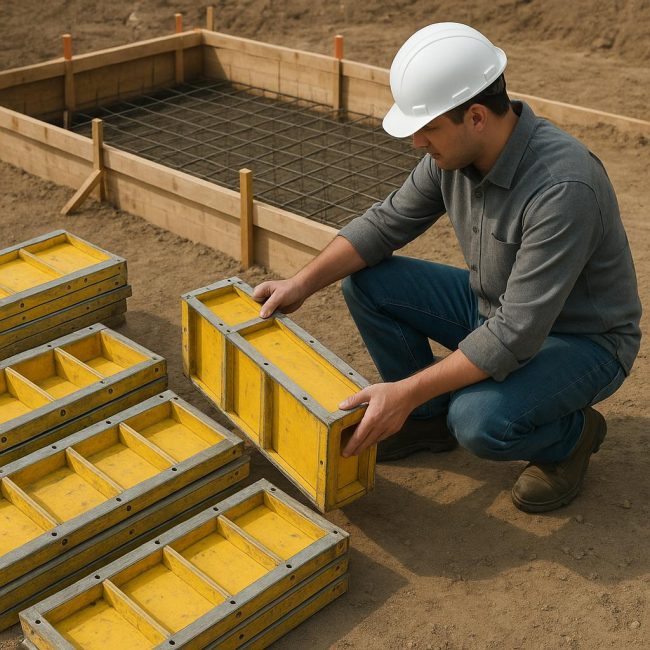
The foundation is the foundation of any building, and its quality determines the longevity of the entire structure. Properly selected and installed formwork plays a key role in creating a strong and reliable foundation. Experienced builders know that skimping on formwork can lead to serious problems down the road. Here are some practical tips for choosing foundation formwork.
Determine the type of foundation and its dimensions
The first step is to understand what type of foundation you will be pouring:
- Strip foundation: The most common, suitable for most buildings.
- Slab foundation: A solid slab under the entire building, requiring large volumes of concrete.
- Columnar (pile) foundation: Used for light buildings or on soft soils, formwork is needed for the grillage and pile heads.
The dimensions (height, width, length) and configuration of the foundation directly influence the choice of formwork. The larger and more complex the foundation, the more durable and flexible the formwork system will be.
Consider the project budget
The cost of formwork can make up a significant portion of the estimate. Your main options are:
Formwork rental: Cost-effective for one-off or small projects where purchasing is impractical. Allows the use of professional systems without a large initial investment.
Purchase of formwork: Justified for companies that regularly perform monolithic work, or for private developers planning several projects.
DIY: The most cost-effective option for small foundations (e.g., using planks or plywood). It requires time, skill, and doesn't always guarantee perfect geometry, but it may be sufficient for outbuildings or saunas.
3. Formwork material: what to choose?
Wooden formwork (boards, plywood):
- Boards: The most affordable option for custom construction. You'll need smooth, unedged or edged boards 25-50 mm thick. The key is to ensure a tight fit to prevent concrete leakage, and good rigidity with supports and ties.
- Laminated plywood: A more expensive but much higher-quality option. It provides a smooth surface, is reusable, and is highly durable. It requires a frame made of timber or metal profiles.
- A practical tip: For wooden formwork, use screws instead of nails—this will make dismantling easier. Lubricate the inside surface with used oil or a special form release to prevent concrete from sticking.
Metal formwork (steel, aluminum panels):
- Advantages: High strength, durability, reusable, ideal geometry, smooth concrete surface.
- Disadvantages: High cost of purchase or rental, requires the use of lifting equipment (for large panels).
- Practitioner's tip: Ideal for large, critical foundations and commercial construction where speed and quality are important.
Permanent formwork (EPS, expanded polystyrene concrete blocks):
- Advantages: It serves as both formwork and insulation. It speeds up the construction process and provides thermal insulation for the foundation.
- Disadvantages: Higher cost, not always suitable for all types of soil, requires compliance with installation technology.
Practical Tip: A great choice for energy-efficient homes, but make sure it's appropriate for the loads and site geology.
4. Rigidity and strength of formwork
The foundation is a large volume of concrete, which creates enormous pressure on the formwork walls.
- Be sure to use a sufficient number of ties, supports, and braces. This is critical for wooden formwork. The spacing between props for wooden formwork made from planks is typically 0.8-1 m.
- Consider the pouring height: The higher the foundation, the greater the pressure. It may be necessary to pour the concrete in layers or use stronger formwork.
- Avoid a "bulky" foundation: If the formwork isn't rigid enough, it can be pushed out by the pressure of the concrete, resulting in an uneven foundation. This is difficult to correct and can affect the quality of the walls.
5. Accuracy and tightness
- Use a level and tape measure at every stage of construction. The foundation must be perfectly level and have the correct geometric dimensions. Any deviations at this stage will create problems when erecting the walls.
- Ensure the joints are tightly sealed. Concrete slurry (cement paste) should not leak out of the formwork. This weakens the concrete, reduces its strength, and impairs its appearance. For wooden formwork, you can use polyethylene film or seal the cracks with clay.
6. Ease of installation and dismantling
- Choose a system that's relatively easy to assemble and disassemble. This is especially important for private developers.
- When designing formwork, consider how you will remove it without damaging the fresh concrete.
Conclusion
Choice formwork for the foundation — It's a compromise between cost, quality, speed, and available resources. Don't skimp on materials or reinforcing the formwork. It's better to spend a little more time and money at this stage than to face costly repairs or problems with the overall strength of the building later.
Remember: properly prepared formwork is the key to a strong and durable foundation.