A properly selected stove determines the character of the sauna: from light, moist steam with gentle warmth to a dry, invigorating sauna. Miscalculations lead to overheating, stuffy air, or an endless wait for the steam room to reach temperature. Before comparing models, it's important to understand what mode you need and how to calculate the power specifically for your space. For a guide to the sizes, designs, and variations of stoves, you can check out the selection of large specialized retailers, such as https://fixit.washerhouse.com/en/In the article below, we'll explore selection criteria without any brand ties: just logic, calculations, and practical recommendations.
- First, understand your vaping pattern.
- Power calculation: not only cubes, but also “cold” corrections
- Stone Mass: Inertia vs. Water Vacuum
- Choice of fuel: wood, electricity or gas
- Oven design: open, closed, hybrid
- Chimney and passage units: safety down to the centimeter
- Ventilation and air exchange
- Control and automation
- Examples of turnkey selection
- Common mistakes and how to avoid them
- Sheathing materials and thermal insulation
- Electrics (for electric heaters)
- Maintenance and service life
- A quick checklist before purchasing
- Result
First, understand your vaping pattern.
Different scenarios have different "thermal mathematics".
- Finnish sauna (dry): 80–100°C, humidity 5–15%. Fast heating is required, and smaller stones are possible. The power of the heating elements/firebox and ventilation are important.
- Russian bath (wet): 55–75 °C, humidity 40–60%. Required inertia: large heater (mass of stones), closed or semi-open heater for fine steam, neat feeders.
- Combined mode: 65–85°C, humidity 20–40%. A universal option: more stones than the "Finnish" version, but fewer than the "Russian" version.
Conclusion: For a Russian sauna, the priorities are stone weight and thermal inertia; for a Finnish sauna, pure power and ventilation; for a combination sauna, balance. This determines which stove to choose, even for the same steam room size.
Power calculation: not only cubes, but also “cold” corrections
The basic formula is simple, but adjustments are always added to it.
Step 1. Basic volume of the steam room (V): length × width × height, m³.
Step 2. Equivalent volume (Ve):
Ve = V + Σ(corrections for “cold” elements) − Σ(preferential corrections for insulation).
Practical amendments:
- Glass door: +1.5–2.0 m³.
- Window in the steam room: +1.0–1.5 m³ for each medium-sized window; panoramic — +2–3 m³.
- Uninsulated or weak walls (block, brick without warm cladding): +10–20% of V.
- Large stone/tile surfaces: +1–2 m³.
- Excellent thermal insulation (foil + 50 mm basalt, thorough vapor barrier): -10–15% of V.
Step 3. Power (P):
- For Finnish sauna: 1 kW per 1.2–1.4 m³ equivalent volume.
P_finn ≈ Ve / 1.3 - For Russian bath: 1 kW per 1.0–1.2 m³ equivalent volume, plus taking into account the stone mass.
P_rus ≈ Ve / 1.1
If you are hesitating between adjacent power levels, choose a model that allows you to adjust the intensity (damper, flaps, stepped heating elements), rather than a tight fit.
Two quick examples
- Steam room 2.2×2.2×2.3 m = 11.1 m³. Eat glass door (+1.5), good insulation (−10%).
Ve = 11.1 + 1.5 − 1.11 ≈ 11.5 m³.
— For sauna mode: P ≈ 11.5 / 1.3 ≈ 8.8 kW → we take 9 kW.
— For a Russian bath: P ≈ 11.5 / 1.1 ≈ 10.5 kW + increased mass of stones. - Steam room 1.8×2.0×2.2 m = 7.9 m³Window (+1.0), average insulation (0%).
Ve = 7.9 + 1.0 = 8.9 m³.
— Sauna: P ≈ 8.9 / 1.3 ≈ 6.8 kW → 7 kW.
— Russian: P ≈ 8.9 / 1.1 ≈ 8.1 kW + reserve for stones.
Stone Mass: Inertia vs. Water Vacuum
The mass of the stones determines the quality and fineness of the steam, resistance to impacts and comfort at high humidity.
- Finnish sauna: 20–40 kg for small steam rooms (6–8 m³), 40–60 kg for 8–12 m³.
- Russian bath: 60–100 kg for 8–12 m³, 100–160 kg for 12–18 m³.
- Combo mode: We strive for average values with the possibility of partially “closing” the heater.
Grain and styling: Large stones on the bottom (for inertia), medium ones for the "working" layer, and a small layer of smaller stones on top for reaction to the pressure. Don't cram the heater into a wedge—an air gap is needed for convection.
Types of stone: Diabase, peridotite, jadeite, gabbro-diabase. The key factors are strength, heat resistance, and the absence of cracks and dust. Rinse, calcine, and renew once per active season.
Choice of fuel: wood, electricity or gas
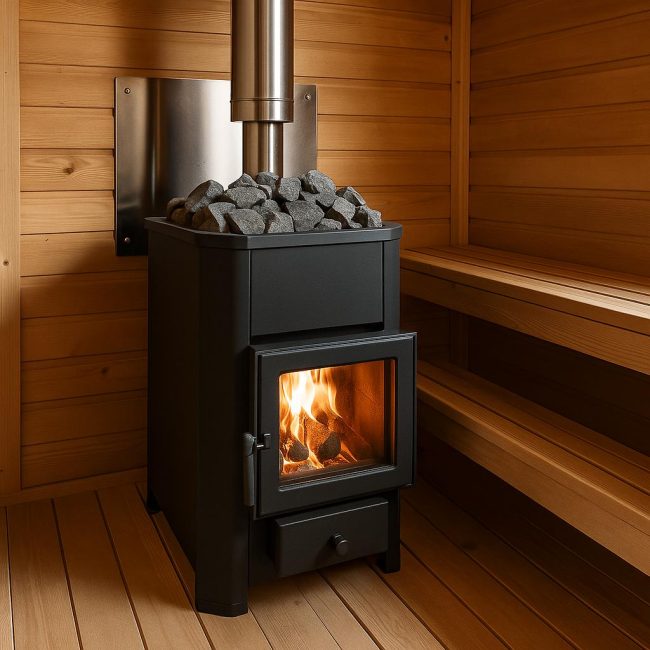
Wood-burning stoves
- Pros: "live" heat, autonomy, atmosphere.
- Cons: Chimney, firewood storage, ash removal, more attention to safety.
- Who is it suitable for: For those who appreciate the ritual and aroma of wood, there is a place for a chimney and a woodshed.
Electric heaters
- Pros: The most precise control of the mode, timer, minimum maintenance, no chimney required.
- Cons: requirements for the electrical network (power, cable, circuit breakers), tariff.
- Who is it suitable for: city saunas, summer houses with good input (usually 7–9 kW and higher).
Gas (stationary/cylinder solutions)
- Pros: fast warm-up, cheap fuel (often).
- Cons: permits and safety requirements, service.
- Who is it suitable for: when gas is available and there is experience/possibility of official installation.
Oven design: open, closed, hybrid
- Open heater: quick start, good for dry sauna, less inertia - rougher steam with larger inputs.
- Closed heater/with steam generator: slower acceleration, but finely dispersed steam at Russian modes, comfortable at 55–70 °C and high humidity.
- Combined solutions: the ability to “close” some of the stones and control the character of the steam.
Metal thickness and cladding: A thicker body and the presence of cladding (talc chlorite, serpentine, brick) increase thermal inertia and comfort, but increase acceleration time and price.
Chimney and passage units: safety down to the centimeter
- Chimney diameter — strictly according to the stove's specifications. A "narrow" chimney = backdraft, a "well" of smoke in the steam room; too wide = cooling and condensation.
- Sandwich pipes at the exit through the ceilings and roof: minimize overheating and the risk of fire.
- Passage units (PUF): Maintain clearances to flammable structures (usually 130–250 mm) and screens.
- Spark arrestor on the head is required for wood-burning stoves.
- Damper (flap): to regulate the draft, but do not close the chimney completely when hot.
Ventilation and air exchange
Even an ideal stove won’t help if the air in the steam room “stagnates.”
- Tributary on the floor next to the stove (or in the stove area), hood diagonally above, through an adjustable valve.
- For electric heaters, the required flow rate is in the volume recommended by the manufacturer.
- For a Russian bath you can use recirculation circuit: heating of the inflow near the stove, “soft” ventilation without drafts.
Control and automation
- Electric heaters: Remote controls, PID control, timers, protective shutdowns.
- Wood burning stoves: Mechanics—ash pit, door, damper. Some solutions include overheating sensors and spark protection.
- Combined systems sometimes supplemented with a steam generator with fine dosing.
Examples of turnkey selection
Case A: Russian bathhouse 12 m³, glass door, good insulation
Ve ≈ 12 + 1.5 − 1.2 = 12.3 m³.
- Stove: wood-burning mass heater 80–120 kg, closed/semi-closed heater.
- Power equivalent to ≈ 11–12 kW.
- Chimney: sandwich, polyurethane foam, cap with spark arrestor.
- Ventilation: inlet near the stove, exhaust diagonally above the shelf.
- Mode: 60–70 °C, humidity 40–55%, small additions of 50–100 ml every 2–3 minutes.
Case B: sauna 8.5 m³, window, medium insulation
Ve ≈ 8.5 + 1.0 = 9.5 m³.
- Electric heater 7–8 kW, stones 35–50 kg, open heater.
- Active ventilation, timer for 60–90 minutes, smooth adjustment.
- Mode: 85–95 °C, 10–15% humidity, rare additions for aroma.
Common mistakes and how to avoid them
- The oven is just right in terms of power. The result is a slow warm-up and a "boiling" stove with little air. Get a heater with adjustable settings.
- Ignoring glass and stone in Ve calculation. A glass door and window are complete heat sinks.
- Poor ventilation. A “heavy” head, stuffiness, fluctuations in humidity – these are almost always related to the air.
- Incorrect chimney. Too long/cold vertical section without insulation - condensation, tar.
- Stinginess with stones for the "Russian" regime. There will be a lot of steam, but it is rough and “wet”, quickly “kills” comfort.
Sheathing materials and thermal insulation
- Thermal insulation: basalt wool 30–50 mm, aluminum foil with sealed joints, ventilation gaps.
- Finishing: Linden, aspen, abash - low thermal conductivity, comfortable to touch.
- Shelves and ergonomics: at least 2 levels, top shelf width 60–80 cm, rounded edges.
- Thermal protection around the stove: Stainless steel screens with an air gap, firebox sheet, basalt slabs.
Electrics (for electric heaters)
- Dedicated line of the required cross-section (refer to the data sheet: 7–9 kW — three phases or reinforced single-phase line), circuit breaker + RCD.
- Cable in heat-resistant corrugated pipes, hidden connections in distribution boxes outside of “hot” zones.
- Remote control remote in a dry room, sensors - according to the manufacturer's diagram.
Maintenance and service life
- Stones: Inspection of fireboxes every 30–40 minutes – replace any cracked or dusty ones; relining to maintain convection.
- Chimney: inspection and cleaning at least once a season (more often during active use).
- Tree: Drying the steam room after the session (ventilation slots slightly open), once a season lightly treating the wood with compounds approved for high temperatures.
A quick checklist before purchasing
- Mode: Russian/Finnish/combo?
- Exact dimensions of the steam room and adjustments (glass, windows, wall material, insulation).
- Equivalent volume Ve and estimated power.
- Required mass of stones.
- Fuel type and engineering restrictions (electrical supply, chimney).
- Adjustment reserve (damper, power stages, lockable heater).
- Ventilation: supply/exhaust scheme.
- Safety: polyurethane foam, screens, gaps, spark arrestor.
- Service and availability of consumables (stones, seals, gaskets).
- The budget is not only for the stove, but also for chimney/cable/PUF/screens.
Result
Choosing a stove isn't a matter of randomly selecting kW. First, choose the desired steam mode, then equivalent volume taking into account glass, insulation and materials, then - selection of power and masses of stonesFor a Russian banya, it's crucial to have sufficient inertia (stones and/or cladding), while for a sauna, precise adjustment and ventilation are crucial. Careful attention to the chimney, passageways, and air exchange ensures not only a comfortable but also a safe outcome. If you plan everything in advance, the stove will fit your steam room like a glove: it will quickly warm up, maintain its temperature, and provide that gentle steam that everyone loves about the banya.