Instantaneous water heaters are becoming increasingly popular among homeowners. These units provide hot water as needed, saving space and energy. However, when installing a water heater, it's important to consider many factors, including the correct selection of electrical cable. One key step is determining the appropriate wire size for connecting an 8 kW unit. Mistakes at this stage can lead to overheating, short circuits, or even fire. In this article, we'll discuss how to select the correct cable based on the water heater's power, as well as the nuances to consider during the selection process.
Why is choosing the right wire important?
When connecting any electrical appliance, especially a powerful one like a water heater, it's important to consider the load it will place on the electrical system. It's crucial to select a cable that can handle this load without overheating. For an 8 kW water heater, calculating the cable cross-section is crucial for ensuring safe operation. Incorrect cable selection can cause it to overheat, leading to an emergency.
How a tankless water heater works and what affects energy consumption
A tankless water heater operates by instantly heating water as it moves through the heater's tubes. The heater's power consumption depends on its wattage and the line voltage. Water heats up to the desired temperature in a matter of seconds, requiring constant energy consumption.
For a device with a power of 8 kW at a standard voltage of 220 V (for most Russian networks), the current consumption can be calculated using a simple formula:
�=��
Where�— current in amperes,�— device power in watts,�— line voltage. For an 8 kW water heater, the calculation would look like this:
�=8000220≈36.36 A
This means that the current that will flow through the wire will be approximately 36.36 amps.
How to choose the right wire
To ensure safe operation of the water heater, it's important that the wiring is rated for the required load. When calculating the cable cross-section for an 8 kW water heater, consider not only the current, but also the length of the cable, the cable material, and the operating conditions.
1. Selecting the cable cross-section
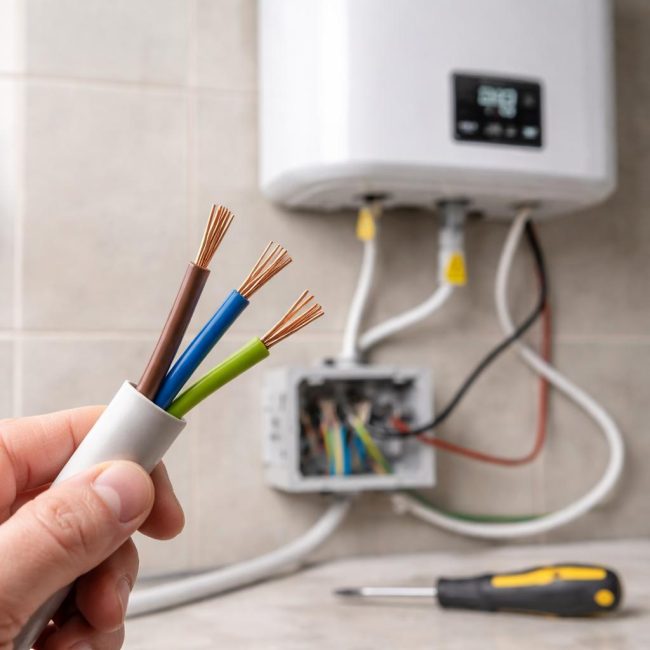
For a current of 36.36 A, the optimal choice is a cable with a cross-section of at least 6 mm² for copper or 10 mm² for aluminum. These values will ensure the current can pass safely without overheating the wire. Copper is a better conductor than aluminum, so a smaller cross-section is required for copper wires.
2. Consider the length of the wire
The longer the cable, the higher the resistance and the greater the voltage drop. For long cable runs (over 30 meters), it's recommended to increase the cable cross-section. Otherwise, you may experience problems with the device or even damage it.
3. Cable type and its insulation
When choosing a water heater cable, it's important to consider the cable type. For home installations, cables with insulation that can withstand high temperatures are suitable. These can be cables with PVC insulation or other heat-resistant materials. Be sure to check that the cable is marked to ensure it meets safety standards.
4. Grounding wire
It's important to remember that for water heaters with a metal casing, it's important to ensure proper grounding. This will prevent possible electric shock. Typically, a 2.5 mm² wire is used for grounding.
Use cases and consequences of choice
1. Choosing the right wire: what does it give?
Properly sized wire prevents overheating, emergency shutdowns, and ensures the longevity of the device. A cable selected with consideration for actual operating conditions will not overheat, and the water heater will operate reliably and safely.
2. Mistakes when choosing a cable: what can happen?
Selecting a cable with a gauge that's too small will cause the wire to overheat, leading to damage or fire. Installing a wire that's too thin may impair the water heater's proper operation and result in additional repair costs.
3. Influence of cable length
The longer the cable, the greater the voltage drop during its passage. This can affect the device's operation, especially if the input voltage is lower than required. For longer distances, the cable cross-section should be increased to avoid this.
Expectations and common misconceptions
1. One wire - one power
Some owners believe that the device's power directly dictates the cable's choice. In fact, in addition to power, the current flowing through the cable is also important. Therefore, calculations should always be based on actual current values.
2. Using cheap cables
Sometimes owners skimp on wiring, choosing cheaper alternatives. However, cheap wiring may not withstand the required loads and quickly fail. It's better to invest in high-quality materials to avoid costly repairs down the road.
Conclusion
Choosing the right cable for an 8 kW instantaneous water heater isn't just a matter of convenience, but also safety. Properly sizing and selecting the right cable size will ensure reliable operation and prevent overheating and breakdowns. Don't forget to also consider the cable length, material type, and insulation. As a result, your water heater will provide long, safe service, providing hot water as needed.