The modern bathroom has long since ceased to be simply a utilitarian space. Today, it's a space for relaxation, rejuvenation, and morning recharge. The focus is on comfort, aesthetics, and technology that make daily rituals more convenient and hygienic. This trend illustrates the general direction of modern interior design: a desire for multifunctionality, efficient use of space, and attention to personal hygiene.
- Basic principles for choosing plumbing fixtures
- Toilet: From a Basic Device to an Intelligent Assistant
- Sink and faucet: a union of design and ergonomics
- Bath or shower: a matter of space and preference
- Materials and durability of plumbing fixtures
- Water and energy saving technologies
- Design and style: unity of form and function
- Ergonomics and safety
- Smart Plumbing: The Future Is Here
- Conclusion
Basic principles for choosing plumbing fixtures
Choosing bathroom fixtures begins with understanding the needs and characteristics of a particular space. Modern designers advise considering not only the bathroom size but also the occupants' lifestyle. Some emphasize aesthetics and visual harmony, while others prioritize practicality and durability.
The key rule is to find a balance between convenience, functionality, and design. Every detail, from the sink to the faucet, should perform its intended purpose without compromise. This is especially true in an era when technological solutions are becoming increasingly integrated: concealed mounting systems, touchless faucets, thermostats, and water-saving devices.
Toilet: From a Basic Device to an Intelligent Assistant
The classic toilet has long ceased to be a mere "necessity." Modern models are engineered systems designed for comfort, hygiene, and resource conservation. A toilet with a bidet function has been one of the most popular solutions of the last decade. It combines two functions, saving space and improving hygiene.
Such models may have:
- adjustable water and seat temperature;
- built-in hair dryer;
- self-cleaning system;
- control via remote control or mobile app;
- presence sensors and automatic lid opening.
This combination of technologies transforms a familiar process into a comfortable ritual. Furthermore, the device helps reduce toilet paper consumption, making it an eco-friendly choice.
Sink and faucet: a union of design and ergonomics
When choosing a sink, it's important to consider not only the shape and material, but also the bowl depth, installation height, and storage space. Overhead models are popular today, offering a striking appearance and convenient placement of plumbing fixtures.
Faucets are also becoming increasingly smart: thermostatic options maintain a stable water temperature, while touch-sensitive models respond to hand movements. This not only saves water but also reduces the risk of bacteria spreading—especially important for families with children.
Bath or shower: a matter of space and preference
Many apartment owners face a choice: keep the bathtub or install a shower. The decision depends on the size of the room and the habits of the residents.
- Bath Perfect for those who enjoy relaxation, aromatic treatments, and cozy evenings with foam and salt. Modern models are equipped with hydromassage, lighting, and even an aromatherapy system.
- Shower cabin — an option for those who value dynamism and space efficiency. Compact systems with glass partitions and built-in faucets visually enlarge the room.
Some designers offer combined solutions—a bathtub with a shower area or an open shower system combined with a floor drain.
Materials and durability of plumbing fixtures
The quality of materials directly impacts the service life of equipment. Modern manufacturers offer a wide selection, from classic sanitary ceramics to innovative composites and tempered glass.
- Earthenware and porcelain — time-tested materials that are durable and easy to maintain.
- Acrylic Often used for baths due to its lightness and pleasant to the touch surface.
- Stainless steel used in faucets, providing durability and corrosion resistance.
- Composites (e.g. quaryl, cast marble) are increasingly used in the premium segment, combining durability with aesthetics.
Modern coatings often have antibacterial and dirt-repellent properties. These prevent plaque buildup and reduce the need for frequent cleaning.
Water and energy saving technologies
Innovations in plumbing are aimed not only at comfort, but also at resource conservation.
- Double flush in toilets allows you to choose the volume of water - usually 3 or 6 liters.
- Aerators in faucets saturate the air flow, reducing consumption without loss of pressure.
- Thermostatic systems prevent sudden temperature changes, reducing energy consumption.
These decisions are especially important in the context of rising tariffs and environmental awareness.
Design and style: unity of form and function
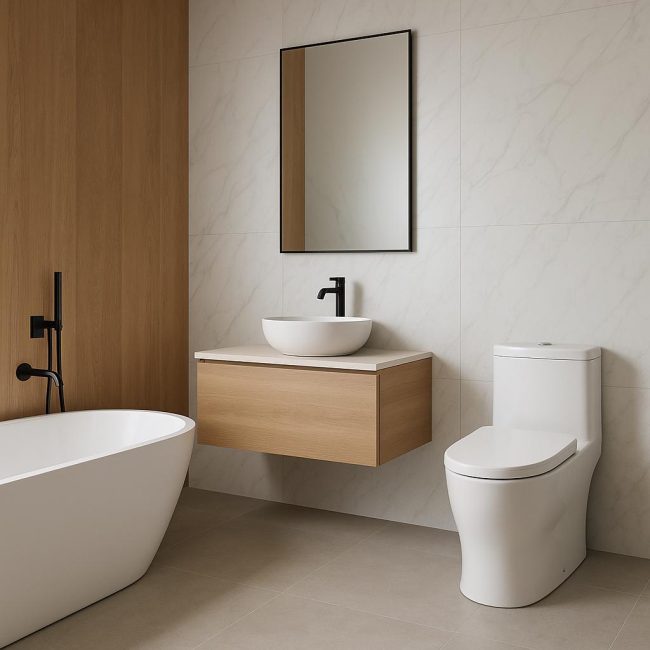
A modern bathroom is more than just a collection of fixtures, but a well-thought-out ensemble. The harmony of shapes, shades, and textures creates a sense of cohesion.
Trends of recent years:
- minimalism and clean lines;
- combination of matte and glossy surfaces;
- use of natural materials (stone, wood, ceramics);
- Hidden communications and suspended structures that create a light effect.
It's important to remember that plumbing fixtures aren't just a functional element, but a part of the visual design. Therefore, it's important to choose models that support the chosen interior design concept.
Ergonomics and safety
When choosing plumbing fixtures, it's important to consider not only appearance but also ease of use. The height of the toilet, the shape of the sink, and the placement of the faucet all impact everyday comfort.
For families with children or elderly people, it is worth paying attention to:
- soft-close toilets;
- non-slip floor coverings;
- handrails and stable supports in shower areas;
- systems for protection against overflow and overheating of water.
These details are not noticeable at first glance, but they make the bathroom truly safe.
Smart Plumbing: The Future Is Here
Digitalization has reached the bathroom, too. Smart devices integrated into smart home systems are becoming increasingly common.
Examples of such solutions:
- control of lighting and ventilation using voice commands;
- automatic filling of the bath at a set temperature;
- toilets with bidet function, controlled via smartphone;
- notifications about leaks and high humidity.
These technologies not only improve comfort but also control energy consumption, ensuring safety and savings.
Conclusion
When choosing plumbing fixtures, consider not only appearance but also functionality, durability, ergonomics, and efficiency. Properly selected fixtures create a harmonious space, and daily rituals are pleasant and convenient. Ultimately, the ideal bathroom is one where technology is discreet, yet every element works for your convenience. This is the essence of the modern approach to choosing plumbing fixtures—to combine practicality and style, comfort and efficiency, so that the home becomes a place where you can live and relax.