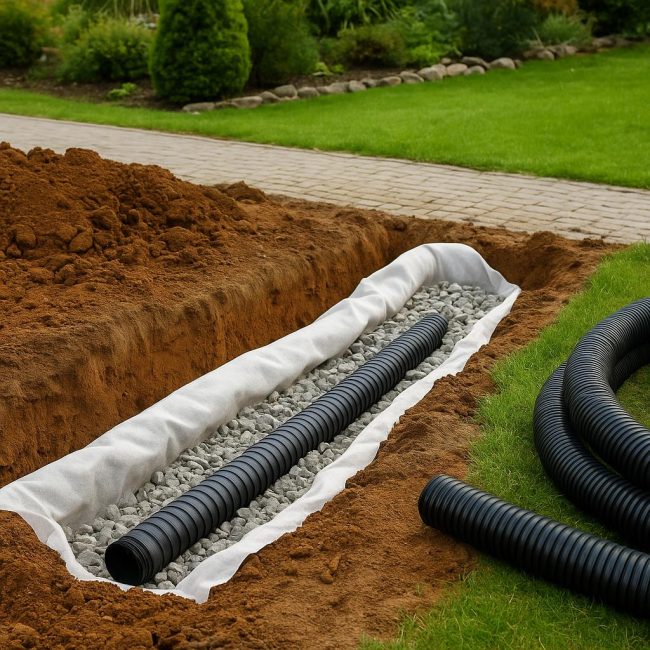
Installing a drainage system isn't just a technical step; it's a crucial measure to protect a site from moisture and flooding. This is especially important in regions with a capricious climate and high groundwater levels. For example, in St. Petersburg, it's best to entrust drainage to professionals right away to avoid mistakes and rework. Incorrect slope, unaccounted soil conditions, and the choice of inappropriate materials can all reduce the system's effectiveness to zero. Of course, a basic understanding of drainage principles will also be useful for those planning to entrust the work to professionals. In this article, we'll cover in detail the main types of systems, their selection criteria, and common installation mistakes.
- Why is drainage necessary on a site?
- Main types of drainage systems
- Surface (open) drainage
- Deep (closed) drainage
- Local drainage
- How to choose the right type of drainage
- Assess the relief
- Study the soil composition
- Check the groundwater level
- Think about where to drain the water
- Common mistakes when installing drainage
- ❌ Lack of a project
- ❌ Ignoring geotextiles
- ❌ Use of unsuitable materials
- ❌ Incorrect slope
- ❌ No revisions
- Maintenance of the drainage system
- Conclusion
Why is drainage necessary on a site?
Drainage is an engineering system that removes excess moisture from a site. It protects:
- foundation of the building from destruction;
- basements from dampness and mold;
- priming from waterlogging and subsidence;
- plants and lawns from root rot;
- paths and paving from swelling and destruction in frost.
Even if a site appears dry, this doesn't always mean there are no problems. In the spring, during the snowmelt, or after heavy rains, the situation can change dramatically.
Main types of drainage systems
The choice of system type depends on the topography, soil composition, groundwater depth, amount of precipitation and development.
Surface (open) drainage
This is the simplest and most inexpensive drainage method. It consists of a network of shallow ditches or channels through which water flows into a well or off-site.
When is it suitable:
- with high groundwater levels;
- in areas with clayey or loamy soil;
- when there is a need to quickly drain rainwater.
Pros:
- easy to set up;
- cheap;
- easy to clean.
Cons:
- the visible part disrupts the aesthetics of the area;
- works only with surface moisture;
- requires regular maintenance (cleaning from leaves, debris).
Deep (closed) drainage
It consists of a system of perforated pipes laid below the frost line and wrapped in geotextile. These pipes collect groundwater and drain it into a drainage well.
When is it suitable:
- at high groundwater levels;
- to protect foundations and basements;
- in heavy, poorly drained soils.
Pros:
- does not disturb the landscape;
- protects the entire area along the perimeter;
- durable if installed correctly.
Cons:
- Expensive;
- requires precise calculations;
- difficult to clean without revisions.
Local drainage
It is designed to dry out a specific element, such as a house's blind area, a garage entrance, or a gazebo area.
Pros:
- does not require design of the entire system;
- economical;
- solves local problems.
Cons:
- ineffective for general drainage of the area.
How to choose the right type of drainage
Assess the relief
On slopes, open ditches make sense—water flows downwards by gravity. On flat areas, deep drainage with a slope through pipes is more effective.
Study the soil composition
Clay soils retain water, while sandy soils drain well. The heavier the soil, the higher the risk of water stagnation.
Check the groundwater level
If groundwater levels rise above 1.5 m, deep drainage is essential.
Think about where to drain the water
It's important to plan a well or drainage field in advance. Discharging water onto a neighboring property is a violation of sanitary regulations and subject to legal action.
Common mistakes when installing drainage
❌ Lack of a project
Without a clear plan, it is easy to make incorrect slopes, depths, or pipe placement errors.
❌ Ignoring geotextiles
Without filter material, the pipes quickly become clogged and the system fails.
❌ Use of unsuitable materials
For example, sewer pipes are not designed for drainage - they do not have the necessary perforation and can burst.
❌ Incorrect slope
If the slope is too shallow, water will stagnate. If it's too steep, gravel can be washed away and the soil can settle.
❌ No revisions
Inspection manholes are essential for pipe maintenance. Their absence complicates cleaning and repairs.
Maintenance of the drainage system
Even properly installed drainage requires preventative maintenance:
- once every 1–2 years flush the pipes (using a pump or under pressure);
- in autumn and spring clean trays if open drainage is used;
- check the wells for siltation;
- replace geotextiles when repairing or expanding the system.
Conclusion
A drainage system isn't a luxury, but a necessary element of landscaping, especially in regions with high humidity. Experience in drainage design shows that a competent approach at the site preparation stage can avoid many problems in the future, from a damaged foundation to a ruined garden. Before installation, conduct a site survey, determine the soil type and water level, draw up a design, and don't skimp on materials.