Panoramic glazing is no longer a rarity: it's used in private homes, cottages, modern townhouses, and even apartments. Large glass surfaces create a sense of spaciousness, provide maximum natural light, and visually connect the interior with the surrounding landscape. However, along with aesthetics comes the engineering challenge of how to provide efficient heating when a significant portion of the exterior walls have been replaced with glass.
When designing such spaces, various solutions are used: from traditional radiators to concealed underfloor systems, such as Vitron convector heaters, designed for use in areas with panoramic glazing. But the choice shouldn't be limited to the equipment's name—it's important to understand the physics of the processes, heat loss, air circulation, and comfort requirements.
- Why do panoramic windows complicate the heating task?
- Basic approaches to heating with panoramic glazing
- Wall-mounted radiators
- Warm floor
- Floor convectors
- How to correctly calculate heating capacity
- It is important to consider the architecture and layout
- The influence of ventilation and tightness
- Combined schemes: the most rational option
- What to look for when choosing equipment
- Mistakes in heating design with panoramic windows
- Energy efficiency and operating costs
- Results
Why do panoramic windows complicate the heating task?
The main characteristic of large glass surfaces is increased heat loss compared to an insulated wall. Even modern double- and triple-glazed windows with energy-saving coatings are inferior to a solid wall in terms of thermal resistance.
Main problems:
- Cold radiation from glass
In winter, the interior surface of the glass is cooler than the walls. This is felt as a "dragging chill," even if the room temperature is normal. - Convective currents
Cooled air near the glass descends, creating a cold current along the window. If left unchecked, this can cause discomfort. - Risk of condensation
If the lower glazing area is not heated sufficiently, moisture may form on the glass.
Therefore, heating in a house with panoramic windows should not just heat the air, but also form thermal curtain along the glass.
Basic approaches to heating with panoramic glazing
Wall-mounted radiators
The classic solution is to install radiators under the windows. However, with floor-to-ceiling panoramic glazing, installing a traditional radiator is often impossible.
Pros:
- ease of installation,
- accessibility,
- clear operation.
Cons:
- limited height,
- violation of the visual cleanliness of the interior,
- impossibility of installation with floor-to-ceiling glazing.
If you do have a windowsill, you can use low horizontal radiators. However, their output must be carefully calculated.
Warm floor
Water or electric underfloor heating is often considered a universal solution.
Advantages:
- uniform heating of the room,
- lack of visible instruments,
- comfortable temperature in the floor area.
However, it is important to understand: underfloor heating does not create a directed air flow along the glassIt heats the room, but is not always able to effectively compensate for the cold from large windows.
Therefore, in houses with panoramic glazing, underfloor heating is often used as additional heat source, and not the only one.
Floor convectors
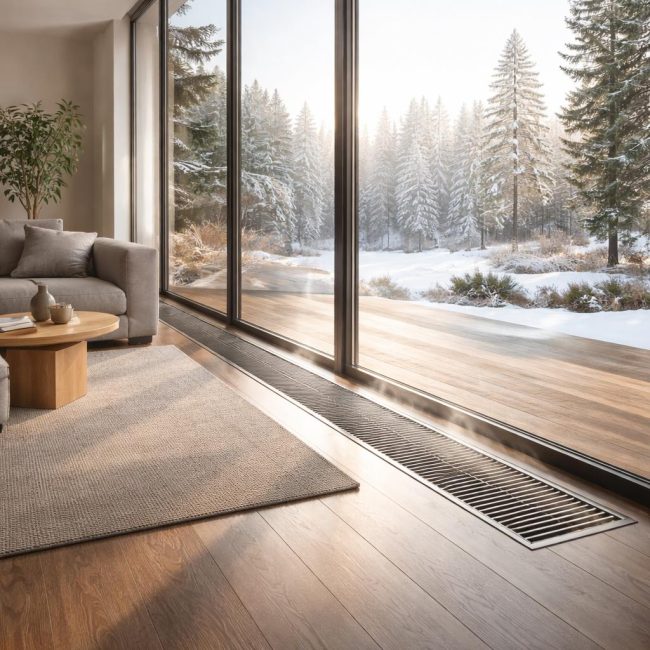
This is one of the most popular solutions for homes with floor-to-ceiling glazing. The convector is mounted in a recess in the screed along the window and covered with a decorative grille.
Operating principle:
- cold air sinks to the floor,
- enters the heat exchanger,
- heats up,
- rises up along the glass,
- forms a thermal curtain.
Advantages:
- hidden installation,
- effective fight against cold flow,
- preserving the panoramic view,
- possibility of integration into modern interiors.
There are models with natural convection and with fans (forced convection). The latter are more powerful but require a power connection.
How to correctly calculate heating capacity
For panoramic windows, standard average values of "100 watts per square meter" cannot be used as a guide. It is necessary to consider:
- area and height of glazing,
- type of glass unit,
- construction region,
- orientation of the house to the cardinal points,
- the presence of underfloor heating,
- level of insulation of walls and roof.
It's best to perform a thermal engineering calculation. This will help determine:
- total heat loss,
- the required power of the devices,
- heat distribution by zones.
An error at the calculation stage leads either to overheating and energy waste, or to a constant feeling of cold.
It is important to consider the architecture and layout
In a house with panoramic windows, heating is part of the architectural design. It's important to determine in advance:
- screed depth for underfloor devices,
- location of collectors,
- pipe routing,
- automation connection points.
If the decision is made after the floor has been poured, the options are significantly limited.
The influence of ventilation and tightness
Even a perfectly selected heating system will not provide comfort if:
- there are uncontrolled influxes of cold air,
- there is no ventilation system,
- The double-glazed windows are not installed correctly.
Modern homes with panoramic glazing require well-designed supply and exhaust ventilation. Otherwise, the following problems may occur:
- fogging,
- drafts,
- uneven temperature.
Combined schemes: the most rational option
In practice, a combination of several solutions is most often used:
- underfloor heating as a basic heat source,
- floor convectors along the glass,
- additional wall radiator in a remote area.
This approach allows:
- create a comfortable temperature,
- compensate for heat loss,
- preserve the architectural aesthetics.
What to look for when choosing equipment
- Heat exchanger material
Copper-aluminum systems have high heat transfer. - Depth and width of the body
It is important to provide a mounting niche in advance. - Type of grille
It must be able to withstand the load, especially if it is installed in a walk-through area. - Noise level
If a fan is used, acoustic comfort must be taken into account. - Temperature control
The presence of thermostats and automation significantly increases ease of use.
Mistakes in heating design with panoramic windows
- selection of equipment "by eye" without calculation;
- installation of only underfloor heating with a large glass area;
- lack of cold flow compensation;
- savings on insulation of slopes and assembly units;
- late adoption of engineering decisions.
Each of these errors can lead to systemic discomfort that is difficult to resolve after the repair is completed.
Energy efficiency and operating costs
Large glass surfaces increase heat loss, which in turn increases heating costs. To reduce these costs, it's important to:
- use energy-efficient double-glazed windows,
- use automatic weather-dependent control,
- zoning heating,
- Set temperature settings correctly.
Modern systems allow you to maintain comfort with reasonable energy consumption if they are properly designed.
Results
Choosing a heating system for a home with panoramic windows is an engineering challenge, not just a matter of selecting equipment. Large glass surfaces require the creation of a thermal curtain, compensation for convective flows, and precise power calculations.
The most efficient solution is often a combination of in-floor convectors and underfloor heating. However, the final choice should be based on thermal analysis, the building's architecture, and climatic conditions.
A well-designed system will preserve the main advantage of panoramic windows—the feeling of open space—without sacrificing comfort and energy efficiency.