Sunbathing on a sunny day, enjoying fresh air during a summer rain, and not having to worry about gusts of wind—sounds like a dream? With a bioclimatic pergola, it becomes a reality. This complex name conceals an innovative system that transforms your balcony, terrace, or patio into an all-season living area. Let's figure out how to choose the right one.
What is it and how does it work?
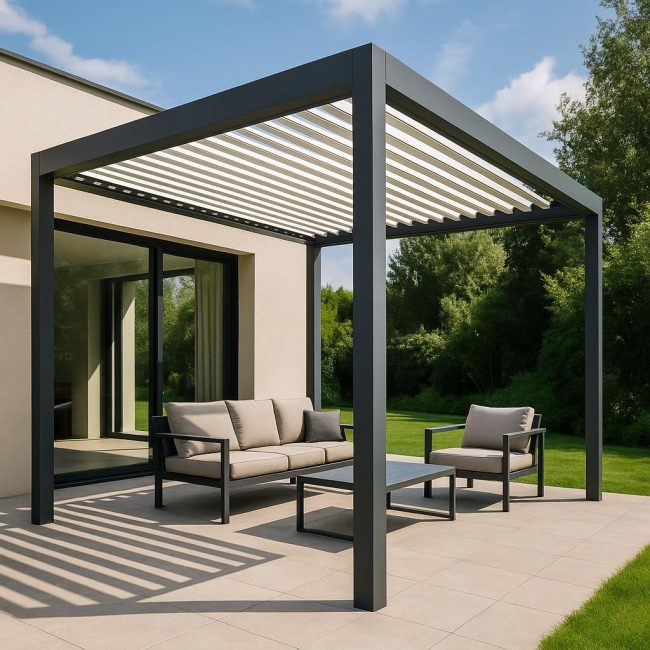
A bioclimatic pergola is a structure with rotating awning slats instead of a solid roof. Its "bioclimatic" properties refer to its ability to adapt to weather conditions.
Operating principle: The aluminum slats can be smoothly rotated around their axis, adjusting the angle from 0° (fully closed) to 90° (fully open) and up to 180° (leaf or snow shedding). Rotation can be manual (using a crank) or automatic (using an electric motor).
Key benefits:
- Climate control: You decide how much sun and shade you need at any given moment.
- Protection from rain and wind: When closed, the slats direct water into the side gutters.
- Strength and Durability: Aluminum construction is corrosion resistant and can withstand heavy loads.
- Aesthetics: A modern and stylish look that will transform any facade.
Key selection criteria
Design and installation method
- Cantilever (sloping): Has only two supporting posts, the other side is attached to the wall of the house. It looks light and airy. Ideal for balconies and terraces adjacent to the house.
- Freestanding (arched): Has four support posts and can be installed anywhere on the property (for example, over a patio or pool). Often has a gable roof for improved water drainage.
Your choice depends on the installation location: against a wall or as a stand-alone object.
Control system: Manual or Automatic?
- Manual control (crank):
- Pros: Cheaper, more reliable, does not depend on electricity.
- Cons: Not as comfortable, especially if the structure is tall or large.
- Who it's for: For compact pergolas with easy access to all control points.
- Automatic control (electric drive):
- Pros: Maximum comfort. Control via remote control or smartphone. Integration with sensors possible.
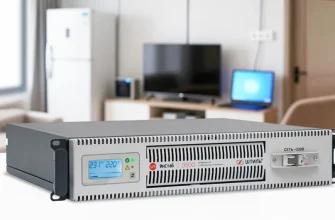
- Disadvantages: Higher cost, dependence on electricity supply (can be solved by installing a UPS).
- For whom: For large structures, connoisseurs of a smart home and uncompromising convenience.
Material and workmanship
- Aluminum: This is the standard. Look for aluminum profiles with a powder-coated finish. It resists fading in the sun and is scratch-resistant. Pay attention to the thickness of the metal—it determines its strength.
- Lamels: They should be thick and rigid enough to resist deformation under load. Check for smooth operation when turning.
- Glazing (optional): Some models allow the installation of side sliding or frameless glass systems, turning the pergola into a full-fledged veranda.
Additional accessories and options
They are what make using a pergola truly comfortable.
- Gutter system: High-quality gutters hidden in the support beams guarantee that water will not pour down on you in a stream.
- Integrated lighting: LED strips integrated into the cornice create a stunning ambience in the evening.
- Retractable awnings: Additional protection from low sun from the side.
- Heaters and IR lamps: Extend the season of use in cool weather.
- Mosquito nets: Protection from insects without losing the feeling of open space.
- Wind and rain sensors (for automatic models): The system will automatically close the slats when the weather worsens.
Color and design
Manufacturers offer a wide range of colors (usually from the RAL catalog). Choose a shade that complements your home's façade and window frames. Classic options include white, black, graphite, and shades of brown.
What to look for when buying? Checklist
- Manufacturer: A well-known brand (for example, Renson, GAP, Fristads) is a guarantee of quality fittings and the accuracy of engineering calculations.
- Certificates and warranty: Request technical documentation and make sure there is an official warranty (usually 5+ years).
- Installation: Trust installation only to certified professionals. Incorrect installation will negate the benefits of an expensive system.
- Try-on: If possible, see the working design in a showroom or with friends.
- Assembly and installation: Check whether the installation is being performed by the manufacturer or a contractor. The former option is more reliable.
Conclusion
A bioclimatic pergola is an investment in comfort and increased living space for your home. By choosing wisely and paying attention to detail, you'll be purchasing more than just a canopy, but a multifunctional system that will provide years of enjoyment, regardless of the vagaries of nature.