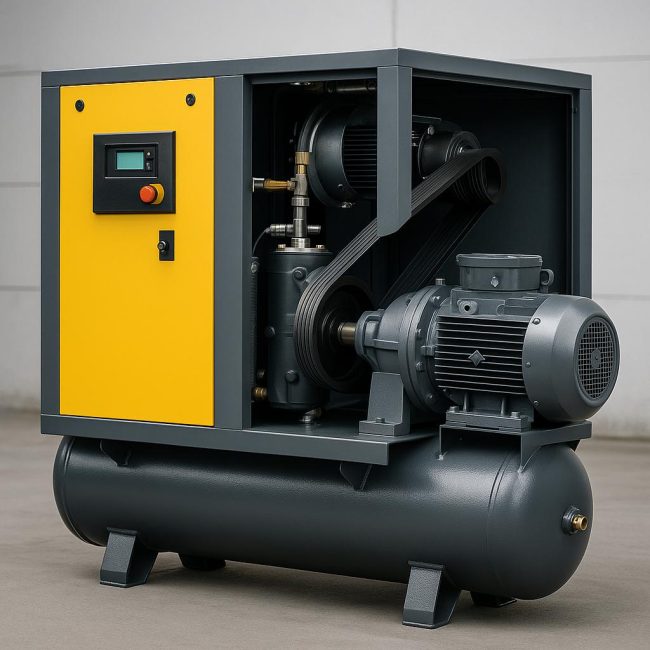
In today's environment, the stability and efficiency of production processes depend largely on properly selected equipment. Screw compressors, models of which can be found here, have become an integral part of most industrial facilities—from metalworking shops to food factories. Their popularity is due not only to their high performance and stable supply of compressed air, but also to the ability to fine-tune them to meet specific production needs. However, choosing a screw compressor is no easy task. First, it's important to determine key parameters: power, pressure, air volume, and equipment capacity.
While choosing a compressor used to be a matter of evaluating a couple of technical specifications, today, expert advice from compressor equipment suppliers is crucial. An incorrectly selected unit can lead to increased maintenance costs, reduced service life, or even complete shutdown of production.
- Why a screw compressor?
- Key parameters when choosing a screw compressor
- Performance (air flow volume)
- Working pressure
- Engine power
- Cooling type: air or water
- Operating mode: continuous or variable
- Secondary but important parameters
- Where mistakes are most often made when choosing
- Summary: Algorithm for selecting a screw compressor
- Conclusion
Why a screw compressor?
First, it's worth understanding the advantages of screw compressors over piston compressors. The main difference is the compression principle. A screw compressor operates by rotating two screws (rotors), which capture air and compress it as they rotate. This ensures:
- Smooth and stable air supply, without the pulsations typical of piston models.
- High energy efficiency during long-term continuous operation.
- Low noise level and vibrations.
- Long service life between repairs, especially if regular maintenance is performed.
- Compactness and integration with dehumidifiers and receivers as part of a single installation.
For businesses that require constant compressed air without pressure surges, choosing a screw compressor is virtually the only option.
Key parameters when choosing a screw compressor
Performance (air flow volume)
This is the main parameter that indicates how much compressed air the compressor can deliver per minute. It is measured in liters per minute or cubic meters per hour.
The equipment performance must correspond to the total consumption of all pneumatic tools operating simultaneously.
It is important to lay down 10–20% of stockto avoid operating the equipment at its limits, which reduces service life and increases wear.
Working pressure
Compressors are available in low (up to 8 bar), medium (8–15 bar) and high pressure (15 bar and above).
For most industrial needs, a pressure compressor is suitable. from 7 to 10 bar, but if we are talking about, for example, sandblasting or injection molding, equipment with a higher output pressure will be required.
Engine power
Expressed in kW.
Power is directly related to performance. However, it's important to consider not only the nominal values, but also engine energy efficiency (for example, compliance with class IE3 or IE4). The higher the class, the lower the energy conversion losses.
Cooling type: air or water
- Air cooling — easier and cheaper to operate, suitable for most standard tasks.
- Water cooling — necessary at high ambient temperatures or for powerful compressors with high performance.
The choice depends on operating conditions: temperature, ventilation, humidity.
Operating mode: continuous or variable
If the compressor should work in continuous mode (for example, in three shifts), it is important to choose equipment with a high safety margin and a reliable cooling system.
For variable loads, compressors with frequency converter (inverter), which regulates the speed of rotation of the rotors depending on the need.
Secondary but important parameters
- Built-in dehumidifier and receiverThis reduces the space required and simplifies installation.
- Noise level — especially important for workshops with working people.
- Drive type: belt, direct or through a gearbox.
- Availability of service and spare parts — a key point when choosing a supplier.
- Warranty and service life of rotors, which are the most expensive part of a screw compressor.
Where mistakes are most often made when choosing
- They focus only on price.
Cheap models with a shorter service life quickly fail under active use. - They do not take into account the future growth of the enterprise.
They choose a compressor “just right” without any reserve, and within a year it has to be replaced. - The duty cycle is calculated incorrectly.
A compressor that operates 24/7 without stopping will quickly fail if it is not designed for such a load. - They ignore climatic conditions.
Installing a compressor in a poorly ventilated room without taking the temperature into account is a common cause of overheating.
Summary: Algorithm for selecting a screw compressor
Determine the total need for compressed air.
Specify the required pressure.
Select a compressor with a performance reserve (10–20%).
Calculate the operating mode (hours per day, shifts, seasonality).
Assess connectivity and power grid options.
Check the availability of a service center in your region.
Pay attention to the delivery time, warranty and ease of service.
Conclusion
Choosing a screw compressor isn't just a piece of equipment; it's an investment in the stability and efficiency of the entire production cycle. Understanding the key parameters and their impact on plant operations helps avoid common mistakes and select the optimal option in terms of cost, performance, and reliability. It's important not only to rely on technical specifications but also to consider actual operating conditions. Consulting with technical specialists and experienced suppliers will help you select a compressor that will provide long-lasting, reliable operation without downtime.