When building or renovating a home, the question of leveling floor slabs often arises. This is an important step that can significantly impact the quality of the entire future construction, as well as the durability and performance of the building. Even if the floor slabs appear perfectly level and flawless, leveling them is often necessary to prepare the base for subsequent finishing or new flooring.
The process of leveling floor slabs has its own nuances, and it's important to understand why this task is important and what methods can be used. In practice, such work may involve adjusting the position of the slabs themselves, correcting any unevenness, and preparing the floor for subsequent construction stages.
Why level floor slabs?
There are several main reasons why leveling floor slabs is necessary. First, the slab's shape itself isn't always perfect. Deviations from standard dimensions and geometry can occur during production. A slab, even if its dimensions match the design, may have slight differences in surface height. Such deviations can cause problems during ceiling installation, door and window installation, and creating a stable floor base.
Furthermore, cracks or other defects may form on the surface of the slabs due to physical stress or time. Such damage must be repaired to ensure the safety and durability of the entire structure.
Leveling the slabs is also important for improving thermal and acoustic insulation. If the floor surface is uneven, gaps may form, allowing heat to escape or excess noise to penetrate. This can be avoided by leveling the slabs using appropriate materials.
How does the alignment process occur?
The process of leveling floor slabs can vary depending on specific conditions. The main differences lie in the method used—mechanical or chemical—and the materials used. For large construction projects and buildings, mechanical leveling methods are typically used. For smaller projects, such as apartment renovations, chemical compounds and mortars are more commonly used.
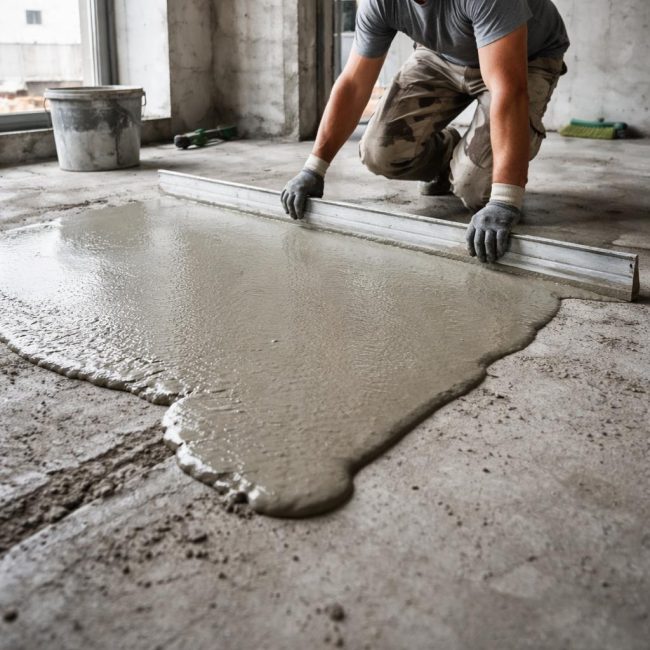
One of the most popular methods for leveling slabs is using cement-sand mixtures to create a smooth surface. These are applied to the slab and smoothed using a special tool. This method requires particular attention, as not only is the uniform application of the mixture crucial, but also the correct consistency.
To prevent deformation and increase strength, special reinforcing mesh can be used, which is placed on the surface before pouring the mortar. This improves adhesion and prevents cracking during drying.
Another method is to use self-leveling floors. This is suitable for creating a perfectly flat and smooth surface, but it requires specific working conditions, such as maintaining a certain temperature and humidity.
Use of leveling compounds: when is it justified?
One of the most important decisions to make when leveling floor slabs is the choice of leveling compound. Leveling compounds vary depending on their intended use, for example, they can be putty for minor defects or concrete mixtures for larger irregularities.
In addition, the operating conditions and strength characteristics of the coating must be taken into account. If the floor slab is planned to be used as a base for subsequent laying of tiles or other materials, it is important that the mixture has a high degree of adhesion and strength.
It's also worth keeping in mind that self-leveling floors, although they can be used to level floor slabs, require careful application. This material conceals minor defects well, but due to its fluidity, it may not be suitable for deep cracks or highly uneven surfaces.
Potential problems and limitations
It's important to remember that leveling floor slabs isn't always a simple task, and various difficulties can arise during the process. For example, achieving perfect levelness using traditional mortars isn't always possible. This can be due to large elevation differences between the slabs, as well as the insufficient strength of some mortars.
Additionally, there's the issue of drying time and material shrinkage. If the leveling was done using cement-sand mixtures, it's important to consider that they may shrink during drying, leading to cracks. In such cases, additional reinforcing materials or multiple layers must be used to achieve the desired result.
Another challenge is choosing a leveling material if the floor slab already has significant damage. In this case, it's important not only to choose the right compound but also to ensure it can effectively seal cracks and ensure strength and durability.
Scenarios for the application of various methods
The choice of leveling method directly depends on the specifics of the project and the type of space. For example, for residential spaces, using a self-leveling floor is sufficient to correct minor defects. In cases where the floor slab needs to be leveled for a heating system or in spaces with increased strength requirements, more robust compounds should be used.
For the construction of industrial facilities or large commercial premises, where floor slabs are subject to heavy loads, reinforcement and the use of denser materials for leveling are often used.
Common misconceptions
One common misconception is that floor slabs don't require leveling if they are factory-produced and have standard dimensions. However, in practice, such slabs can have microscopic deviations, which over time can impact the quality of construction. On the other hand, using the most expensive and sophisticated leveling materials isn't always justified if the height differences between the slabs don't exceed a few millimeters.
Furthermore, there's a common misconception that self-leveling floors are always the best solution. This isn't true, as this method requires ideal working conditions, such as temperature and humidity, which aren't always possible.
Conclusion
Leveling floor slabs requires careful consideration and assessment of multiple factors, from the condition of the slabs themselves to the operating conditions. The correct choice of materials and methods can significantly improve the final result and ensure a durable and reliable floor. It's important to understand that approaches, methods, and materials may vary depending on the type of structure and structural requirements.