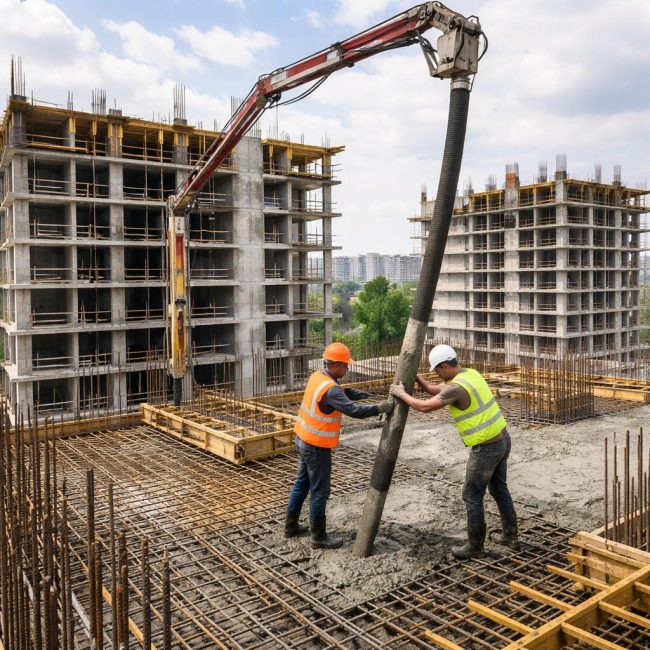
Pouring a monolithic house is a complex and demanding process, requiring precise adherence to technology and consideration of numerous factors. This approach ensures the strength and durability of buildings and allows for flexible adaptation of the design to specific requirements. In this article, we'll explore what you need to know to properly pour a monolithic house, the pitfalls involved, and what's important to consider during the design process.
Introduction: What is monolithic construction?
Monolithic construction is a method in which all building elements (foundations, walls, and floors) are poured in a single process. This approach is characterized by high strength, durability, and the ability to create complex, custom shapes. A monolithic house is more than just a technical solution; it is a project that requires a comprehensive approach and attention to detail at every stage.
The operating principle of a monolithic structure
Monolithic construction is based on the use of concrete poured into pre-prepared forms (formwork). Once the concrete hardens, it forms a single, integral structure that requires no additional joining of elements, as is the case with brick or block. This method ensures the necessary rigidity and strength of walls, as well as a high degree of thermal and acoustic insulation.
Pouring a monolithic building requires several key elements: high-quality concrete, reinforcement structures, and properly installed formwork. It's important to remember that the pouring process requires precise adherence to the correct technology, from the correct concrete proportions to high-quality reinforcement; otherwise, the building will not meet standards.
How does this work in practice?
In real practice, pouring a monolithic house involves several stages:
- Preparing the foundationFoundation preparation begins with clearing the area, excavating the pit, and installing reinforcement. For a monolithic foundation, it's important to correctly calculate the loads and soil conditions to ensure the stability of the house.
- Installation of formworkFormwork is the mold into which concrete is poured. It must be strong enough to support the load of the liquid. Formwork can be either wood or metal, depending on the scale of the project.
- ReinforcementOne of the key stages is the installation of reinforcement—metal rods that provide structural strength. The reinforcement must be positioned so that it effectively distributes loads across the entire height of the wall or floor.
- Pouring concreteOnce the formwork is installed and the reinforcement is in place, the concrete pour begins. It's important to monitor the quality of the concrete and avoid introducing air into the mixture.
- CuringAfter pouring the concrete, it's important to ensure the right conditions for its hardening—temperature and humidity must be stable. During the first few days, the concrete must be carefully monitored, as its structure is not yet complete.
Limitations and nuances
The process of pouring a monolithic house isn't always straightforward and requires attention to numerous details. One of the main challenges is the need for high-quality concrete. Using low-quality components (such as sand or low-grade cement) can lead to a reduction in the structural strength.
It's also important to understand that pouring monolithic structures is impossible without highly qualified specialists. Errors at any stage—whether improper reinforcement or a weak concrete coating—can lead to serious consequences.
Common misconceptions about monolithic construction
- Monolithic houses are too expensiveAlthough the cost of monolithic construction may be higher initially (for example, due to the use of more expensive materials and complex technologies), in the long term, these buildings prove cost-effective due to their durability and strength.
- The monolithic house does not require repairs.Of course, monolithic buildings are more resistant to external influences, but this doesn't mean they don't require maintenance. Common problems, such as shrinkage cracks or wear and tear, can still arise.
- To fill it, it is enough to hire workersWithout precise planning and quality control, this process can lead to unsuccessful results. This requires not only experienced labor but also competent engineering supervision.
Conclusion
Pouring a monolithic house is a high-tech process that requires attention to detail, high-quality materials, and professionalism. By following recommendations and properly organizing all stages of the work, you can build not only a beautiful but also a durable and safe building. With an approach that includes meticulous preparation and precise adherence to all technologies, building a monolithic house will be a successful project for any family or owner.