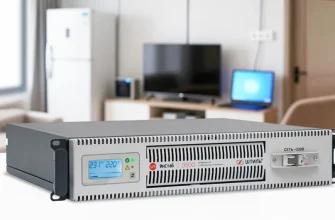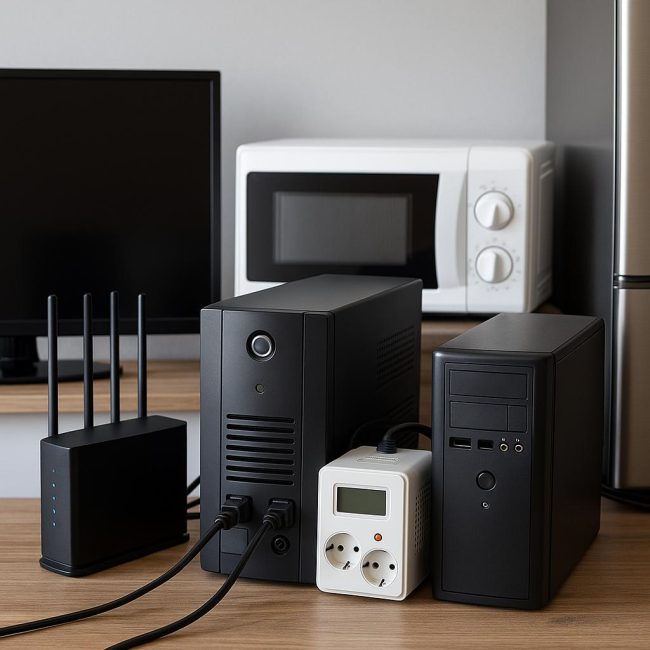
A modern home contains dozens of electrical devices, each of which depends on a stable power supply. Computers, televisions, refrigerators, washing machines, boilers, and even smart home systems require protection from voltage fluctuations. Uninterruptible power supplies (UPS) are considered one of the most effective solutions. They keep your equipment running during power surges or short-term outages.
A stable power supply isn't just a matter of convenience; it's a genuine necessity. After all, a power surge lasting just a split second can damage expensive equipment, fry a computer's power supply, or destroy a refrigerator's controller. To understand how to properly protect your equipment, it's important to understand the origins of power surges and the available methods for compensating for them.
- Causes of voltage surges in household networks
- Types of protection against voltage surges
- Surge protectors
- Voltage stabilizers
- Uninterruptible power supplies (UPS)
- Why choose a UPS?
- Practical recommendations for choosing a UPS
- Alternative methods of protection
- How to extend the life of your equipment
- Bottom line: Protecting your equipment is an investment in its longevity.
Causes of voltage surges in household networks
Most users believe that outages are caused only by substation or power line failures. However, there are many more causes:
- Worn out electrical networks. Old cables, weak contacts, and poor quality connections are common sources of voltage drops.
- Uneven load. In apartment buildings, the general power supply circuit is often overloaded, especially in the evening when many powerful devices are turned on.
- Weather factors. Thunderstorms, strong winds, and ice on wires can all cause short-term outages or surges.
- Electrical installation errors. Incorrect grounding or phasing may result in unstable current supply.
- Work of large consumers. When an elevator, welding machine, or compressor is turned on, short-term fluctuations occur on the line, which are reflected in sensitive devices.
Even if the voltage in the network drops only slightly—from 220 to 200 V—electronics may malfunction: the computer reboots, the router freezes, and the refrigerator's compressor fails to start. Overvoltages above 240 V can have even more serious consequences, potentially damaging the control board or overheating the wiring.
Types of protection against voltage surges
To avoid trouble, several layers of protection are used. Each layer performs its own function, and together they create a comprehensive security system.
Surge protectors
These are the simplest devices protecting against short-duration surges. They contain varistors—elements that dampen sharp voltage spikes. However, filters are unable to compensate for prolonged sags or power outages. Their main purpose is to prevent lightning strikes or electromagnetic pulses.
Voltage stabilizers
A more serious protection measure, they automatically adjust the voltage supplied to equipment, keeping it within acceptable limits (usually 200–240 V).
There are several types of stabilizers:
- Relay — they work quickly, but stepwise, with a characteristic click when switching.
- Servo-driven — smoothly regulate the flow, but are less reliable in frosty and dusty conditions.
- Electronic (thyristor) — the most accurate and durable, but also the most expensive.
The stabilizer is useful for refrigerators, televisions and heating systems, especially in private homes where voltage often fluctuates.
Uninterruptible power supplies (UPS)
These are devices that not only stabilize voltage, but also temporarily provide power from built-in batteries during a complete power outage.
UPS are:
- Office and household (off-line, line-interactive) — protect computers, routers and low-power devices.
- Online models — form an ideal sine wave and are suitable for gas boilers, servers and medical equipment.
The main advantage of a UPS is instantaneous switching to battery power without interrupting the power supply. For a computer or boiler, this means all settings are preserved and no reboots are required.
Why choose a UPS?
Many users limit themselves to a stabilizer, believing that this is sufficient. However, a stabilizer won't save you from a complete power outage. Unlike a stabilizer, uninterruptible power supplies They act as a backup mini-battery, supporting equipment for several minutes or even hours, depending on the model.
Key benefits:
- Full protection against voltage surges and sags.
- Automatic switching to battery.
- Stable output signal shape.
- Possibility of saving data and correct shutdown of equipment.
- Short circuit and overload protection.
For household needs, a 500–1000 VA UPS is usually sufficient. This is enough to power a computer, modem, TV, or boiler circulation pump. Private homes sometimes use more powerful systems with external batteries that support lighting and communications for several hours at a time.
Practical recommendations for choosing a UPS
- Determine the purpose. Line-interactive is suitable for a computer, and on-line is suitable for a heating boiler.
- Calculate the power. Add up the total power of the connected devices and add a 20–30% reserve.
- Consider the shape of the signal. If a device requires a pure sine wave (for example, a pump or boiler), do not skimp on the model.
- Pay attention to battery life. For a PC, 5–10 minutes is enough, for heating systems – 30–60 minutes.
- Choose a reliable manufacturer. A high-quality UPS will last 5–7 years without losing battery capacity.
Alternative methods of protection
In addition to the UPS, there are additional measures that should be implemented for comprehensive security.
- Residual current device (RCD) Prevents electric shock due to leaks.
- Automatic circuit breakers protect wiring from overloads.
- Lightning protection and grounding will save you from a direct lightning strike.
- Network monitoring — Modern smart sockets allow you to monitor voltage via your smartphone and notify you of power surges.
How to extend the life of your equipment
Even with protection, it is important to follow simple operating rules:
- Do not connect powerful devices to the same outlet using extension cords.
- Unplug devices during thunderstorms.
- Do not use damaged cables or plugs.
- Check the condition of the contacts and grounding regularly.
- Once a year, perform preventive maintenance on your UPS – replace batteries and clean the ventilation.
Bottom line: Protecting your equipment is an investment in its longevity.
Power surges are a problem faced by every owner of modern technology. Ignoring them means risking expensive equipment and personal data. Simple surge protectors provide minimal protection, while stabilizers offer more reliable protection, but only uninterruptible power supplies are able to guarantee complete safety in the event of a power outage.
A properly selected UPS will extend the life of your devices, prevent data loss, and avoid repair costs. This is a one-time solution that provides long-term peace of mind for your home's stability.