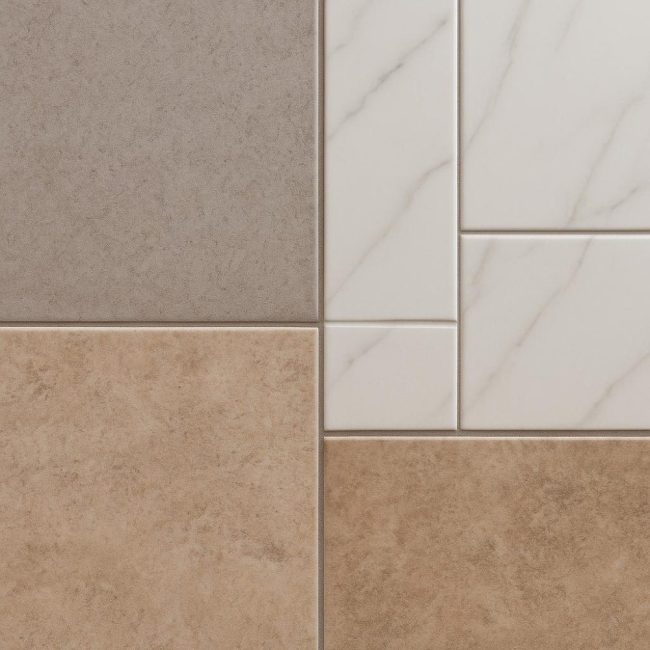
Ceramic tiles have long held a firm place among finishing materials and are used in renovations in both residential and commercial spaces. Today, the selection is so diverse that hundreds of collections can be found in stores like these—from simple, basic models to designer solutions imitating wood, stone, or metal. However, with such a wealth of choice, it's important to understand that floor tiles and wall tiles differ significantly. Trying to use the wrong tiles can lead to rapid wear, chipping, cracking, or even injury.
In this article, we'll take a detailed look at the differences between ceramic floor tiles and wall tiles, what parameters to pay attention to when purchasing, and what mistakes are most often made when choosing.
- The main differences between floor and wall tiles
- Strength and wear resistance
- Thickness
- Surface
- Weight
- Ceramic floor tiles: selection criteria
- Load resistance
- Anti-slip properties
- Frost resistance
- Size and format
- Ceramic wall tiles: features and benefits
- Light weight
- Variety of designs
- Ease of processing
- Gloss and relief
- Why you shouldn't confuse floor and wall tiles
- Practical tips for choosing tiles
- Conclusion
The main differences between floor and wall tiles
Strength and wear resistance
- Floor tiles It is made denser and harder. It must withstand the loads of furniture, equipment, and constant human traffic.
- Wall tiles, on the contrary, is thinner and lighter. Its strength is lower, as it is not subjected to constant pressure and impact loads.
To assess strength, manufacturers use the following indicator: PEI (abrasion resistance).
- For the floor, it is recommended to choose tiles of class PEI III–V.
- For walls, PEI I–II is sufficient.
Thickness
- Floor tiles usually have a thickness of from 8 to 12 mm.
- Wall-mounted - from 4 to 8 mm.
This is explained by the need to withstand the load: the thicker the tile, the stronger it is.
Surface
- Floor Requires a matte or textured surface to prevent slipping. Glossy floor tiles can be dangerous, especially in wet areas.
- Walls They can be tiled with any finish: glossy, matte, or textured. Gloss on vertical surfaces is safe.
Weight
- Floor tiles are heavier and are not recommended for use on walls, as the adhesive may not hold up.
- Wall tiles are lighter, so they cannot be laid on the floor - they will not withstand the load and will quickly deteriorate.
Ceramic floor tiles: selection criteria
Load resistance
The main criterion is the ability to withstand the weight of furniture, appliances, and heavy traffic. For the kitchen, hallway, and entryway, choose models with high wear resistance (PEI IV–V).
Anti-slip properties
Particularly important for bathrooms, toilets, and balconies. Look for tiles marked R9–R13 — the higher the indicator, the lower the risk of slipping.
Frost resistance
For open spaces (loggias, terraces, street paths), tiles must be frost-resistant, otherwise they will crack in winter.
Size and format
- For small spaces, medium formats (30×30 or 40×40 cm) are more convenient.
- Large tiles (60×60, 80×80 cm) look impressive in spacious rooms.
Ceramic wall tiles: features and benefits
Light weight
Due to their smaller thickness and weight, wall tiles are easy to fix on vertical surfaces.
Variety of designs
Wall tiles serve primarily a decorative function. This segment is where original textures, imitation wood, stone, and fabric, vibrant panels, and decorative inserts are most common.
Ease of processing
Thin tiles are easier to cut and are convenient for fitting around sockets, switches and corners.
Gloss and relief
On the walls, you can confidently use both glossy and textured surfaces. They create visual accents and add depth to the interior.
Why you shouldn't confuse floor and wall tiles
- Floor tiles on the wall: too heavy, may fall off over time, overloads the surface.
- Wall tiles on the floor: quickly cracks, wears out, becomes slippery and dangerous.
A simple rule: floor tiles can be used on walls if desired (for example, to create a unified style in the bathroom), but the opposite is strictly not recommended.
Practical tips for choosing tiles
- See markingsThe packaging always indicates what surfaces the material is intended for.
- "Foot" - for the floor.
- "Palm" - for walls.
- Check the caliber and toneTiles from different batches may differ in size and shade.
- Assess the surfaceFor the floor, avoid tiles with excessive shine.
- Check the geometryPlace several tiles next to each other—high-quality material will not warp.
- Consider the space. Durable tiles are needed for the kitchen and hallway, moisture-resistant and slip-resistant tiles are needed for the bathroom, and more decorative options are suitable for the living room.
Conclusion
Ceramic tiles are a versatile material, but choosing them requires careful consideration. Wall tiles are designed for aesthetics and lightness, while floor tiles are designed for durability, safety, and load-bearing capacity. Improper use can lead to unnecessary costs and risks, so it's important to carefully examine the markings and specifications when purchasing.
Properly selected tiles will not only highlight the style of the interior, but will also last for decades, maintaining their appearance and functionality.