The choice of material is always a pressing issue, as the durability, reliability, and environmental friendliness of future housing directly depend on it. Companies engaged in construction of houses, offer a variety of materials, from traditional ones like wood and brick to modern energy-efficient solutions like SIP panels or ceramic blocks. But among this diversity, not only durability but also environmental safety is particularly important: after all, a home must be comfortable to live in while also being environmentally friendly.
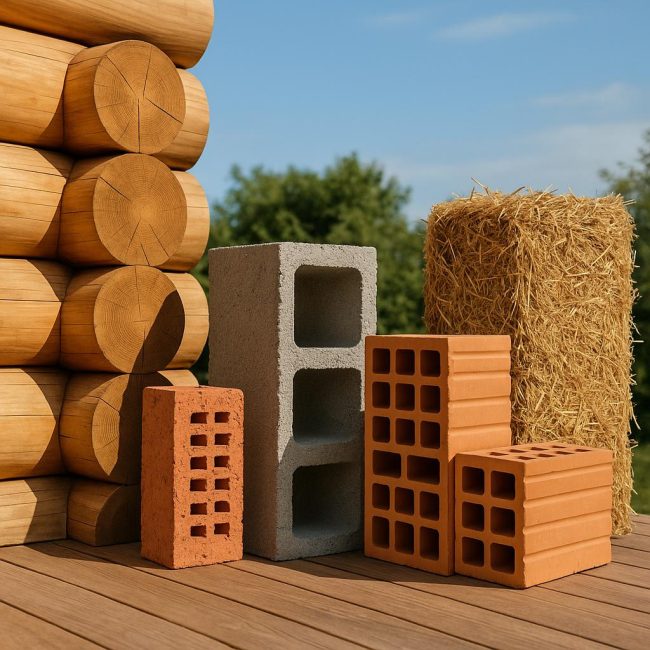
Wood is a renewable and living material
Wood is traditionally used for building houses around the world. Its main advantages are:
- Eco-friendliness: It is a natural material that does not require energy-intensive production and, when harvested correctly, is a renewable resource.
- Air exchange: wooden walls “breathe”, providing a natural microclimate inside the premises.
- Aesthetics and comfort: Wood creates a warm atmosphere and fits well with modern architectural solutions.
However, the longevity of wooden houses directly depends on their treatment. Without protection, wood is susceptible to rot, insect attack, and fire. Modern technologies (preservatives, fire retardants, and laminated timber) significantly increase their service life. A well-built and treated wooden house can last 70–100 years or more.
Brick is a classic of durability
Brick is deservedly considered one of the most durable building materials.
- Service life: houses made of high-quality brick can stand for more than 100–150 years, with virtually no loss of properties.
- Eco-friendlinessBrick is made from clay, a natural and safe material. Production requires energy, but the final product does not emit harmful substances.
- Thermal insulation and inertia: brick walls accumulate heat and release it slowly, making housing comfortable in winter and summer.
The only drawback is the high energy consumption of production and the weight of the material, which increases the load on the foundation. Nevertheless, brick remains one of the most reliable and environmentally friendly solutions.
Stone and natural rocks
Building houses from stone has been known to humanity since ancient times. Today, stone is used less frequently due to its labor-intensive nature, but it remains the benchmark for durability.
- Natural material: granite, limestone, sandstone do not contain artificial additives and are absolutely safe.
- Durability: stone buildings are capable of standing for centuries, which is proven by historical architectural monuments.
- Eco-friendliness: the material does not require complex processing, which means it has a minimal impact on the environment.
The main drawback is the high cost of construction and the need for a massive foundation. However, when it comes to durability, stone is unrivaled.
Concrete and reinforced concrete
It is impossible to imagine modern construction without concrete.
- Durability and versatility: concrete is used for foundations, load-bearing structures, and floors.
- Service life: Reinforced concrete houses, with proper maintenance, can last 70–120 years.
- Eco-friendlinessConcrete consists of cement, water, and aggregates (crushed stone, sand). It does not emit harmful fumes.
From an environmental perspective, the main problem with concrete is its production, which produces large amounts of CO₂ emissions. At the same time, "green concrete" technologies, which incorporate recycled materials, have been rapidly developing in recent years, reducing the environmental footprint.
Ceramic blocks and porous ceramics
A modern alternative to brick is ceramic blocks. These are large-format porous clay blocks.
- Thermal insulation: Due to the voids and porosity, ceramic blocks retain heat better than bricks.
- Eco-friendliness: the material is made from natural clay and is safe for health.
- Strength and durability: with proper operation, the service life exceeds 100 years.
Ceramic blocks combine the reliability of traditional brick with the energy efficiency of modern materials, making them a popular solution.
SIP panels and modern composites
Building houses using SIP panels is gaining popularity. These panels consist of a layer of insulation (usually expanded polystyrene) sandwiched between two OSB boards.
- Eco-friendliness: Modern SIP panels are manufactured according to standards that eliminate harmful emissions.
- Energy efficiency: such houses retain heat well, which reduces energy consumption.
- Durability: service life is estimated at 50–70 years.
SIP technology is not as time-tested as brick or stone, but due to its energy efficiency it is considered promising.
Adobe and clay houses – an old solution with a new look
In recent years, there has been a resurgence of interest in adobe, a mixture of clay, sand and straw.
- Eco-friendliness: this is perhaps the most environmentally friendly material, completely natural in origin.
- Thermal insulation: clay walls with the addition of straw retain heat in winter and coolness in summer.
- Price: Construction is cheap when local materials are available.
The disadvantage is their shorter lifespan than stone or brick. Adobe houses last 50–70 years and require protection from moisture.
Durability and ecology: selection criteria
To determine which material is best, it is worth considering:
- Service life - how long does the material retain its strength?
- Energy efficiency - the ability to retain heat and reduce heating costs.
- Eco-friendliness - natural origin and impact on the environment.
- Cost and availability — an important factor in private construction.
If durability is your top priority, choose brick or stone. If eco-friendliness and breathability are more important, wood and adobe are excellent options.
Conclusion
Modern home construction strives to combine reliability and environmental friendliness. Today, the market offers solutions for every need: from classic brick to innovative SIP panels and adobe technologies.
The optimal choice depends on the climate, budget, and the owner's preferences. However, the combination of durability and eco-friendliness is becoming a key trend, as housing must be not only durable but also healthy for people and safe for the environment.