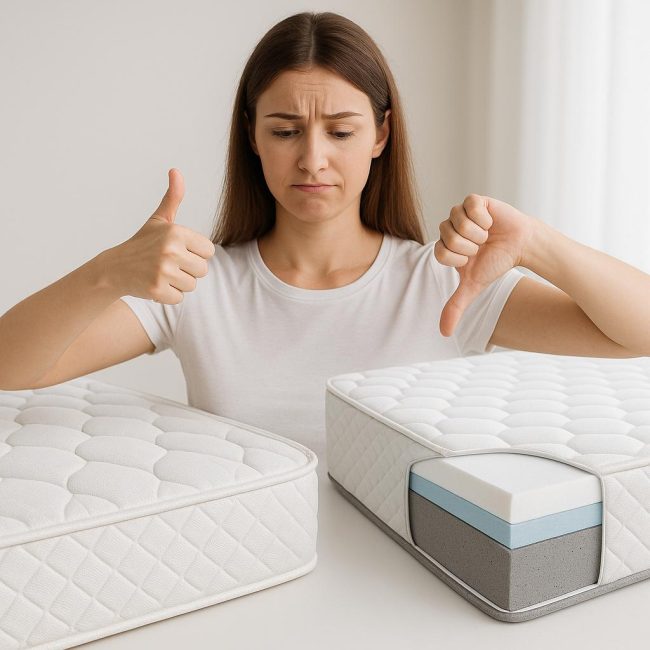
Choosing a mattress is an important and sometimes challenging process, significantly affecting the quality of your sleep and overall well-being. An incorrectly chosen mattress can lead to back and neck problems and even reduce the quality of your night's rest. Therefore, it's important to approach this matter with particular attention. In this article, we'll look at how to choose the right mattress and discuss the different types, their strengths and weaknesses.
The Importance of Choosing the Right Mattress
- The first thing to consider when choosing a mattress is your individual needs. Different people have different preferences and requirements for firmness, filling materials, and mattress height: some prefer a soft and cozy mattress, while others prefer a firmer one that provides maximum support. To determine which mattress is right for you, consider the following factors:
- Sleeping position. Back sleepers typically need a medium-firm mattress to provide lumbar support. Side sleepers should choose a softer mattress to relieve pressure on the shoulders and pelvis. Stomach sleepers may need a firmer mattress to prevent spinal sagging.
- Weight and build. Heavier people may prefer firmer models that provide adequate support and prevent sagging, while lighter people can choose softer models.
Types of mattresses and their features
There are many types of mattresses available on the modern market, each with its own advantages and disadvantages:
Spring mattresses
Strengths:
- Good ventilation thanks to the spring system.
- A variety of models by rigidity.
- Durability.
Weaknesses:
- Some models may be noisy.
- Springs can wear out over time.
Spring mattresses are divided into two main types: dependent spring mattresses and independent spring mattresses. In dependent spring mattresses, the springs are linked together and work as a single unit, while in independent spring mattresses, each spring operates independently. Independent springs better conform to the contours of the body and reduce the rolling effect.
Latex mattresses
Advantages:
- Excellent support and anatomical shape.
- Good air permeability.
- Durability and resistance to deformation.
Flaws:
- High price.
- Not always suitable for allergy sufferers.
Latex mattresses can be made from either natural or synthetic latex. Natural latex is usually more expensive but offers superior properties. These mattresses provide even weight distribution and can be an excellent choice for those with allergies.
Memory foam (mattresses with memory effect)
Pros:
- Anatomical support that adapts to the shape of the body.
- Reducing pressure on joints and spine.
Cons:
- May be a bit too stiff for some users.
- It may be too warm in summer.
Memory foam mattresses provide a "hug" feeling, which can be comfortable, but for people who prefer a firmer surface, this mattress may not be the best choice.
Mixed type structures
Strengths:
- They combine the advantages of different technologies.
- There are options with different levels of hardness on different sides.
Weaknesses:
- May be more expensive.
- They require careful selection to understand which combination is best suited.
This type of mattress can meet the needs of most users, offering both softness and support.
Choosing a mattress is a process that shouldn't be rushed. Consider your personal preferences, sleeping position, and comfort level. It's important to make a conscious choice, as a high-quality mattress can significantly improve the quality of your sleep and, consequently, your overall well-being. Before purchasing, it's a good idea to test several models to determine which one will be the most comfortable. Remember, a good mattress is an investment in your health and comfort.