The wall plate is a crucial element of the rafter system of any pitched roofing system, ensuring the strength, stability, and durability of the entire roof. Despite its visual simplicity, choosing a wall plate requires consideration of numerous technical and practical factors, from the type of wood to the cross-section, the fastening method, and even the regional climate. In this article, we'll take a detailed look at which wall plate is best for residential construction, the appropriate sizes for different roof types, and the nuances to consider during design and installation.
- What is a Mauerlat and why is it needed?
- Requirements for the wall plate material
- Main characteristics of wood for Mauerlat:
- Optimal dimensions of the wall plate
- The most popular sections:
- Which Mauerlat to choose: recommendations for selection
- Wall type
- Roof type
- Climate conditions
- Alternatives and replacements
- Laying and fastening the wall plate
- Mounting methods:
- Common mistakes when choosing and installing a wall plate
- Conclusion
What is a Mauerlat and why is it needed?
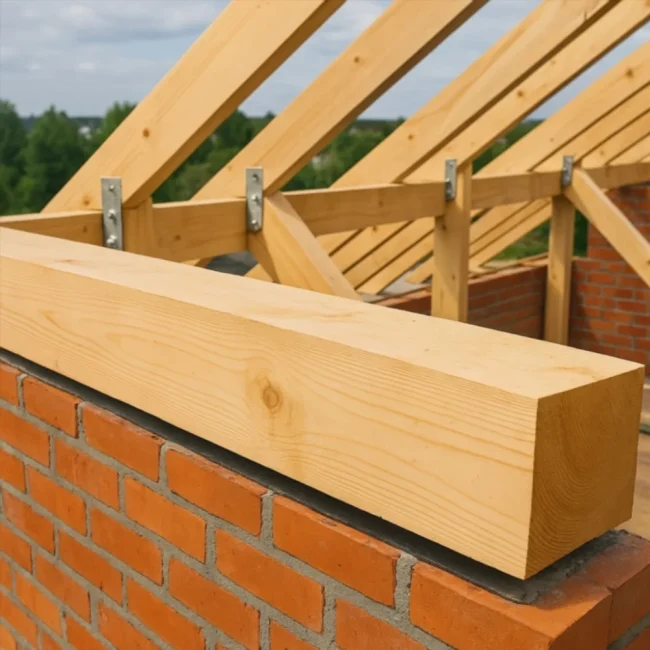
A Mauerlat is a horizontal wooden beam laid along the perimeter of load-bearing walls, serving as a connecting link between the building walls and the roof truss system. Its main function is to redistribute the point load from the rafters across the entire area of the load-bearing walls. This prevents masonry failure, wall deformation, and reduces the risk of roof warping or collapse.
Furthermore, the wall plate provides reliable support for the rafters, which is especially important under heavy wind and snow loads. Without a wall plate, the rafter system loses stability and becomes vulnerable to external factors.
Requirements for the wall plate material
The primary material for mauerlat construction is coniferous wood: pine, spruce, and larch. These woods are fairly strong, moderately dense, and easy to work with. Larch is particularly prized for its resistance to moisture and biological damage, but it is more expensive than other woods.
Main characteristics of wood for Mauerlat:
- Humidity— no more than 20%. High humidity will lead to shrinkage, deformation, and cracking of the wall plate.
- Strength class— not lower than C24 according to the European classification.
- No rot, mold, or cracks- any defects significantly reduce the load-bearing capacity.
- Impregnation with antiseptics and fire retardants— a prerequisite for protection against fungi, insects and fire.
Important: In regions with high humidity and cold climates, it is advisable to use timber that has been kiln-dried and factory-treated with protective compounds.
Optimal dimensions of the wall plate
The choice of wall plate cross-section directly depends on the roof structure, span length, slope angle, and loads (roofing material weight, snow, wind). The most common wall plate sizes are 100x150 mm and 150x150 mm. However, in some cases, non-standard options are used.
The most popular sections:
- 100×100 mm— used in small structures: sheds, bathhouses, and outbuildings. Suitable for lightweight roofing.
- 100×150 mm— most often used in single-story houses with a light roof.
- 150×150 mm— a universal option for most private homes. Provides high stability and durability.
- 150×200 mm— recommended for massive roofs with large spans, as well as when using heavy roofing materials (for example, natural tiles).
- 200×200 mm— used in two-story houses, attics and buildings with increased wind or snow loads.
Which Mauerlat to choose: recommendations for selection
The choice of a Mauerlat should be based not only on size, but also on many other factors:
Wall type
- Forbrick and concrete wallsOften, a beam with a cross-section of 150x150 mm is used, fixed to studs, anchors or a reinforced belt.
- Foraerated concreteIt is necessary to lay the Mauerlat on the reinforced concrete belt, since the block itself cannot withstand mechanical loads.
- INwooden housesThe role of the Mauerlat can be performed by the upper crowns of the log house, however, when using classic rafter systems, it is better to install a separate Mauerlat.
Roof type
- Shed and gable roofsdo not impose any special requirements - a standard 150x150 mm wall plate is sufficient.
- Forhipped and hipped roofsA reinforced wall plate will be required - from 150x150 mm and above.
- Atmansard roofswith large spans and additional loads, a beam of 150×200 mm is required.
Climate conditions
- In regions with heavy snowfalls and strong winds, a more powerful Mauerlat is required.
- In dry and warm regions, wood of a smaller cross-section can be used, but fire protection is mandatory.
Alternatives and replacements
In rare cases, the use of metal profiles (channels, I-beams) as a substitute for a wall plate is permitted, especially in industrial buildings. However, in private housing construction, such solutions are extremely ineffective due to the difficulty of fastening and poor thermal insulation.
Glued laminated timber can also be used, especially in projects where precise geometry and resistance to deformation are essential. Glued laminated timber is more expensive, but more durable and shrinkage-resistant.
Laying and fastening the wall plate
Mounting methods:
- On heels with a reinforced belt— the most reliable method. A reinforced concrete belt is poured along the top edge of the wall, and studs are installed into it, onto which the wall plate is mounted.
- Anchor bolts- used on concrete or brick walls.
- Wire twisting— an outdated method, acceptable only in light structures.
- With metal brackets and corners- in addition to the main fastening.
When laying the wall plate, waterproofing is essential—most often, roofing felt or similar materials are used to prevent wood rot.
Common mistakes when choosing and installing a wall plate
- Incorrect selection of section— a beam that is too thin will not withstand the load, while one that is too massive will lead to an overconsumption of materials.
- Using wet wood— leads to shrinkage, deformation, and damage to the wall plate.
- Lack of antiseptic treatment— wood quickly deteriorates under the influence of moisture and fungi.
- Incorrect fastening- weak fixation leads to displacement of the rafters.
- Ignoring the reinforced concrete belt on aerated concrete- is fraught with cracks in the walls and deformation of the roof.
Conclusion
A Mauerlat is more than just a wooden beam around the perimeter of a house. It's the foundation of a stable, durable, and safe roof. When choosing a Mauerlat, it's important to consider a number of factors: the type of building, the roof's structural features, climatic conditions, and load. The most versatile and common option is a 150x150 mm beam made of dry coniferous wood, treated with a preservative and installed on a reinforced concrete belt using studs. This approach will ensure the longevity of the roof and prevent future problems.