Living in a private house all year round quickly shows that autonomous sewerage system A sewer system isn't just an "add-on" to the amenities, but an engineering system that determines comfort, sanitary safety, and even the condition of the property. While a simple and inexpensive solution can sometimes work for a summer cottage, in a permanent residence, such savings often result in odors, overflowing sewers, frequent calls for sewer cleaning, and repairs at the most inopportune moments.
This article is about How does an autonomous sewage system for permanent residence differ from a country house one?, what are the highest requirements for it, which parameters are most important, and how to select a system so that it works stably and without surprises.
- Why "dacha" solutions aren't always suitable for permanent residence
- The main differences between autonomous sewerage systems for permanent residences
- Productivity (daily volume of wastewater)
- Resistance to peak discharges (salvo discharge)
- Stability of operation in winter
- Requirements for water treatment and drainage
- What types of decisions are most common and how do they work with permanent residence?
- Storage tank
- Septic tank (settling + additional treatment in the ground)
- Deep biological treatment plant
- What to consider when choosing a system for permanent residence
- Actual number of residents and peak days
- Soils and groundwater levels
- Location on the site and sanitary distances
- Electricity and reliability
- Service: Regular and Clear
- Common mistakes when transitioning from a "dacha" to permanent residence
- How to understand that the system is truly suitable for permanent residence
- Conclusion
Why "dacha" solutions aren't always suitable for permanent residence
A seasonal dacha and a house for permanent residence create different load modes to the sewer.
- At the dacha: people come only occasionally, water consumption is sometimes high (weekends), sometimes zero (weekdays), in winter there is often no use at all.
- For permanent residence: the drains are coming in daily, more evenly, with a predictable load - shower, bath, washing machine, dishwasher, toilet, kitchen.
It is paradoxical, but it is precisely the “uniformity” and “consistency” of the load that is good for the system - provided that it designed for this volume and is capable of purifying wastewater in a predetermined mode. Simplified versions for summer cottages are often not designed for a constant flow, meaning they begin to wear out.
The main differences between autonomous sewerage systems for permanent residences
Below are the key parameters that distinguish the “right” system for a year-round home.
Productivity (daily volume of wastewater)
For permanent residence, the system must reliably process the daily volume. This calculation takes into account not only the number of residents but also their daily habits:
- shower/bath every day;
- washing machine 3-7 times a week;
- dishwasher;
- frequent cooking and washing dishes;
- guests, holidays, increased water consumption.
For a summer house They often choose "on a tight schedule" - as long as it works during the season. For permanent residence, you need stock in terms of performance and ability to survive peak discharges.
Resistance to peak discharges (salvo discharge)
Permanent residency is a reality: someone takes a shower, does laundry, and flushes the toilet at the same time. For the system, this means salvo discharge: a large volume of water in a short period of time.
- For a summer house, compromises are acceptable: “don’t turn them on at the same time.”
- For permanent residence, the system must be designed for normal scenarios without restrictions.
If the system cannot cope with salvo discharges, typical problems arise:
- overflow into chambers;
- removal of unsettled particles;
- poor cleaning and odors;
- blockages and alarms.
Stability of operation in winter
This is where the difference is especially noticeable.
Dacha mode often involves:
- preservation for the winter;
- periodic "downtime" without drains;
- minimal exploitation.
permanent residence requires:
- stable operation in frosty conditions;
- protection against freezing of pipes and chambers;
- correct drainage of purified water, even if the ground is frozen or saturated with moisture.
In winter, the system experiences not only cold but also changes in water drainage conditions. Therefore, for a year-round home, proper pipe installation depth, insulation (where needed), proper slope, and a well-thought-out drainage system are essential.
Requirements for water treatment and drainage
For summer cottages, solutions are sometimes chosen where the main focus is simply to "collect" the wastewater somewhere and remove it as it fills.
In the case of permanent residence, this approach becomes expensive and inconvenient. It is important normal cleaning cycle and the proper drainage of purified water. This is what determines:
- will the area be damp;
- will there be a smell;
- will there be a "swamp" in the discharge zone;
- Will constant pumping be required?
What types of decisions are most common and how do they work with permanent residence?
Without going into details about brands, let's look at the logic.
Storage tank
The essence: the wastewater is not treated, it is simply accumulated and then removed.
- For a summer residence (rare visits) it is sometimes acceptable.
- For permanent residence, this usually results in constant expenses for pumping and dependence on a sewage truck.
Pros: simplicity, minimum engineering.
Cons for permanent residence: expensive to operate, risk of overflow, logistics, odors due to ventilation errors.
Septic tank (settling + additional treatment in the ground)
The essence: primary settling in chambers, then the water is further purified in the ground through filtration fields/wells.
For permanent residence it may work well, but only if:
- soils allow absorption (sand/loam is better, clay is worse);
- the groundwater level does not interfere;
- there is space on the site for post-treatment facilities;
- everything is calculated based on volume and salvo discharges.
Risks of permanent residence: if the soil is complex or the groundwater level is high, the system begins to “choke”, the area becomes damp, and a smell appears.
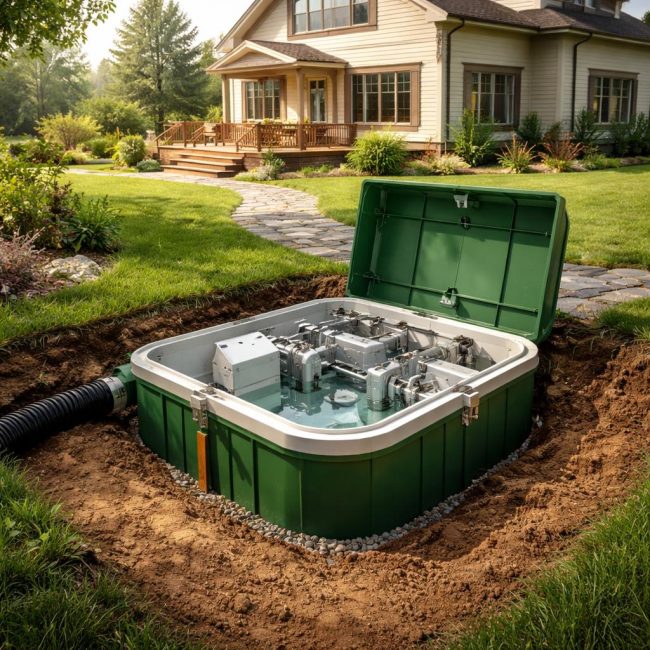
Deep biological treatment plant
The essence: active cleaning with the participation of bacteria and aeration (often energy-dependent).
For permanent residence it is usually convenient because:
- designed for regular inflow of wastewater;
- provides a high level of purification;
- Reduces the need for frequent pumping (usually referring to service and sludge removal, rather than "a sewage truck every week").
An important nuance: such systems are usually sensitive to:
- long periods of downtime without drainage (they are worse off than during permanent residence);
- power outages (if the system is energy-dependent);
- improper use (aggressive chemicals, discharge of construction solutions, etc.).
What to consider when choosing a system for permanent residence
Actual number of residents and peak days
The rule is simple: you need to count not “as it is now”, but how will it be:
- the children will grow up;
- relatives will come;
- guests for holidays;
- additional bathrooms will appear.
For permanent residents, a load reserve is not a luxury, but rather an accident prevention measure.
Soils and groundwater levels
This is the number one factor that makes some designs ideal and others problematic.
- Sandy soils usually take water more easily.
- Clay soils They filter worse and often require other solutions.
- High groundwater level complicates the discharge and may require a forced reset or alternative circuit.
If you ignore this point, you can get a “nice” installation that actually works unstable.
Location on the site and sanitary distances
For permanent residence, it is important to immediately consider:
- where the system will be located;
- where the pipe from the house will run;
- how the access road will be organized (for service/maintenance);
- where will the purified water go?
Sometimes "dacha" solutions are chosen simply because "we'll put it somewhere." When living there permanently, this often ends in remodeling.
Electricity and reliability
If the house is for permanent residence, electricity is usually always available, but outages do occur. It's important to understand in advance:
- how much the system depends on electricity;
- What happens if the power is turned off for 6-12 hours;
- Is there any overflow protection?
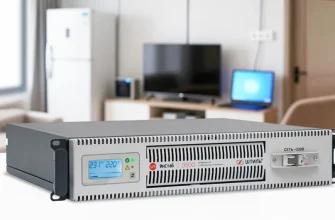
In some cases, it makes sense to have a backup (such as a UPS)—especially if outages are common in your area.
Service: Regular and Clear
Permanent residence = the system must be predictable in operation:
- how often is the sediment removed;
- What is included in the service;
- what actions the owner performs himself (and whether he performs them at all).
A bad sign is when a solution requires too much "dancing with a tambourine" and strict restrictions on ordinary everyday processes.
Common mistakes when transitioning from a "dacha" to permanent residence
- Selection by price without load calculation
Result: overcrowding, odors, frequent emergency situations. - Ignoring soils and groundwater levels
Result: water does not drain, the area becomes waterlogged, and an unpleasant odor appears. - Underestimation of salvo discharge
Bottom line: the system can’t handle the everyday life of an ordinary family. - Incorrect pipe laying from the house
Result: freezing in winter, blockages, need to open the soil. - Too complex a system without understanding of maintenance
Bottom line: it works for the first few months, then the quality drops due to improper use.
How to understand that the system is truly suitable for permanent residence
Let me formulate a simple test: if you answer “yes” to most of the questions, you’re on the right track:
- The performance is calculated for the actual number of residents + reserve.
- The system allows for unlimited salvo discharges "only in turns".
- There is a clear scheme for operation in winter (without the risk of freezing and overflows).
- The soil and water level are taken into account, not just by eye.
- Water drainage and location on the site have been thought out.
- You understand how and how often to maintain the system.
- Operating costs are predictable.
Conclusion
The main difference between an autonomous sewage system for permanent residence and a country house one is in stability requirementsIn permanent residences, the system should not be a "seasonal compromise"; it must withstand daily runoff, peak loads, and winter conditions, while remaining easy to maintain.
If you approach the selection as an engineering task—with load calculations, consideration of soil conditions, and a well-thought-out drainage system—an autonomous sewer system will operate for years without any unpleasant surprises. But if you choose a system "like for a summer house, but for a house," you'll almost always end up with a story about remodeling and unnecessary expenses.