A bare frame house is not an intermediate stage of a "nearly finished" home, but a standalone technical object that serves as a benchmark for the overall construction quality. It is at this stage that the design logic, precision of assembly, installation standards, and compliance with the design become apparent. Once the frame is finished, most errors are either concealed or become expensive to correct. Therefore, understanding what a bare frame is is important not only for builders but also for clients, architects, and technical supervisors.
- What is considered a bare frame?
- Constructive logic: what should be visible
- Material and Geometry: What Quality Assembly Looks Like
- Rigidity and spatial performance of the structure
- Open Frame Engineering Context
- A temporary state or a conscious pause
- Common misconceptions surrounding the "bare" frame
- Restrictions and risk areas
- Why understanding this stage is important for future operation
What is considered a bare frame?
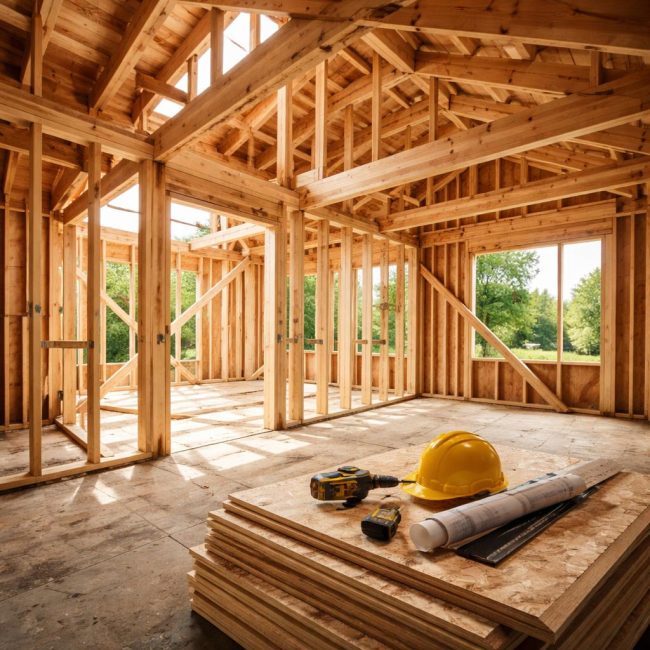
A bare frame refers to the load-bearing structure of a house, assembled from posts, beams, crossbars, joists, and ties, without internal or external cladding. This type of frame lacks façade materials, drywall, paneling, finished floors, and decorative finishes. The frame can be either completely exposed or partially covered with engineered or protective layers, such as temporary windbreaks.
It's important to distinguish between a "bare frame" and a "frame to be finished." In the latter case, the structure is already covered with paneling, windows and doors are installed, and the interior is sealed from the outside. In the former, the building's structural design is clearly visible.
Constructive logic: what should be visible
An open frame allows you to see how loads are transferred from the roof and floors to the foundation. Clear verticality of the posts, regular spacing, and proper operation of the braces and beams are signs of a well-thought-out design. Any logical errors, such as arbitrary extensions, uneven post spacing without structural justification, or "hanging" openings, indicate design errors or assembly deviations.
Particular attention is paid to joints: the junctions between walls and floors, corners, and openings. In a frame house, it is the joints that determine rigidity and durability, not the nominal board thickness. Without finishing, these areas are easily visible and assessable.
Material and Geometry: What Quality Assembly Looks Like
The quality of an unfinished frame is evident in the details. The wood must be dry, free of pronounced screw deformations, cracks along the entire length, and signs of biological damage. Minor surface cracks are acceptable, but they must not extend through the cross-section of the supporting element.
Geometry is the second key indicator. The posts are perfectly aligned, the corners are not slanted, and the diagonals of the openings are aligned. Even without a measuring tool, gross misalignments are visually noticeable. If the frame "plays" even before the trim is installed, the problem won't disappear after the finish is installed, but will only become less noticeable.
Rigidity and spatial performance of the structure
An unfinished frame clearly demonstrates how the house resists wind and operational loads. These may include diagonal braces, slab elements, or rigid opening frames. The lack of a clear spatial rigidity system is one of the most common design flaws.
It's important to understand that the sheathing itself shouldn't compensate for structural errors. If the stiffness calculations are "offloaded" onto the future finish, this indicates an incorrect approach. A properly constructed frame already provides sufficient stability when exposed.
Open Frame Engineering Context
Without finishing, the planned utility lines are clearly visible. Penetrations for ventilation, electrical, and water supply systems must not weaken the supporting elements. Drilling holes in studs "by eye," especially near the edges, is a potential source of problems.
A well-designed project includes planned routes in advance, and the framework adapts to them without compromising its load-bearing capacity. It's easier to adjust decisions at this stage than after the walls are closed.
A temporary state or a conscious pause
Sometimes, an unfinished frame is left unfinished for months or even years. This is only acceptable if the consequences are understood. Exposed wood is susceptible to moisture and UV rays, and temperature fluctuations accelerate deformation. Temporary protection—films, canopies, and preservation—becomes not an option, but a necessity.
If the gap between frame assembly and finishing is prolonged, the structure's condition must be regularly monitored. A house doesn't "wait" for completion in a neutral state—it's already aging at this stage.
Common misconceptions surrounding the "bare" frame
It's a common misconception that the unfinished frame is a rough stage, where imperfections are acceptable because "everything will be covered later." In practice, it is this stage that determines how evenly and correctly all subsequent layers will fit.
Another misconception is related to visual assessment. An open frame can look "rough" while still being technically sound. Conversely, a neatly assembled structure doesn't guarantee proper operation if the design principles are violated.
Restrictions and risk areas
An unfinished frame is vulnerable to external influences and human error. Any on-site modifications not envisaged in the design, especially to load-bearing elements, increase the risk of hidden defects. Also, at this stage, there's often a temptation to simplify solutions that "won't be visible." These shortcomings later cause creaking, warping, and finishing problems.
Why understanding this stage is important for future operation
Assessing the frame without finishing is a way to peer into the house's "skeleton" and understand how it will perform for decades to come. Correcting errors here is easier and cheaper than after all the work is completed. For the owner, this isn't a matter of aesthetics, but of predictable performance and structural stability.
A frame house doesn't begin with the façade and end with the interior. Its foundation is the logic and quality of the frame, which are best seen when the finishing is yet to be applied.